
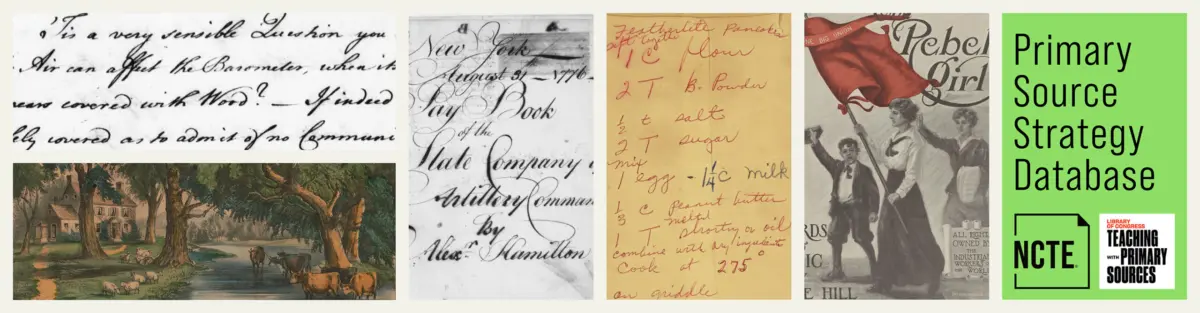
In an era defined by rapid technological change and evolving pedagogical frameworks, the National Council of Teachers of English (NCTE) has redoubled its commitment to deepening historical literacy. Through an ongoing, highly collaborative partnership with the Library of Congress as part of the esteemed Teaching with Primary Sources (TPS) Consortium, the NCTE is spearheading initiatives designed to integrate authentic historical documents directly into the daily habits of literacy teachers and students nationwide.
At the core of this initiative is a robust, searchable digital database featuring expertly crafted instructional strategies for over 150 specific items drawn from the Library of Congress’s vast digitized primary source collections. Developed by more than two dozen distinguished educators and leaders in English language arts (ELA) education, these resources do more than simply present historical artifacts; they articulate specific literacy merits for curriculum use, map out thematic units, and align directly with state and national educational standards.
Among the myriad documents highlighted within this database is a rare, haunting petition written during the height of the seventeenth-century Salem Witch Trials. Authored by ten women languishing in an Ipswich jail after being accused of witchcraft, the document provides an unprecedented window into the lived experiences of those marginalized by historical power structures. By spotlighting this primary source, the NCTE and the Library of Congress are offering educators an invaluable tool for fostering critical thinking, empathy, and rigorous textual analysis. This article explores the multifaceted dimensions of this collaborative educational initiative, examining the historical significance of the Ipswich petition, its pedagogical value in modern ELA classrooms, and the broader implications of bringing marginalized voices from the archives directly to twenty-first-century learners.
Detailed Chronology: Unearthing the Ipswich Petition
To fully grasp the instructional value of the Ipswich prison petition, educators and students must first understand the chilling historical chronology that produced it. The document dates back to the winter of 1692–1693, during the height of the Salem Witch Trials in colonial Massachusetts—a period characterized by mass hysteria, spectral evidence, and profound societal disruption.
The Escalation of the Witchcraft Hysteria (Spring–Fall 1692)
- January–February 1692: Accusations begin to surface in Salem Village within the household of Reverend Samuel Parris, rapidly spreading across Essex County and neighboring jurisdictions.
- March–September 1692: Special Courts of Oyer and Terminer are established to try the accused. Dozens of individuals, predominantly women who transgressed social norms or lacked male protection, are formally indicted. Executions by hanging begin in June and reach a crescendo by late summer.
- Autumn 1692: As public skepticism grows—fueled in part by the concerns of prominent clergymen regarding spectral evidence—Governor Sir William Phips orders the suspension of the Court of Oyer and Terminer, temporarily halting further executions and initiating a cooling-off period.
Confinement and Desperation in Ipswich Jail (Winter 1692–1693)
- Late 1692: While formal trials have slowed or halted, hundreds of accused individuals remain incarcerated across Massachusetts, awaiting formal hearings or trials that may not occur for months. Among them are ten women held in the frigid confines of the Ipswich jail.
- The Winter of 1692–1693: Facing brutal New England winter conditions, the imprisoned women realize that the structural inadequacies of the jail, combined with rampant illness, pregnancy, and bitter cold, threaten to kill them before they ever reach a courtroom.
- The Petition: In a desperate bid for survival, the ten imprisoned women draft a formal petition to the authorities. They request to be released on bail so they can return safely for trial in the spring, explicitly arguing against a death sentence dealt by weather rather than the courts.
Archival Preservation and Modern Accessibility
- Post-Colonial Period: The original manuscript finds its way into official state and regional repositories, eventually being cataloged and preserved within the Library of Congress’s digitized collections.
- Modern Integration: Through the NCTE-Library of Congress partnership, this rare document is indexed, tagged with pedagogical descriptors such as picturebook and argument, and paired with lesson frameworks designed to bring primary source analysis into contemporary secondary classrooms.
Supporting Context & Metrics: The Mechanics of the NCTE-Library of Congress Partnership
The integration of the Ipswich petition into modern curricula is not an isolated pedagogical experiment; it is part of a sweeping, nationally coordinated effort to transform how primary sources are utilized in American education. The TPS Consortium, funded and coordinated by the Library of Congress, empowers educational organizations to develop scalable models for teaching with primary sources.
Quantitative Scope of the Initiative
- 150+ Specific Artifacts: The searchable database meticulously curates over 150 individual items from the Library of Congress’s vast digital archives, ranging from early American manuscripts to twentieth-century civil rights photographs.
- 25+ Educational Leaders: More than two dozen expert teachers, curriculum directors, and ELA scholars collaborated to author the pedagogical rationales, ensuring that every source is rigorously tested for classroom applicability.
- Dual Standard Alignment: Every resource within the database is mapped against both the National Council of Teachers of English (NCTE) Standards and the Common Core State Standards (CCSS), providing seamless integration for school districts nationwide.
Pedagogical Frameworks and Searchability
The database is engineered for intuitive navigation by busy educators. Users can filter content using specific tags, such as argument, persuasive writing, historical fiction, and picturebook. This design acknowledges that primary sources are not solely the domain of social studies classrooms; they are exceptionally powerful tools for English language arts teachers seeking to anchor reading, writing, and speaking instruction in authentic texts.
By analyzing historical petitions, diaries, broadsides, and letters, students move beyond passive consumption of textbook summaries. They engage in active historical inquiry, evaluating authorial intent, assessing rhetorical strategies, and interrogating the biases inherent in both historical and contemporary accounts.
Official Statements: Bridging Archives and Classrooms
Educational leaders and administrators involved in the TPS Consortium and the NCTE have consistently emphasized the transformative power of engaging directly with archival materials.
"Mainstream historical accounts have historically sidelined the voices of the accused, the marginalized, and the disempowered," notes a lead curriculum developer associated with the NCTE-Library of Congress partnership. "When students read a petition written by women begging for their lives from the freezing confines of an Ipswich jail, history ceases to be a distant list of dates and names. It becomes a deeply human encounter with rhetoric, fear, and survival."
Scholars focusing on English language arts pedagogy emphasize that historical documents serve as masterclasses in argumentation.
"An incarcerated woman pleading for bail during the Salem Witch Trials is not merely offering a historical data point; she is constructing a sophisticated, high-stakes argument under conditions of extreme duress," explains an ELA standards specialist. "Analyzing how these women marshaled language to appeal to hostile authorities directly fulfills Common Core requirements for evaluating text structure, authorial choice, and rhetorical context."
Furthermore, the Library of Congress has repeatedly underscored the mission of the TPS program to democratize access to its collections. By partnering with organizations like the NCTE, the Library ensures that its unparalleled repository of Americana is translated into practical, classroom-ready strategies that inspire critical inquiry among students of all backgrounds.
Future Outlook: The Evolution of Primary Source Literacy
As education systems continue to adapt to the demands of an information-rich society, the ability to analyze primary sources critically has become an essential twenty-first-century skill. The ongoing collaboration between the NCTE and the Library of Congress points toward a future where archival research is seamlessly woven into the fabric of daily literacy instruction.
Expanding the Digital Repository
Plans are already underway to expand the searchable database, incorporating additional items from the Library of Congress that highlight underrepresented perspectives in American history. Future updates will likely introduce more interactive digital tools, allowing students to annotate manuscripts collaboratively, cross-reference local court records with national histories, and explore the geographic contexts of historical events through spatial mapping.
Professional Development and Teacher Empowerment
A critical pillar of the future outlook is sustained professional development. The NCTE continues to offer workshops, webinars, and fellowship opportunities designed to train ELA teachers in primary source pedagogy. By equipping educators with the confidence to navigate complex, potentially sensitive historical texts—such as those dealing with witch trials, slavery, or social unrest—the partnership ensures that classrooms remain safe spaces for rigorous intellectual inquiry.
Impact on Student Outcomes
Ultimately, the integration of artifacts like the Ipswich prison petition promises to cultivate a generation of students who are not only proficient readers and writers, but also discerning citizens. By learning to interrogate primary sources, students develop a healthy skepticism toward simplistic narratives, a deep appreciation for the complexities of the human experience, and the analytical tools necessary to evaluate arguments in both historical and contemporary contexts.
Appendix: Standards and Curricular Alignment
To assist educators in implementing these resources, the NCTE-Library of Congress database explicitly aligns primary source investigations with established national benchmarks. Below is a detailed breakdown of the standards supported by the Ipswich prison petition module:
NCTE Standards for the English Language Arts
- NCTE-1: Students read a wide range of print and nonprint texts to build an understanding of texts, of themselves, and of the cultures of the United States and the world; to acquire new information; to respond to the needs and demands of society and the workplace; and for personal fulfillment. (Applies to the deep reading of historical petitions and legal appeals).
- NCTE-2: Students read a wide range of literature from many periods in many genres to build an understanding of the many dimensions (philosophical, ethical, aesthetic) of human experience. (Applies to exploring the ethical dilemmas and human suffering during the Salem Witch Trials).
Common Core State Standards (CCSS) for English Language Arts
- CCSS.ELA-LITERACY.L.9-10.3: Apply knowledge of language to understand how language functions in different contexts, to make effective choices for meaning or style, and to comprehend more fully when reading or listening. (Applies to analyzing how the imprisoned women adapted their language and tone when petitioning figures of authority).
- CCSS.ELA-LITERACY.RH.9-10.1: Cite specific textual evidence to support analysis of primary and secondary sources, attending to such features as the date and origin of the information. (Applies to contextualizing the 1692–1693 Ipswich manuscript).
Through these rigorous alignments and the continued expansion of the NCTE-Library of Congress partnership, educators are equipped to bring the powerful, resonant voices of the past into vibrant, living dialogues within the modern classroom.

