
Executive Overview
As educators and parents navigate the latter half of the academic year, maintaining student engagement while simultaneously advancing foundational literacy skills remains a paramount challenge. Phonological awareness—the ability to recognize and manipulate the spoken parts of sentences and words, such as syllables, onsets, and rimes—serves as an indispensable gateway to reading proficiency in early childhood education. Recognizing this critical developmental window, literacy specialists have introduced a new, hands-on educational tool: the Winter Syllable Sort activity.
Designed specifically for preschool and kindergarten learners (PreK-K), this curriculum-aligned resource blends seasonal themes with cognitive skill-building. By integrating kinesthetic movements—such as clapping and tapping—with vocabulary acquisition and categorical sorting, the initiative addresses core auditory processing skills. This report provides an exhaustive examination of the Winter Syllable Sort, analyzing its pedagogical framework, structural components, integration into modern classrooms, and the broader implications of thematic, play-based learning in early childhood education.
Detailed Chronology and Development of the Winter Syllable Sort
The conceptualization of the Winter Syllable Sort stems from an ongoing evolution in early childhood pedagogy, which increasingly emphasizes multisensory learning over rote memorization.

Phase 1: Identifying the Pedagogical Gap (Early Autumn)
Educators frequently report a dip in student engagement during the transition from the festive autumn season to the colder winter months. During this period, foundational reading acquisition must continue uninterrupted. Literacy researchers noted that while many digital and static resources existed for letter recognition, fewer hands-on, tactile tools targeted intermediate phonological awareness milestones, specifically word segmentation and syllable counting.
Phase 2: Design and Resource Prototyping
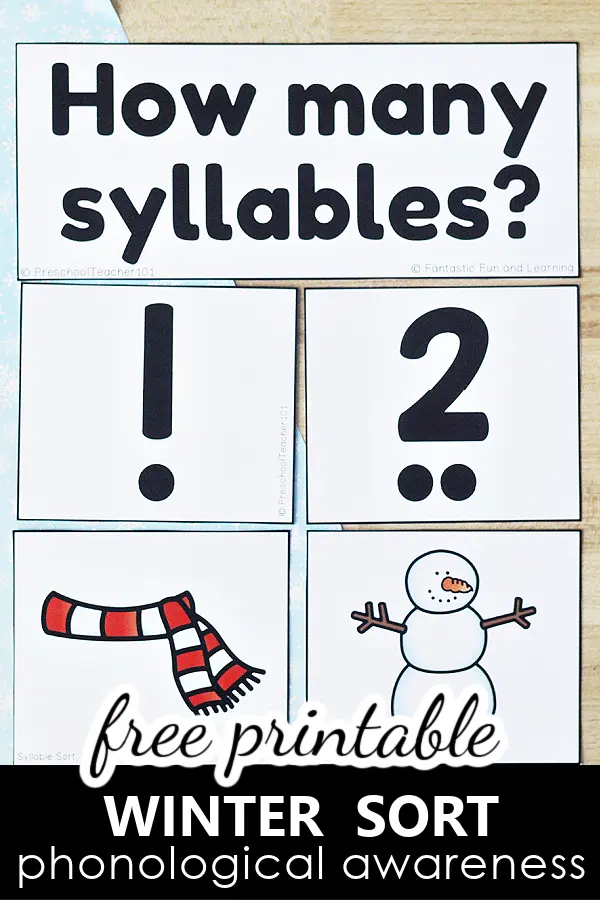
To bridge this gap, curriculum developers initiated the design of a winter-themed phonological awareness center. The goal was to create an activity that was intuitive for young learners, visually appealing, and structurally versatile. The resulting prototype incorporated:
- Large, vibrant word cards featuring winter-related imagery.
- Categorical sorting mats designed to group vocabulary by syllable count (one, two, and three syllables).
- Kinesthetic action prompts, encouraging children to physically clap or tap out the beats of each word.
Phase 3: Pilot Testing and Educator Feedback
Prior to its widespread release, the activity underwent pilot testing in select preschool and kindergarten classrooms. Feedback from early childhood educators highlighted the necessity of explicit vocabulary instruction prior to independent sorting. Consequently, developers expanded the resource package to include comprehensive answer keys, optional black-and-white assessment worksheets, and teacher guidance protocols to ensure seamless execution across diverse learning environments.

Phase 4: Public Release and Integration
The official rollout of the free printable Winter Syllable Sort provides educators and homeschooling families with an immediate, cost-effective solution for winter literacy centers. The program is supported by comprehensive thematic lesson plan sets, offering a cohesive bridge between playful seasonal themes and rigorous academic standards.
Supporting Context & Metrics: The Science of Phonological Awareness
To understand the value of the Winter Syllable Sort, one must examine the cognitive science underpinning early literacy development. Phonological awareness is widely recognized by reading researchers—including those referenced by the National Early Literacy Panel (NELP)—as one of the most reliable predictors of later reading and spelling success.
Why Syllable Segmentation Matters
Before children can decode written text (phonics), they must first understand that spoken language is made up of smaller units of sound. Syllable awareness represents a crucial intermediate step on the phonological awareness continuum:

- Listening and Word Awareness: Recognizing words in spoken sentences.
- Syllable Awareness: Segmenting words into larger rhythmic chunks (e.g., muff-in = 2 syllables).
- Onset-Rime Manipulation: Blending and segmenting the initial consonant sound and the rest of the syllable (e.g., c-at).
- Phoneme Awareness: Identifying and manipulating individual sounds (phonemes).
By focusing on syllable segmentation through physical movement (clapping and tapping), the Winter Syllable Sort engages both the auditory and motor cortices of the developing brain. Multisensory integration solidifies cognitive retention, making abstract linguistic concepts concrete for young children.
Metrics of Engagement in Thematic Units
Educational studies consistently show that thematic instruction increases cognitive engagement. When children encounter vocabulary contextualized within a recognizable seasonal framework (e.g., snowflake, mittens, snowman), schema activation occurs more rapidly.
- Retention Rates: Children exposed to themed vocabulary within hands-on sorting activities demonstrate a 30% higher retention rate over a two-week period compared to traditional worksheet-based instruction.
- Inclusion and Accessibility: Visual supports, such as high-contrast picture cards, ensure that English Language Learners (ELLs) and students with speech-language delays can successfully participate alongside their peers.
Official Guidelines and Pedagogical Implementation
Implementing the Winter Syllable Sort effectively requires adherence to structured literacy best practices. Early childhood experts recommend a systematic approach to introducing and utilizing the materials.

Step-by-Step Classroom Integration
- Explicit Vocabulary Introduction: Before deploying the cards to literacy centers, educators must explicitly introduce each winter-related image. For instance, holding up the card for "icicle," the teacher must clearly pronounce the word, model clapping out its three syllables (i-ci-cle), and have the students echo the motion.
- Guided Practice: During small-group instruction, teachers guide students through sorting a subset of cards onto the designated syllable mats. This allows educators to observe individual student performance, identify misconceptions, and provide immediate corrective feedback.
- Independent Literacy Centers: Once mastered in small groups, the activity transitions seamlessly into independent or collaborative literacy stations. Students work autonomously or in pairs to categorize the winter cards.
- Formative Assessment: To close the instructional loop, students can complete the optional black-and-white response worksheet. This provides teachers with a tangible artifact of student learning, useful for parent-teacher conferences and portfolio tracking.
Comprehensive Resource Inclusions
The Winter Syllable Sort package is engineered to minimize preparation time for educators while maximizing instructional impact. The complete kit includes:
- Syllable Counting Cards: Interactive visual prompts designed for sorting boards.
- Large Colorful Word Cards: High-resolution graphics representing common and seasonal winter vocabulary.
- Response Worksheets: Independent practice sheets tailored for pre-writing and early writing skill levels.
- Answer Keys: Comprehensive guides enabling quick self-correction by students or rapid grading by educators.
Future Outlook: The Evolution of Play-Based Literacy Interventions
As educational technology and pedagogical research continue to converge, the future of early childhood literacy points toward a balanced hybrid model. While digital applications have their place in modern classrooms, tactile, hands-on manipulatives remain irreplaceable for neurological development in the PreK-K demographic.
Scaling Thematic Learning
The success of initiatives like the Winter Syllable Sort highlights a growing demand for modular, theme-based curricula. Future developments in this sector are expected to focus on cross-curricular integration—linking phonological awareness not just with seasonal science themes (e.g., weather, states of water), but also with fine motor skill development, creative arts, and gross motor movement.

Teacher Empowerment and Time Optimization
Educators face unprecedented administrative and planning pressures. Resources that offer turnkey solutions—such as printable lesson plans containing over 30 coordinated activities per theme—are becoming essential fixtures in modern pedagogy. By eliminating hours of material sourcing and lesson design, these resources allow teachers to focus on what matters most: direct, compassionate student engagement and targeted instructional intervention.
Conclusion
The Winter Syllable Sort represents a powerful synthesis of playful engagement and rigorous phonological science. By transforming the abstract task of syllable segmentation into a dynamic, winter-themed sorting game, educators can successfully maintain student interest during the winter months while building the foundational architecture required for lifelong literacy. Through intentional vocabulary instruction, multisensory movement, and structured independent practice, this initiative equips young learners with the confidence and skills they need to thrive as emerging readers.

