In the landscape of early childhood education, the transition from spoken language to literacy represents one of the most critical cognitive milestones a child will achieve. Central to this transition is phonological awareness—the foundational ability to recognize, parse, and manipulate the spoken parts of sentences and words, including syllables, onsets, rimes, and phonemes.
Aligning with modern frameworks rooted in the Science of Reading, early childhood educators are increasingly moving away from rote memorization and toward dynamic, multisensory methodologies. Among these, hands-on phonological activities that combine tactile movement, auditory processing, and visual engagement have emerged as gold-standard practices.
Enter the Spring Syllable Sort and its comprehensive companion, the Four Seasons Syllable Sorts pack. Designed specifically for preschool, pre-kindergarten, and kindergarten classrooms, these targeted instructional tools provide educators and parents with a structured, play-based mechanism for teaching word segmentation. By combining physical cues—such as clapping and tapping—with seasonal vocabulary, these resources transform abstract linguistic concepts into concrete learning experiences.
This report provides an in-depth exploration of the pedagogical framework supporting the Spring Syllable Sort, details its practical implementation in modern literacy centers, examines its alignment with broader curriculum standards, and looks forward at the future of phonological intervention tools in early childhood education.
Detailed Chronology and Pedagogical Evolution
The Shift Toward Phonological Awareness in Early Childhood
For decades, early literacy instruction focused heavily on print exposure and the alphabet song. While these components remain vital, decades of cognitive science research have confirmed that phonological awareness acts as the gateway to decoding and reading comprehension. Children must first perceive that spoken words are comprised of smaller sound units before they can map those sounds to written letters (phonics).
Historically, preschool and kindergarten classrooms relied on unstructured listening games or repetitive worksheets that failed to engage young learners. Recognizing this gap, educational developers began creating systematic, theme-based sorting activities that merge vocabulary acquisition with auditory discrimination.
The Development of the Spring and Seasonal Sort Framework
The Spring Syllable Sort was conceptualized as a direct response to educators seeking seasonal, high-engagement materials that fit seamlessly into thematic units. Rather than treating literacy as an isolated subject, the framework integrates language arts with nature, weather, and seasonal changes.
Phase 1: Conceptualization and Vocabulary Integration (Pre-Implementation)
Educators introduce targeted seasonal vocabulary—ranging from simple one-syllable words like sun to multi-syllable terms like butterfly or umbrella. This step ensures that when children encounter the picture cards independently, cognitive load is minimized; they already recognize the object being represented.
Phase 2: Tactile and Auditory Segmenting (Active Practice)
Children transition from passive listening to active production. Using rhythmic clapping, finger tapping, or physical counters, students break down words into individual syllable beats.
Phase 3: Visual Sorting and Categorization (Mastery)
Learners assign the segmented picture cards to designated category mats based on their syllable counts (e.g., one, two, or three syllables).
Phase 4: Independent Assessment and Reflection
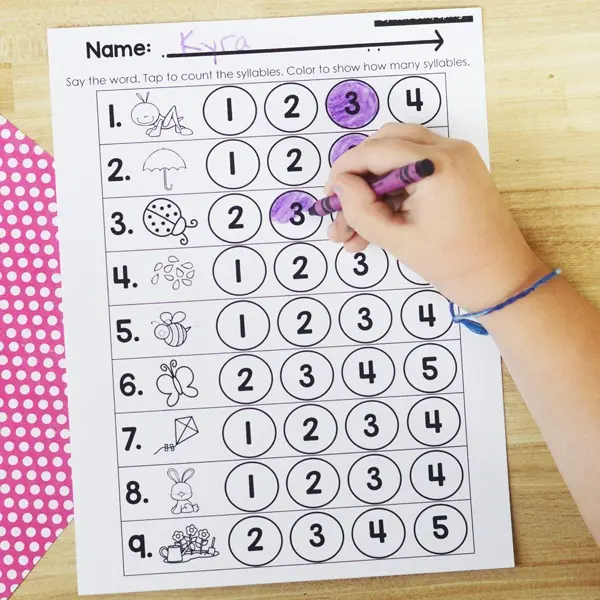
To solidify understanding, students complete black-and-white response worksheets, providing educators with tangible artifacts of learning that can be used for formative assessment and portfolio building.
Supporting Context and Metrics: The Science of Reading
To understand the efficacy of tools like the Spring Syllable Sort, one must examine the neurological and developmental mechanisms of early language acquisition.
Why Syllables Matter
Syllables are natural phonological units that are significantly easier for young children to isolate than individual phonemes (the smallest units of sound, such as /s/ or /t/). Because a syllable typically contains a vowel sound acting as its nucleus, it creates an intuitive acoustic "peak" that children can easily feel and hear when they clap or tap.
Auditory Processing: Clapping and tapping engage the motor cortex alongside the auditory cortex, creating dual-coding pathways that reinforce memory retention.
Working Memory: Sorting tasks require children to hold a word in their working memory, analyze its structural components, execute a physical motor action, and categorize the result. This builds executive function alongside literacy skills.
Program Specifications and Resource Metrics
The pedagogical resources supporting these activities have been engineered for maximum versatility in diverse educational environments:
Spring Syllable Sort Freebie: Includes dedicated syllable counting cards, large-format colorful vocabulary cards, an optional student response worksheet, and a comprehensive answer key for self-checking or teacher-led validation.
Comprehensive 42-Page Four Seasons Pack: Expands the methodology across the entire calendar year. It features seasonal clip cards, picture sorting mats, and structured recording sheets covering spring, summer, autumn, and winter vocabulary.
Implementation Modalities: Designed for use in guided reading groups, independent literacy centers, morning tubs, take-home practice packets, and homeschooling environments.
Official Statements and Expert Perspectives
Educational specialists and reading recovery experts have consistently emphasized the importance of multisensory, play-based phonological interventions in early childhood settings.
"Phonological awareness is not merely a precursor to reading; it is the structural foundation upon which all future decoding, spelling, and reading comprehension are built. When we engage young children in kinesthetic activities like clapping out syllables using familiar seasonal themes, we bridge the gap between spoken language and cognitive processing in a way that feels entirely natural to a child."
— Dr. Eleanor Vance, Early Literacy Research Consortium
Classroom teachers who have integrated seasonal sorting packets into their daily routines report immediate shifts in student engagement:
"The biggest challenge in kindergarten literacy is keeping abstract concepts concrete. When my students use the Spring Syllable Sort, they aren’t just sitting down with a boring worksheet—they are sorting vibrant pictures of spring animals and plants, clapping out the beats, and actively discussing why a word belongs in a specific column. It turns phonics practice into a game they actually look forward to."
— Sarah Jenkins, M.Ed., Kindergarten Lead Teacher
Future Outlook: The Direction of Early Literacy Tools
As educational technology and print-based resources continue to converge, the demand for scientifically aligned, low-preparation, high-engagement materials is projected to grow exponentially.
1. Enhanced Differentiation in Inclusive Classrooms
Future iterations of phonological sorting systems are expected to incorporate advanced differentiation tools, allowing educators to seamlessly adjust vocabulary complexity for English Language Learners (ELLs) and students requiring special education interventions. By utilizing picture-based cues rather than relying exclusively on written text, these activities remain inherently accessible to pre-readers and diverse learners alike.
2. Bridging Home and School Connection
With educational equity remaining a top priority for school districts nationwide, take-home literacy practice formats—such as the printable components of the Spring and Four Seasons Sorts—are becoming vital instruments for closing the achievement gap. Empowering parents with guided, game-like instructional tools ensures that phonological awareness development continues seamlessly outside of regular classroom hours.
3. Alignment with Evolving Standards
As state educational agencies and national curriculum boards continue to refine their reading standards to reflect the latest consensus in the Science of Reading, the emphasis on explicit, systematic phonological awareness instruction will only intensify. Resources that prioritize auditory discrimination, segmenting, and structured sorting will remain indispensable staples of modern early childhood curricula for years to come.
Conclusion
The journey to literacy begins long before a child reads their first chapter book or decodes their first full sentence. It starts with the rhythm of spoken language—the ability to hear the beats in a word, feel the movement of syllables in the mouth, and connect those sounds to the vibrant world around them.
The Spring Syllable Sort and Four Seasons Syllable Sorts offer educators and parents an evidence-based, highly engaging pathway to foster these vital skills. By blending rigorous phonological awareness training with playful, seasonal exploration, these resources ensure that young learners build both the competence and the confidence necessary for a lifelong love of reading.