

Executive Overview
Instructional planning remains one of the most demanding and foundational responsibilities in the education sector. Whether stepping into a classroom for the very first time or refining decades of pedagogical practice, educators constantly search for systematic, reliable frameworks to turn broad educational standards into engaging, impactful classroom experiences. To address this perennial challenge, educational platforms and veteran instructors are revisiting the bedrock principles of curriculum design, advocating for a structured, back-to-basics methodology that replaces ad-hoc lesson creation with intentional instructional architecture.
This comprehensive guide breaks down a practical, step-by-step framework for unit planning. By shifting the focus away from last-minute night-before planning and toward a cohesive, big-picture approach, teachers can build durable learning sequences. Utilizing a hypothetical adult education course titled Cooking Fundamentals, this framework illuminates the distinctions between educational standards, curricula, and instructional units. Furthermore, it demonstrates how the time-tested paradigm of backward design can transform the modern classroom, ensuring that every daily lesson serves a clear, measurable purpose.
Detailed Chronology: The Evolution of Unit Planning
For many educators, unit planning is often reactive rather than proactive. Historically, teachers have built lessons on a day-to-day basis, stitching together activities based on immediate availability and patching together a final assessment at the end of a unit based on whatever material happened to get covered. Over the last three decades, however, educational theory has evolved to prioritize proactive, outcomes-based mapping.
Phase 1: Defining the Educational Landscape
Before constructing a single lesson, an educator must understand the hierarchy of instruction. This process begins by defining three critical terms:
- Standards: The broad goals or benchmarks outlining what students should know and be able to do by the end of a course or grade level. While these are often mandated by state or local school systems, independent educators can establish them based on course competencies.
- Curriculum: The overarching roadmap that organizes and sequences standards into manageable clusters known as units. A curriculum dictates how topics flow across a semester or school year.
- Unit: A targeted collection of individual lessons—lasting anywhere from a few days to several weeks—focused on a specific subset of related knowledge and skills.
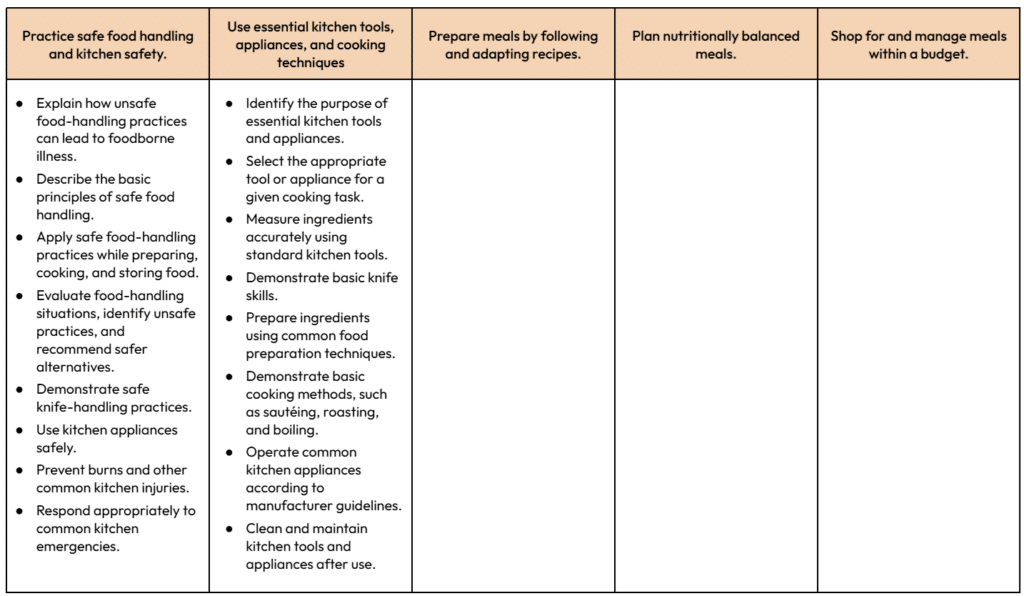
To illustrate this structural hierarchy, imagine designing an eight-week adult education course titled Cooking Fundamentals. An instructor begins by drafting five broad course goals: understanding nutrition, mastering essential kitchen tools and techniques, planning everyday meals, executing safe food handling, and navigating grocery budgeting.

When expanded, each broad goal reveals a complex sub-tier of knowledge and skills. For instance, the domain of kitchen tools and appliances involves dozens of distinct items, specialized techniques, and safety protocols. Organizing these vast data points into coherent thematic blocks transforms raw standards into six distinct instructional units:
- Food Safety
- Kitchen Tools and Appliances
- Food Prep and Cooking Techniques
- Everyday Meal Preparation
- Nutrition
- Grocery Shopping and Budgeting
Phase 2: Implementing the 3-Step Backward Design Process
With the Food Safety unit selected as a concise, three-to-four-day pilot module, the instructor applies the principles of backward design—a methodology popularized by Grant Wiggins and Jay McTighe in their seminal 1991 text, Understanding by Design.
Unlike traditional forward planning, backward design operates in three precise chronological steps:
Step 1: Set Measurable Objectives
An effective unit begins by establishing what success looks like. Objectives must avoid vague mental processes (like "understanding" or "learning") and instead focus on observable student behaviors. For the short food-handling unit, the instructor establishes four concrete, measurable objectives:
- Students will be able to identify cross-contamination risks in various food preparation setups.
- Students will be able to demonstrate correct handwashing and sanitation timelines.
- Students will be able to distinguish between safe and unsafe internal temperatures for various cooked meats.
- Students will be able to explain proper food storage hierarchy in a refrigerator.
To anchor these objectives meaningfully, the instructor assigns a unit title (Safe Food Handling) and an essential guiding question: "How do your choices in the kitchen affect the safety of the food you prepare?" This ensures the unit remains driven by conceptual understanding rather than rote memorization.
Step 2: Design the Summative Assessment
With the destination clearly defined, the instructor determines how student mastery will be evaluated before writing daily lessons. In backward design, the "test" is not an arbitrary hurdle; it is a meticulously crafted evaluation of high-quality learning objectives.
Because the food safety unit is brief, the assessment must be appropriately scoped. Rather than a lengthy exam, the instructor creates an open-response performance task. Students analyze simulated scenarios where fictional home cooks make subtle kitchen safety errors. Test-takers must identify the mistakes, articulate why they present health hazards, and prescribe correct procedural alternatives. This assessment evaluates whether students can transfer abstract rules into dynamic, real-world applications.
Step 3: Plan the Daily Lessons
Only after securing the objectives and the assessment plan does the instructor turn to daily lesson planning. Every activity, discussion, and lab exercise is intentionally reverse-engineered to bridge the gap between where students begin and where the summative assessment requires them to be.
Supporting Context & Metrics: Why Structure Matters
Educational research consistently demonstrates that intentional curriculum design directly correlates with student achievement. When teachers operate without a coherent unit map, instruction often becomes fragmented, leading to significant gaps in student comprehension and unnecessary cognitive overload.
The Metrics of Instructional Alignment
- Cognitive Retention: Studies in cognitive science indicate that students retain up to 40% more information when concepts are organized into thematic, cohesive units rather than isolated, disjointed lessons.
- Planning Efficiency: While front-loading unit design via backward design requires a higher initial investment of time, educators report a 50% reduction in nightly lesson-prep friction once a solid unit framework is established.
- Transfer of Knowledge: Assessments structured around authentic, scenario-based problem-solving—as opposed to simple multiple-choice recall—yield higher rates of long-term behavioral and academic skill transfer.
| Design Phase | Traditional Forward Planning | Backward Design Approach |
|---|---|---|
| Starting Point | Content availability & textbook chapters | Measurable learning objectives & standards |
| Assessment Timing | Created after teaching the content | Designed before planning daily lessons |
| Instructional Focus | Covering topics and meeting pacing guides | Ensuring student mastery of core outcomes |
| Student Impact | Fragmented knowledge; "teaching to the test" | Cohesive conceptual understanding & skill transfer |
Official Statements and Expert Perspectives
As educational institutions navigate evolving curriculum standards, experts continue to emphasize the timeless value of foundational design practices.
"Backward design forces educators to stop asking, ‘What am I going to teach tomorrow?’ and instead ask, ‘What do I want my students to understand and be able to do by the end of this unit, and how will I know they’ve achieved it?’" notes instructional design literature. "It changes the entire ecosystem of the classroom from a compliance-driven lecture series to a purpose-driven journey of mastery."
Veteran educators who have adopted multi-step unit frameworks emphasize that these methodologies are equally valuable for seasoned professionals. While novice teachers rely on structured frameworks to survive their initial years in the classroom, experienced instructors use them to prune obsolete materials, tighten alignment, and revitalize stagnant curricula. Curiosity about alternative instructional approaches remains a hallmark of master teaching.
Future Outlook: The Next Wave of Pedagogical Design
Looking forward, the landscape of instructional planning is poised for further evolution. The integration of digital tools, adaptive learning platforms, and comprehensive professional development courses—such as self-paced online curricula like Mastering the Lesson Plan—is democratizing access to high-level pedagogical training.
As school districts increasingly empower educators with curriculum customization tools, the ability to write, sequence, and assess instructional units will remain a core competency for modern teachers. By anchoring daily classroom practice in the disciplined framework of backward design, educators can ensure that their instruction is not only engaging and rigorous, but fundamentally transformative for every student who walks through their door.

