Bridging the Autonomous Gap: Why 83% of Organizations Need an Infrastructure Overhaul for Production-Grade Agentic AI
Layla Zulfa September 25, 2026 25 views 0 Comments
Executive Overview
The landscape of artificial intelligence is undergoing a profound paradigm shift. For the past several years, enterprises have been captivated by the potential of Generative AI (GenAI), treating foundational models as brilliant, isolated engines capable of drafting emails, generating code, and summarizing documents. However, as organizations transition from proof-of-concept experiments and isolated pilots into the harsh realities of enterprise-wide production, a new class of AI has taken center stage: Agentic AI.
Unlike traditional passive prompts that require step-by-step human intervention, agentic AI systems are autonomous, goal-oriented entities. Given a single directive, an autonomous agent can trigger hundreds of downstream actions—independently browsing databases, querying legacy architectures, and executing complex workflows across multiple operational silos.
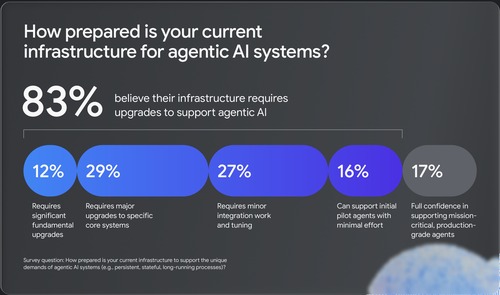
Yet, this autonomy comes at a steep infrastructural cost. According to the newly released 2026 State of Infrastructure in the Agentic AI Era report from Google Cloud, an overwhelming 83% of organizations believe their current underlying infrastructure requires a fundamental upgrade to successfully support production-grade agentic AI systems.
This deep-dive investigative report explores the core findings of Google Cloud’s latest research, unpacking the technological chasm facing modern enterprises, analyzing the unique demands of autonomous workloads, and offering a strategic roadmap for IT leaders, chief technology officers (CTOs), and platform engineering teams attempting to future-proof their operations.
Detailed Chronology: From Static GenAI Experiments to Dynamic Autonomous Agents
To understand the urgency of the 2026 findings, it is essential to trace the rapid evolution of enterprise AI infrastructure over recent years.
The 2025 Awakening: Recognizing the Infrastructure Deficit
In Google Cloud’s landmark 2025 infrastructure research, the enterprise tech sector was forced to confront an uncomfortable truth: infrastructure was the missing piece in early GenAI strategies. While enthusiasm for GenAI adoption was near-universal, companies quickly realized that deploying models without proper data governance, cost controls, hybrid-cloud flexibility, and edge deployment strategies led to runaway costs and stalled projects.
At that stage, the primary bottleneck was data integration and security. Enterprises were scrambling to pipe unstructured corporate data into vector databases, secure API endpoints, and ensure compliance with emerging regulatory frameworks. However, the operational model remained largely transactional—a user asked a question, and the model provided an answer.
The 2026 Paradigm Shift: The Rise of Autonomous Workloads
By 2026, the corporate focus shifted dramatically from broad GenAI experimentation to the execution of autonomous, continuous workflows. Enterprises were no longer content with chat interfaces; they wanted autonomous agents capable of closing supply chain loops, managing customer service lifecycles from intake to resolution, and executing cross-platform software deployments.
This shift from static generation to dynamic, multi-step agency fundamentally broke traditional enterprise IT architectures. Autonomous agents do not behave like traditional web apps or standard microservices. They require continuous reasoning, persistent state management, long-term memory, and the ability to interface natively with decades-old legacy systems like Enterprise Resource Planning (ERP) and Customer Relationship Management (CRM) platforms.
Consequently, the 2026 research marks a major evolution in the infrastructure debate. The discussion has moved past basic data ingestion to address the grueling realities of MLOps for continuous inference, distributed edge execution, strict power consumption parameters, and complex multi-agent orchestration.
Supporting Context & Metrics: Breaking Down the Infrastructure Readiness Gap
The data unveiled in the 2026 State of Infrastructure in the Agentic AI Era report paints a sobering picture of enterprise readiness. While the headline figure—that 83% of organizations require infrastructure upgrades—grabs attention, the granular breakdown reveals a spectrum of technological debt and operational unpreparedness.
The Readiness Breakdown
Google Cloud’s survey data categorizes organizational infrastructure preparedness into distinct tiers:
Significant Fundamental Upgrades (12%): A critical core of organizations find themselves completely unequipped for agentic workloads. Their legacy systems, data pipelines, and network topologies require foundational overhauls before they can even safely test production-grade agents.
Major Upgrades to Specific Core Systems (29%): Nearly three-tenths of respondents reported that while their general infrastructure is sound, specific core components—such as database query limits, API gateways, or security access control layers—require major redevelopment.
Minor Integration and Tuning Required (27%): Over a quarter of enterprises are relatively close, needing targeted integration work, latency reduction, and configuration tuning to support scaling agentic workflows.
Minimal Effort for Initial Pilots (16%): A small subset of organizations possess modern, cloud-native architectures capable of hosting initial pilot agents without heavy lifting, though they acknowledge scaling will still present challenges.
Full Confidence in Production-Grade Support (17%): Just 17% of surveyed organizations reported absolute confidence that their current infrastructure can natively support mission-critical, production-grade autonomous agents at scale.
Why Agentic Workloads Break Traditional Infrastructure
To understand why 83% of enterprises fall short, one must examine the operational DNA of agentic AI. Traditional software applications are stateless, deterministic, and bound by rigid code paths. When an error occurs, the application fails fast, and logs capture the exact point of failure.
In contrast, agentic AI workloads exhibit characteristics that challenge every layer of traditional IT infrastructure:
Persistent and Stateful Execution: Unlike a one-off LLM prompt, an autonomous agent may run for hours, days, or indefinitely. It must maintain a robust, uncorrupted state across lengthy chains of reasoning, remembering past actions, intermediate calculations, and contextual constraints.
High-Multiplier Downstream Actions: A single user prompt given to an agent can trigger hundreds of automated API calls, database queries, and write operations. Without strict rate-limiting, guardrails, and sandboxing, an agent caught in a logical loop can quickly overwhelm downstream legacy systems, corrupt databases, or trigger massive cloud computing bills.
Heterogeneous System Integration: Agents must operate seamlessly across a fragmented enterprise landscape, bridging modern cloud-native microservices with legacy on-premises mainframes, cloud data warehouses, and SaaS tools like Salesforce, SAP, and ServiceNow.
Stringent Security and Data Residency: Because agents actively read and write data across multiple environments (cloud, edge, and on-premises), traditional perimeter security is insufficient. Infrastructure must enforce real-time data governance, role-based access control (RBAC), and strict data residency compliance on the fly.
Official Statements and Industry Insights
Addressing the monumental challenges highlighted in the research, engineering and product leadership at Google Cloud emphasized that the report serves as a crucial blueprint for the future of enterprise software development.
"This report isn’t just a survey of the landscape; it’s a roadmap for establishing the new standard for production-grade autonomous systems," stated Nirav Mehta, VP of Product Management at Google Cloud.
Mehta’s perspective underscores a vital industry realization: moving to agentic AI is not merely an application-layer upgrade. Organizations cannot simply swap out a software development kit (SDK) or deploy a new model wrapper and expect enterprise-grade stability. The entire technology stack—from silicon and networking to orchestration platforms and data pipelines—must be re-architected to accommodate continuous, autonomous machine reasoning.
Industry analysts echo this sentiment, noting that the transition to agentic workflows marks the true beginning of the "Autonomous Enterprise." In this new era, competitive advantage will not belong to the companies with the smartest models, but to those whose infrastructure can safely, efficiently, and reliably unleash agents to execute business logic at machine speed.
Future Outlook: The Roadmap for IT and Platform Engineering Teams
As enterprises look toward the remainder of the decade, bridging the 83% infrastructure gap will require a deliberate, multi-pronged strategic approach. CTOs, Chief Information Security Officers (CISOs), and platform engineering teams must prioritize several key areas to prepare their organizations for the agentic era.
1. Advanced Orchestration and Observability
The ability to monitor a static API endpoint is no longer enough. Platform teams must invest in specialized orchestration and observability tooling designed specifically for multi-agent systems. This includes platforms capable of visualizing multi-step agent reasoning chains, tracing decision paths across distributed systems, and pinpointing precisely where an agent deviated from its intended goal. Furthermore, architectures must incorporate seamless "human-in-the-loop" intervention mechanisms, allowing operators to pause, inspect, and redirect agents in real-time before irreversible actions are executed.
2. Modernizing Data Pipelines and Memory Management
Because agents require continuous access to contextual memory and real-time enterprise data, legacy data warehouses must be upgraded for low-latency vector search and rapid retrieval-augmented generation (RAG) at scale. Data governance frameworks must evolve to handle autonomous read/write permissions, ensuring that agents do not inadvertently expose sensitive Personally Identifiable Information (PII) or violate regulatory mandates like GDPR and HIPAA while executing automated tasks.
3. Distributed Execution and Edge Deployment
As agentic systems push deeper into operational environments—such as manufacturing floors, logistics hubs, and retail environments—infrastructure must become increasingly distributed. Organizations will need to optimize edge computing resources to support local inference and real-time agentic decision-making, minimizing latency and ensuring operational continuity even during intermittent cloud connectivity disruptions.
4. Sustainable Hardware and Power Management
As highlighted in Google’s 2026 research, power consumption has become a primary factor in hardware selection. Continuous inference and long-running autonomous agent loops demand massive amounts of computational power. Future-proofing enterprise infrastructure means selecting energy-efficient accelerators, optimizing model sizes through quantization and distillation, and partnering with cloud providers committed to sustainable, carbon-free energy data center operations.
Conclusion
The transition to agentic AI represents the most ambitious technological leap for enterprises since the advent of cloud computing. While the allure of fully autonomous, goal-driven digital workers is undeniable, Google Cloud’s 2026 research delivers an unmistakable reality check: 83% of organizations are currently standing on the wrong side of an infrastructure divide.
Bridging this gap will require substantial investment, architectural foresight, and a cultural shift toward rigorous MLOps and autonomous governance. Enterprises that treat infrastructure as a strategic differentiator—rather than an afterthought—will successfully harness the power of agentic AI, unlocking unprecedented levels of efficiency, innovation, and operational autonomy. Those that fail to upgrade risk watching their most ambitious AI pilots stall under the crushing weight of legacy limitations.