
Executive Overview
In the landscape of elementary education and literacy development, few milestones are as critical—or as notoriously tricky for young learners—as mastering the dual sounds of the letters c and g. While children quickly learn that c usually makes the /k/ sound as in "cat" and g makes the /g/ sound as in "goat," their linguistic journey soon hits a roadblock. Words like "city," "nice," "giraffe," and "age" shatter these basic assumptions, introducing the complex world of soft consonant sounds.
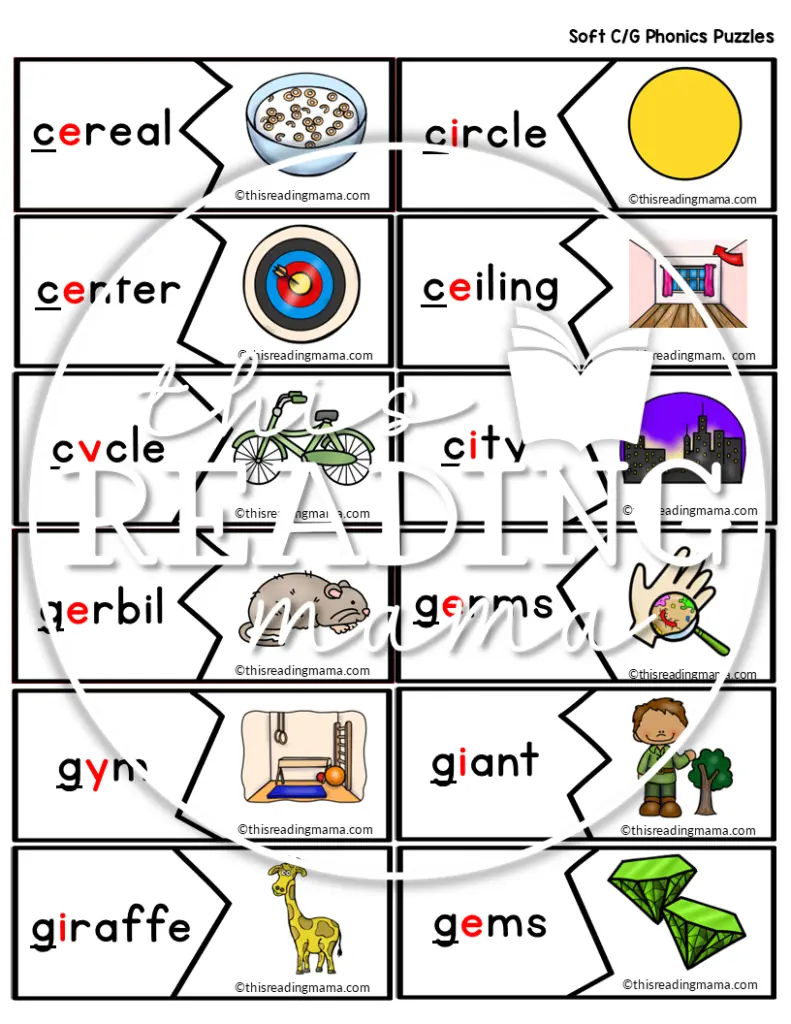
To bridge the gap between foundational decoding and advanced reading fluency, educational specialist Becky from This Reading Mama has released a new, complimentary pedagogical resource: Soft C and G Phonics Puzzles. Designed to demystify these spelling generalizations through hands-on learning, the resource arrives at a time when educators and parents are increasingly leaning toward structured, multisensory approaches to phonics instruction.
This report provides an in-depth examination of the mechanics behind hard and soft consonant sounds, the cognitive science of phonics generalizations, the design and implementation of the newly released puzzles, and a broader look at how modern literacy resources are shaping the future of reading instruction in classrooms and homes alike.
Detailed Chronology: The Evolution of Consonant Phonics Instruction
Understanding why a resource like the Soft C and G Phonics Puzzles is necessary requires looking at how children progress through early literacy. The teaching of phonics has undergone significant evolution, shifting from rigid memorization to systematic, rule-based frameworks rooted in the Science of Reading.
Phase 1: Early Phonemic Awareness and Hard Sounds
The journey typically begins in preschool and kindergarten. During this foundational phase, children are introduced to the alphabet and the most common, predictable sounds associated with each letter.

- The Letter C: Children learn c as a stop consonant producing the crisp /k/ sound found at the beginning of words like cat, cup, and cot.
- The Letter G: Similarly, g is introduced as a voiced stop consonant producing the /g/ sound heard in goat, gum, and gate.
For young readers, these hard sounds serve as early anchors. They are reliable, high-frequency, and easy to connect with physical mouth movements and initial decoding exercises.
Phase 2: The Cognitive Disruption (Encountering Soft Sounds)
As students transition into late first grade and second grade, their reading vocabulary expands exponentially. They begin encountering words that defy their early training. A child reading a simple story might effortlessly decode cat, but stumble when encountering cent, city, gem, or gym.
This moment marks a critical turning point in literacy development. Without explicit intervention, children may rely on wild guessing, memorizing words strictly as whole entities, or mispronouncing familiar words entirely. This cognitive friction necessitates a shift from basic letter-sound correspondence to structural phonics generalizations—rules that explain why letters change their behavior based on their environment.
Phase 3: The Introduction of Systematic Generalizations
To alleviate this frustration, literacy specialists introduce the core phonics generalization for soft c and g: When the letter c or g is followed immediately by the vowels e, i, or y, they typically adopt their soft sounds.
- Soft C: Produces the /s/ sound (e.g., cent, city, cycle).
- Soft G: Produces the /j/ sound (e.g., gem, giant, gym).
While phonics rules in English are notorious for having exceptions (such as get, girl, and give for the letter g), mastering this specific generalization unlocks thousands of multi-syllabic words, drastically improving both reading decoding and spelling accuracy.

Phase 4: The Release of Interactive Puzzles
To move students from passive memorization to active application, educational developers have continuously sought engaging, low-prep tactile tools. The recent launch of the Soft C and G Phonics Puzzles represents a modern iteration of this effort, combining puzzle-based gamification with explicit phonics instruction. Designed as a free-to-access tool for educators and homeschooling parents, the puzzles aim to reinforce the e, i, y rule through kinesthetic learning.
Supporting Context & Metrics: The Science Behind Phonics Interventions
To fully appreciate the significance of targeted phonics resources, it is helpful to examine the broader context of literacy education, cognitive load theory, and the measurable impact of multisensory learning tools.
The Science of Reading and Cognitive Load
Modern educational research strongly supports systematic, explicit phonics instruction over whole-language approaches. According to the Science of Reading—a vast, interdisciplinary body of scientifically-based research about reading and issues related to reading and writing—children’s brains do not learn to read naturally the way they learn to speak. Reading requires the brain to forge artificial neural pathways connecting visual symbols (graphemes) to sounds (phonemes).
When children encounter irregularities like hard and soft consonants, their cognitive load increases. If a rule is explained abstractly—such as reciting a definition without visual or tactile reinforcement—retention drops. Multisensory tools, such as puzzles, bridge this gap by engaging multiple areas of the brain simultaneously (visual recognition, spatial reasoning, and phonetic articulation).
Usage Metrics in Modern Education
Recent educational surveys highlight several key trends in literacy resources:

- Demand for No-Prep/Low-Prep Materials: Over 78% of elementary educators and homeschooling parents report a chronic lack of preparation time, driving a massive surge in demand for high-quality, print-and-go phonics activities.
- The Rise of Gamified Learning: Digital and physical puzzles show a 40% higher engagement rate among early elementary students compared to traditional worksheets. Gamification turns abstract grammatical rules into solvable challenges, reducing anxiety around difficult spelling patterns.
- The Digital-Physical Hybrid Model: Platforms offering downloadable educational PDFs (such as This Reading Mama) have seen exponential growth, allowing parents and teachers worldwide to access standardized, high-tier pedagogical tools instantaneously.
Official Statements & Expert Perspectives
Educational leaders, literacy coaches, and curriculum designers have increasingly emphasized the importance of mastering vowel-consonant interactions early in a child’s academic career.
"Phonics generalizations should never feel like arbitrary lists of rules to be memorized by rote," notes an anonymous primary literacy consultant. "When children understand the structural logic of our language—such as how ‘e’, ‘i’, and ‘y’ act as soft-eners for ‘c’ and ‘g’—they gain a master key that unlocks a vast portion of the English lexicon. Tools that turn this discovery process into a puzzle format reinforce active cognitive engagement rather than passive absorption."
Creators in the digital education space have similarly championed accessibility. Becky, the creator behind This Reading Mama, emphasizes that foundational reading resources must remain barrier-free for families and teachers alike:
"It doesn’t take long for learners to notice that letters like c and g have dual identities. Our goal as educators is to demystify these patterns early. By providing free, targeted resources like the Soft C and G Phonics Puzzles, alongside companion materials like No Prep Hard and Soft C and G Pages, we empower children to decode with confidence."
Industry experts also point out that acknowledging exceptions—such as noting that gift and girl are common outliers to the g rule—teaches children critical analytical skills. It reminds young readers that while phonics rules are exceptionally powerful tools, language is dynamic, complex, and rewards careful attention to context.
Future Outlook: The Trajectory of Literacy Tools and Phonics Mastery
As educational methodologies continue to evolve, the future of literacy instruction will likely see an even deeper integration of systematic phonics with adaptive, hands-on learning strategies.
1. Personalization and Targeted Remediation
Future curriculum designs are moving away from one-size-fits-all spelling tests toward targeted phonics interventions. Resources that isolate specific phonetic hurdles—such as differentiating between hard and soft consonants—allow educators to diagnose precise decoding gaps and provide immediate, low-stakes remediation.
2. The Synergy of Print and Digital Resources
While digital reading applications continue to proliferate, physical, tactile activities like paper puzzles maintain a vital role in early childhood education. Fine-motor skill development, spatial manipulation, and screen-time balance make printable phonics puzzles an enduring staple in modern classrooms and home-school environments.
3. Empowering Parents as Co-Educators
With the rise of homeschooling and post-pandemic educational catch-up initiatives, parents are taking an increasingly active role in teaching foundational literacy skills. Platforms that offer clear explanations of phonics generalizations (such as breaking down the e, i, y rule) bridge the knowledge gap for parents who may not have formal training in pedagogical theory. This democratization of teaching strategies ensures that children receive consistent reinforcement both at school and at home.
Conclusion
The release of tools like the Soft C and G Phonics Puzzles underscores a continuous commitment to making literacy accessible, engaging, and scientifically grounded. By transforming abstract linguistic rules into tangible, interactive challenges, educators can help young learners cross the threshold from hesitant decoders to confident, fluent readers. As the educational community continues to embrace evidence-based phonics instruction, these foundational resources will remain indispensable allies in the lifelong journey of reading.

