For nearly three decades, magnetic building tiles have served as a staple in progressive classrooms and playrooms worldwide. Celebrated for their durability, minimalist design, and capacity to inspire open-ended STEM (Science, Technology, Engineering, and Mathematics) learning, these toys are widely regarded as a parenting essential. However, soaring household inflation and the sheer desire of children to construct ever-larger, more elaborate architectural marvels have created a dilemma for modern parents: how to expand a child’s creative toolkit without breaking the bank.
The primary barrier to entry—and expansion—lies in the market dominance of the industry pioneer, Magna-Tiles. While celebrated for their rigid construction and rigorous safety certifications, authentic Magna-Tiles command a premium price point largely driven by brand equity and strict minimum-advertised-price (MAP) policies. This economic reality has catalyzed a booming secondary market of high-quality, cost-effective alternatives.
This investigative report examines the economics of magnetic toys, the structural differences between brand-name and generic tiles, and the top-tier alternatives that deliver comparable educational value at a fraction of the cost. Through hands-on comparative testing, consumer safety metrics, and expert analysis, we explore whether off-brand magnetic tiles can truly match the gold standard of childhood construction play.
The Economics of Play: Why Are Original Magna-Tiles So Expensive?
To understand the market for magnetic building toys, one must first examine the history and manufacturing standards that dictate their pricing. Introduced to the market in 1997, Magna-Tiles effectively invented the magnetic tile category. As the first-to-market pioneer, the brand secured an invaluable position of authority, allowing them to establish strict pricing controls across major retail channels.
When a consumer purchases an official set of Magna-Tiles, a significant portion of the cost goes toward paying for the brand name. However, manufacturing costs also play a critical role. Like other reputable STEM toy brands, such as Connetix Tiles, authentic Magna-Tiles are manufactured using food-grade ABS (Acrylonitrile Butadiene Styrene) plastic. This material must withstand high-impact drops, heavy weight loads, and constant stress without cracking or exposing the internal neodymium magnets. Furthermore, these toys must clear rigorous product safety standards established by organizations like the Consumer Product Safety Commission (CPSC) to guarantee the absence of toxic heavy metals, phthalates, and lead.
Independent toy-testing organizations, including the Good Housekeeping Institute, frequently note that while Magna-Tiles represent the pinnacle of structural rigidity—having proven the hardest to fracture in stress tests—they do not hold a monopoly on safety or material quality. Numerous generic and off-brand competitors now source identical ABS plastics and comparable ultrasonic welding techniques to seal the magnets securely within the plastic casing. Consequently, parents are left weighing a marginal increase in structural rigidity against a substantial difference in retail cost.
Detailed Chronology: The Evolution of Magnetic Construction Toys
The trajectory of magnetic play has transformed dramatically over the last 25 years. Tracing this evolution reveals how market competition has driven innovation far beyond the original 1997 design.
1997 – The Genesis: Magna-Tiles make their debut, introducing geometric shapes embedded with edge magnets. The toy is initially embraced primarily by educators and progressive preschools as a spatial-reasoning tool.
The 2000s – Educational Expansion: As word-of-mouth grows among parents, magnetic tiles transition from niche classroom aids to mainstream household staples. The focus centers entirely on basic geometric shapes: squares, triangles, and rectangles.
The 2010s – The Rise of Competitors: Recognizing the immense consumer demand and high profit margins of the pioneer brand, alternative manufacturers—most notably PicassoTiles and Cossy—enter the market. These brands introduce competitive pricing models and experiment with higher transparency plastics and vibrant color palettes.
The Late 2010s to Present – Specialized Add-Ons and Hybrid Learning: Modern off-brands revolutionize the category by moving beyond basic geometry. Companies begin integrating architectural elements like archways, fences, doors, and functional add-ons like "StileMags" (magnetic slips featuring letters and pictures). This shift bridges the gap between pure spatial construction and early literacy development, cementing magnetic tiles as comprehensive multidisciplinary STEM tools.
Supporting Context & Metrics: Magna-Tiles vs. The Competitors
When evaluating whether to invest in brand-name tiles or budget-friendly alternatives, consumers must look at several key metrics: material composition, magnet strength, transparency, and architectural versatility.
1. PicassoTiles: The Value King
PicassoTiles has established itself as the leading generic alternative for families seeking scalability. In side-by-side durability tests with Magna-Tiles and Connetix, PicassoTiles hold up remarkably well under daily wear and tear.
Compatibility: One of PicassoTiles’ greatest strengths is its universal sizing. They integrate seamlessly with existing sets of Magna-Tiles, allowing children to merge collections without alignment frustration.
Product Range: From massive starter bundles to specialized car chassis and roller coaster add-ons, PicassoTiles offers greater variety in out-of-the-box play configurations than the original brand.
2. Cossy Kids Magnetic Tiles: High Transparency and Vibrant Hue
For children who love building towering castles that catch the sunlight, Cossy offers a compelling visual advantage.
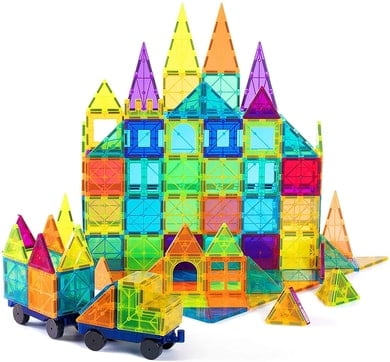
Aesthetics: Cossy tiles feature enhanced color saturation and high-transparency plastic. When exposed to natural light, creations cast vivid, stained-glass-style color patterns across the floor.
Longevity: Stress-tested over multi-year periods in active playrooms, Cossy tiles demonstrate exceptional ultrasonic weld durability, resisting cracks even when stepped on or tossed into toy bins.
3. Shapemags: Bridging Spatial Play and Literacy
Shapemags introduces an innovative pedagogical twist by merging traditional geometric building with early childhood education.
StileMags Integration: Alongside standard shapes, Shapemags offers 24-piece accessory packs featuring letters, numbers, and graphic illustrations that snap magnetically onto the tile faces.
Developmental Impact: This dual-purpose design transforms a standard building session into an interactive spelling and counting lesson, appealing heavily to preschool educators.
4. Magblock Magnetic Blocks: Architectural Realism Out of the Box
Traditional magnetic tile sets often require children to build doors and windows manually out of flat squares and triangles. Magblock eliminates this friction point.
Built-in Architecture: Magblock sets routinely include specialized geometric pieces such as functional archways, swinging doors, and realistic fences within their standard kits.
Creative Efficiency: This allows young builders to replicate real-world infrastructure—such as medieval castles, suburban neighborhoods, and modern skyscrapers—without requiring costly expansion packs.
Official Industry Statements & Consumer Insights
The prevailing wisdom within the toy industry highlights a nuanced reality regarding branded versus generic toys. Consumer advocacy groups and parenting publications consistently emphasize that brand loyalty should not supersede practical household budgeting, particularly when safety standards are universally met.
"Yes, Magna-Tiles are the gold standard of magnetic construction, but the marginal gains in rigidity are simply not enough to justify the staggering price disparity for the average family."
— Comparative Toy-Testing Analysis, STEM Education Guide
Furthermore, retail analysts point out that strict Minimum Advertised Price (MAP) policies enforced by premium brands ensure that true discounts on authentic Magna-Tiles are virtually nonexistent. Retailers caught discounting the baseline brand risk losing their distribution rights. Consequently, families seeking affordability are steered organically toward market alternatives that operate outside these restrictive pricing loops while maintaining strict CPSC compliance.
Future Outlook: The Next Generation of STEM Play
As the market for magnetic building toys continues to mature, the boundary between "name brand" and "knock-off" is rapidly dissolving. Budget-friendly competitors are no longer merely copying the original 1997 blueprint; they are actively innovating past it.
Future trends indicate a heavy push toward smart-integration, enhanced magnetic polarity (ensuring tiles never repel each other awkwardly during rapid building), and eco-friendly plant-based plastics. For parents, this is an encouraging development. The democratization of STEM toys means that inspiring spatial reasoning, engineering prowess, and imaginative architectural play is no longer an elite luxury.
A Final Exploration Tip for Parents:
To transform building time into an active learning exercise, encourage your children to perform comparative analyses of their collection. Ask engaging, open-ended questions such as:
"How does the weight of this PicassoTile compare to that original Magna-Tile?"
"What do you notice about how the light passes through a Cossy tile versus an opaque block?"
Ultimately, open-ended imaginative play remains one of the most powerful catalysts for early childhood development. Whether constructed from premium brand-name plastics or budget-friendly alternative sets, the true magic lies not in the logo stamped on the edge, but in the boundless creativity of the child holding the pieces.