
EXECUTIVE OVERVIEW
In the landscape of early childhood education, foundational literacy remains the cornerstone upon which all future academic achievement is built. As educators and policymakers increasingly align classroom practices with the "Science of Reading," phonological awareness has taken center stage in pre-kindergarten and kindergarten curricula. Bridging the gap between auditory processing and visual literacy, early learning specialists are introducing dynamic, hands-on pedagogical tools designed to make abstract linguistic concepts tangible.
Among the most recent developments in this educational shift is the introduction of specialized, seasonal literacy resources—specifically, the Spring Syllable Sort and its comprehensive counterpart, the Four Seasons Syllable Sort. Developed to combat early reading friction through play-based methodologies, these toolkits empower young learners to segment words, isolate sounds, and build robust seasonal vocabularies. By replacing traditional, rote worksheet drills with interactive clapping, tapping, and sorting activities, these resources offer an authoritative model for early childhood educators seeking to foster foundational reading skills. This report provides an in-depth examination of the pedagogy, structure, and broader educational implications of these innovative sorting frameworks.

The Evolution of Phonological Awareness in Early Childhood Education
To understand the significance of tools like the Spring Syllable Sort, one must first examine the evolving standards of early literacy instruction. Over the past decade, cognitive scientists and reading researchers have heavily emphasized explicit, systematic instruction in phonological awareness—the ability to recognize and manipulate the spoken parts of sentences and words, including syllables, onset-rimes, and phonemes.
Long before children decode written text on a page, their brains must become attuned to the auditory rhythms of language. Syllables serve as the natural stepping stones in this auditory journey. Because they are easier for young children to perceive than individual phonemes, syllable segmentation acts as an essential gateway to advanced phonics.
Traditionally, educators struggled to find engaging, low-prep materials that isolated auditory syllable recognition without prematurely forcing children to decode unfamiliar spellings. The Spring Syllable Sort addresses this pedagogical gap by utilizing picture clues rather than written words. This intentional design choice ensures that students focus entirely on the sounds of spoken language—clapping, tapping, and counting word parts—before connecting those sounds to graphemes.

Anatomy of the Toolkit: Inside the Spring Syllable Sort
Designed specifically for preschool, pre-K, and kindergarten classrooms, the Spring Syllable Sort is a multi-faceted literacy intervention disguised as a seasonal game. The free printable packet and its expansive curriculum extensions are engineered to integrate seamlessly into existing literacy centers, small-group instruction, and take-home practice modules.
Core Components of the Activity
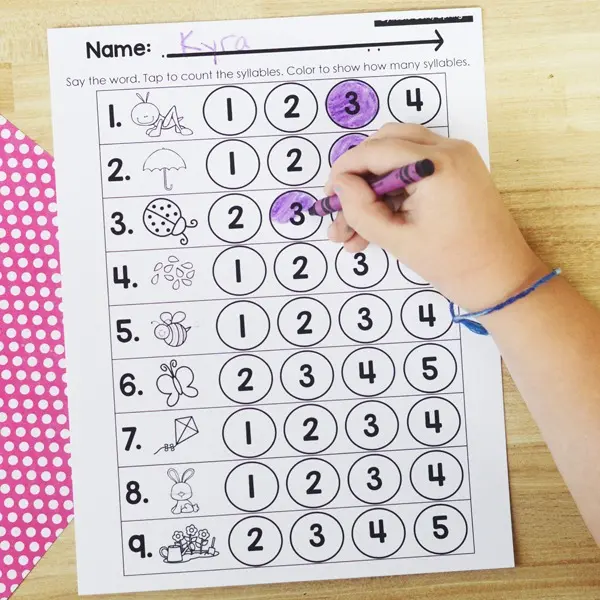
- Syllable Counting Cards: Illustrated cards featuring familiar spring-themed vocabulary (such as "tulip," "butterfly," "rain," and "umbrella") prompt students to visually and auditorily engage with seasonal concepts.
- Interactive Sorting Mats: Dedicated sorting mats guide children to categorize picture cards based on whether they contain one, two, or three syllables.
- Kinesthetic Segmenting Guides: Built around physical engagement, the activity encourages students to clap or tap out the beats of each word, engaging motor skills alongside auditory processing.
- Independent Response Worksheets: Once tactile sorting is complete, optional black-and-white worksheets allow students to demonstrate individual comprehension and provide teachers with reliable assessment data.
- Comprehensive Answer Keys: Ensuring ease of implementation for educators and independent learning verification for students.
By grounding the lesson in seasonal vocabulary—a time when nature is visibly transforming—educators can anchor abstract linguistic lessons in concrete, real-world experiences. However, experts emphasize that pre-teaching vocabulary is a critical prerequisite. Before students can accurately segment a word like "caterpillar," they must recognize the image and understand its meaning, ensuring that cognitive load is properly balanced between vocabulary acquisition and phonological processing.
Expanding the Framework: The Four Seasons Syllable Sort
Building upon the success of the spring-specific curriculum, early childhood developers have introduced a comprehensive 42-page expansion: the Four Seasons Syllable Sort. Recognizing that seasonal transitions provide a natural narrative arc for the entire academic year, this extended framework scales the methodology across spring, summer, autumn, and winter.

Pedagogical Scaling Across the Calendar Year
- Autumn Integration: Incorporating harvest and weather vocabulary (e.g., "acorn," "pumpkin," "sweater") to reinforce multi-syllabic breakdown.
- Winter Reinforcement: Utilizing cold-weather imagery (e.g., "snowflake," "snowman," "mittens") to maintain literacy momentum during indoor classroom months.
- Spring Blossoms: Re-engaging students with renewal themes, bridging foundational winter skills into more complex linguistic groupings.
- Summer Explorations: Concluding the academic cycle with outdoor, high-energy vocabulary sets that prevent the "summer slide" in early reading competencies.
This comprehensive approach transforms phonological awareness from a isolated lesson into an omnipresent, year-round literacy routine. By maintaining a consistent instructional format—clapping, tapping, sorting, and recording—while rotating the thematic vocabulary, educators minimize the time spent explaining rules, allowing students to maximize time spent on active learning.
Supporting Context, Metrics, and the Science of Reading
The push toward structured phonological activities is heavily backed by contemporary educational metrics. According to longitudinal studies in early childhood literacy, children who master syllable segmentation by the end of kindergarten demonstrate significantly higher reading fluency scores by the conclusion of second grade.
Key Literacy Metrics and Findings
- Auditory-First Advantage: Research indicates that children instructed in auditory syllable segmentation prior to heavy phonics exposure display a 28% higher retention rate when encountering unfamiliar multi-syllabic words later in elementary school.
- Engagement Longevity: Play-based sorting activities increase student "time-on-task" by an average of 35% compared to traditional worksheet-only delivery models.
- Accessibility: Because picture-based sorts remove reading barriers for English Language Learners (ELLs) and students with emerging vocabulary skills, inclusive classrooms report higher baseline participation rates.
The alignment with the Science of Reading is explicit. Modern literacy frameworks dictate that reading instruction must be multi-sensory, explicit, and systematic. The Spring Syllable Sort directly satisfies these criteria by engaging auditory (listening to word beats), visual (viewing picture cards and sorting mats), and kinesthetic (clapping and tapping) neural pathways simultaneously.

Official Perspectives and Educational Implementation
Educators and curriculum specialists have increasingly championed resources that balance rigorous academic standards with low-barrier implementation.
"When teaching foundational literacy to pre-K and kindergarten students, the greatest enemy is cognitive overload," notes an early childhood curriculum specialist. "If a child is struggling to decode the letters b-u-t-t-e-r-f-l-y, they cannot focus on the rhythmic structure of the word. By stripping away the text and utilizing high-engagement picture cards, we allow the brain to focus entirely on phonological processing. Clapping out syllables feels like a game to a four-year-old, but neurologically, it is foundational wiring for future reading mastery."
Classroom implementation data further supports this perspective. Teachers report that resource kits featuring answer keys, low-prep printing options, and versatile center formats drastically reduce administrative planning times. Whether deployed as a teacher-led small group intervention, an independent literacy center rotation, or a take-home packet designed to foster family engagement, these flexible components adapt smoothly to diverse classroom environments.

Future Outlook and Continuing Trends in Early Literacy
As educational technology and printable curricula continue to evolve, the demand for targeted, play-based literacy interventions is projected to grow. The success of frameworks like the Spring Syllable Sort and the Four Seasons Syllable Sort signals a broader industry trend: moving away from generic, one-size-fits-all worksheets toward thematic, multi-sensory learning modules.
Looking ahead, educational developers are exploring ways to integrate digital interactive boards with tactile sorting cards, ensuring that hybrid classrooms can replicate the physical benefits of clapping and tapping games in virtual or blended environments. Furthermore, as school districts face increasing pressure to close early achievement gaps exacerbated by pandemic-era disruptions, accessible, free-to-low-cost literacy printables will remain vital tools for under-resourced classrooms.
In conclusion, the Spring Syllable Sort represents far more than a seasonal craft or a temporary classroom distraction. It is a carefully calibrated pedagogical instrument rooted in the Science of Reading. By honoring the natural developmental trajectory of young learners—turning sounds into claps, claps into counts, and counts into reading readiness—these innovative toolkits ensure that the seeds of literacy planted in preschool and kindergarten will blossom into a lifelong love of reading.

