
Executive Overview
In the landscape of modern early childhood education, the transition from passive listening to active phonetic engagement remains one of the most critical milestones for pre-K and kindergarten learners. As educators and curriculum developers increasingly align early learning models with the Science of Reading, the focus has shifted sharply toward phonological awareness—the foundational ability to recognize, isolate, and manipulate the spoken parts of sentences and words.
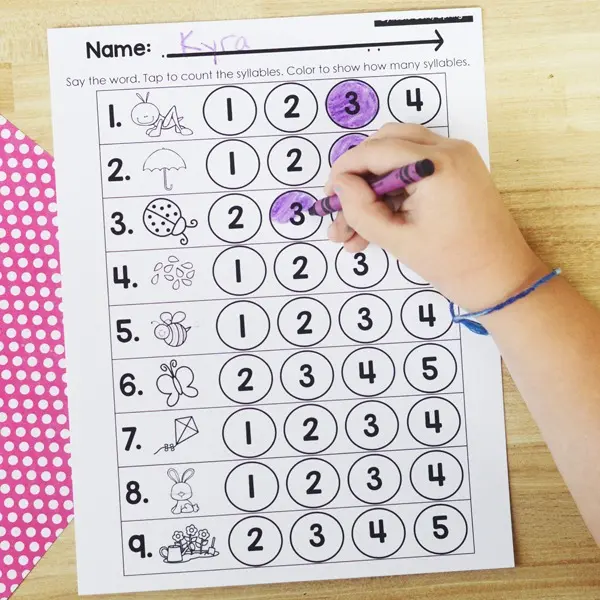
Amid this pedagogical evolution, a new hands-on instructional tool has emerged to capture young imaginations while delivering rigorous cognitive benefits: the Spring Syllable Sort. Designed specifically for early childhood educators, literacy specialists, and parents navigating homeschooling, this engaging, seasonally themed activity transforms abstract linguistic concepts into tactile, interactive play.
By combining visual picture cards, kinesthetic segmenting techniques (such as clapping and tapping), and structured sorting mats, the Spring Syllable Sort helps children isolate word parts with precision. Far more than a seasonal craft, this free printable literacy center tool addresses core developmental milestones, bridging the gap between spoken language and emergent reading comprehension. This report explores the core mechanics of the Spring Syllable Sort, its alignment with modern educational standards, and its broader expansion into a comprehensive Four Seasons Syllable Sort curriculum.

Detailed Chronology: The Evolution of Early Literacy and the Rise of Phonological Hands-On Tools
To understand the impact of tools like the Spring Syllable Sort, it is necessary to examine how early childhood literacy instruction has evolved over recent decades.
Phase 1: The Shift Away from Rote Memorization (Late 20th Century)
For generations, early reading instruction heavily favored whole-word memorization or unstructured exposure to text. However, longitudinal cognitive research steadily revealed that children who struggled with reading often suffered from an underlying deficit in phonological processing—the inability to hear the individual sounds, rhymes, and syllables that make up spoken English.
Phase 2: The Emergence of the Science of Reading (2010s)
As the Science of Reading gained mainstream momentum, educational researchers emphasized explicit, systematic instruction in phonics and phonological awareness. Educators recognized that before children can decode written letters (graphemes) into sounds (phonemes), they must master the auditory landscape of language. Syllable segmentation—breaking words down into beats or chunks—was identified as a critical stepping stone in this hierarchy.

Phase 3: The Integration of Thematic Play (Present Day)
Recognizing that young children learn best through play and contextual engagement, curriculum designers began embedding foundational literacy skills into thematic units. Springtime themes, rich in vibrant vocabulary relating to nature, weather, and biology, provided the ideal backdrop. The introduction of the Spring Syllable Sort represents a modern synthesis of this movement: rigorous, standards-aligned literacy practice delivered through accessible, low-prep printables designed for immediate classroom and home implementation.
Supporting Context & Metrics: Why Syllable Segmentation Matters
Phonological awareness is widely recognized by literacy experts as one of the single best predictors of later reading success. Within this domain, syllable counting and sorting serve specific cognitive functions that prepare young minds for complex text decoding.
The Mechanics of Segmenting
When a child encounters a multi-syllable word, their brain must parse the continuous stream of speech into discrete, manageable units. Activities that incorporate kinesthetic movements—such as clapping, tapping fingers, or marching—activate multiple sensory pathways simultaneously.

- Auditory Processing: Children listen to a spoken seasonal vocabulary word (e.g., "tul-ip" versus "sun-flower").
- Kinesthetic Feedback: They physically clap or tap for each distinct vowel sound/beat they hear.
- Visual Categorization: They match the word’s picture card to the corresponding numerical column (1, 2, 3, or more syllables).
Measurable Educational Benefits
Classroom metrics and literacy assessments highlight several key advantages of incorporating targeted syllable sorts into daily routines:
- Vocabulary Expansion: By utilizing thematic picture cards featuring seasonal flora, fauna, and weather elements, children acquire rich descriptive language while simultaneously analyzing its phonetic structure.
- Working Memory Enhancement: Holding a word in mind, breaking it apart, and assigning it to a category strengthens cognitive working memory.
- Low-Barrier Accessibility: Because these activities focus entirely on auditory and visual picture cues rather than complex text decoding, children of varying reading readiness levels can participate equitably. This makes the tool ideal for inclusive classrooms and English Language Learner (ELL) support.
Official Guidelines and Implementation Strategies
Integrating the Spring Syllable Sort into a pre-K or kindergarten curriculum requires a thoughtful, structured approach to ensure maximum comprehension and student engagement.
Best Practices for Educators
According to early childhood reading specialists, introducing a sorting activity should always follow a specific instructional sequence:

- Vocabulary Pre-Teaching: Before asking students to independently sort picture cards, educators must explicitly introduce and review every vocabulary word represented in the images. If a child does not recognize a picture as a "caterpillar" or a "watering can," they cannot accurately isolate its syllables.
- Model and Guide: Teachers should first demonstrate the segmentation process aloud. For example, holding up a card depicting a "lady-bug," the instructor claps three times while emphasizing each syllable ("la-dy-bug"), inviting the class to echo the movement.
- Independent or Center-Based Practice: Once mastery is demonstrated in a group setting, the activity transitions seamlessly into literacy centers, morning work bins, or take-home practice packs.
Anatomy of the Spring Syllable Resource Package
The comprehensive free printable and extended seasonal packs are engineered to provide complete instructional flexibility. Typical components include:
- Syllable Counting Cards & Large Colorful Word Cards: Designed for pocket charts, sensory bins, or small-group sorting tables.
- Black and White Response Worksheets: Optional independent practice sheets that allow students to record their findings and reinforce pencil-grip and fine-motor skills.
- Comprehensive Answer Keys: Ensuring that educators and parents can quickly verify student sorting accuracy during independent learning stations.
Future Outlook: Expanding the Framework to the Four Seasons
As early childhood education continues to prioritize adaptable, multimodal learning resources, the success of the Spring Syllable Sort has paved the way for broader, year-round literacy frameworks.
The Four Seasons Curriculum Expansion
Building upon the foundational framework of the spring-themed activity, educational developers have introduced comprehensive 42-page seasonal packs encompassing Summer, Autumn, Winter, and Spring. These expansive toolkits ensure that phonological awareness training remains fresh and contextually relevant throughout the entire academic calendar.

By rotating thematic picture cards—transitioning from autumn leaves and winter snowflakes to spring blossoms and summer suns—teachers can maintain high levels of student engagement while systematically revisiting core syllable-segmenting skills.
Conclusion
The transition toward structured, play-based phonological awareness tools represents a major leap forward in early reading instruction. Through initiatives like the Spring Syllable Sort and its four-season counterparts, educators are equipped with the resources needed to transform foundational literacy into an intuitive, joyful experience. As schools continue to embrace the Science of Reading, these accessible, print-and-go activities will undoubtedly remain a cornerstone of effective pre-K and kindergarten classrooms for years to come.

