
Executive Overview
To millions of children—and a surprisingly large cohort of sleep-deprived parents—Mark Rober needs no introduction. Whether he is engineering elaborate obstacle courses to deter backyard squirrels from pillaging bird feeders, filling swimming pools with millions of Orbeez, or constructing giant glitter bombs designed to humiliate package thieves, Rober has established himself as a titan of digital entertainment. But beneath the viral stunts and high-production-value mischief lies a more profound mission: inspiring the next generation of scientists, engineers, and critical thinkers.
In a recent exclusive interview with Scary Mommy, the former NASA mechanical engineer turned educational YouTube powerhouse pulled back the curtain on his creative process, his philosophy on childhood development, and his latest venture: a hands-on STEM toy line in partnership with Moose Toys called CrunchLabs. Far from the typical superficial celebrity brand endorsement, CrunchLabs represents the culmination of Rober’s lifelong obsession with tinkering, problem-solving, and refusing to talk down to young minds.
This deep dive explores Rober’s journey from designing rovers for the Jet Propulsion Laboratory (JPL) to orchestrating global educational phenomena. We examine his core pedagogical frameworks, the operational strategies driving CrunchLabs, the surprising science behind his viral hits, and the broader implications of cultivating STEM literacy in an era dominated by algorithmic distraction.
Detailed Chronology: From the Red Planet to the Red Brick Suburbs
The NASA Foundation: Engineering Through First Principles
Long before his YouTube channel amassed tens of millions of subscribers, Rober spent nearly a decade working as a mechanical engineer at NASA’s Jet Propulsion Laboratory. During his tenure, he contributed significantly to the Curiosity rover project, spending seven years helping design and deliver hardware that successfully touched down on Mars in 2012.
When asked how his high-stakes aerospace background translates into designing consumer toys and viral YouTube videos, Rober’s answer is a masterclass in first-principles thinking. He argues that whether an individual is facing an interplanetary logistical nightmare or trying to build a mechanical can crusher in a suburban kitchen, the cognitive framework remains identical.
"You break any big, intimidating problem down into small steps, and none of the individual steps are actually that hard," Rober explains. "That’s very similar whether you’re putting rovers on Mars or you’re putting can crushers in a kitchen."
This philosophy underpins everything Rober creates. By demystifying complex mechanical concepts and breaking them down into manageable, tactile components, he teaches children that engineering is not an unattainable academic discipline reserved for geniuses in white lab coats, but an accessible, iterative process of trial and error.
The Pivot to Digital Storytelling and the Birth of CrunchLabs
After leaving NASA in 2013, Rober briefly worked as a product designer for Apple before fully committing to his digital media career. As his YouTube channel grew, so did his ambition to bridge the gap between entertainment and education. He realized that traditional educational media often suffered from a fatal flaw: it was boring.
To combat this, Rober adopted a Pixar-esque approach to content creation. He understood that compelling media must operate on multiple levels simultaneously, engaging children with high-energy visuals while providing intellectual depth that satisfies older viewers.
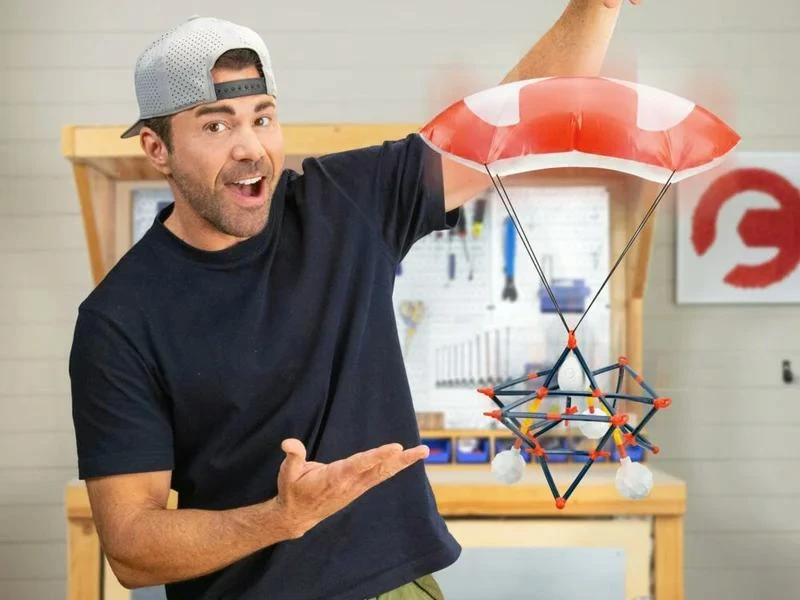
This ethos naturally evolved into the creation of CrunchLabs. Developed in collaboration with Moose Toys, the CrunchLabs lineup—featuring products like the Hover Ring Blaster, the Crunchinator, and the Elephant Toothpaste Blast kit—is designed to shift children from passive consumers of technology to active creators. Each toy arrives as a box of parts paired with an exclusive, highly produced video hosted by Rober, in which he breaks down the underlying physics and engineering principles required to make the device function.
The Accidental Interview Interruption
The interview took a uniquely charming turn when Rober’s philosophy of accessible, family-friendly engagement was tested in real time. Mid-conversation, the interviewer’s seven-year-old daughter—an aspiring CrunchLabs engineer—crashed the video call.
Instead of treating the interruption as a distraction, Rober seamlessly shifted gears, transforming into an enthusiastic collaborator. The impromptu exchange highlighted his genuine connection with his core demographic.
During their impromptu chat, Rober revealed the meticulous thought process behind the Elephant Toothpaste Blast kit, noting that his team had specifically reformulated the chemical reaction to be white rather than its traditional vibrant red.
"In fact, if you had a two-story house, it’d hit the ceiling in the second story," Rober joked, explaining that the redesign was explicitly intended to protect parents’ ceilings and carpets. "That’s me looking out for the moms out there."
Supporting Context & Metrics: The Economics of Engagement and STEM Education
The State of STEM Literacy
The launch of CrunchLabs arrives at a critical juncture in modern education. Global competitiveness increasingly relies on a workforce proficient in Science, Technology, Engineering, and Mathematics (STEM). However, traditional classroom environments often struggle to maintain student engagement, particularly as children transition into their tween and teen years.
According to various educational research initiatives, children typically exhibit a natural curiosity about the physical world during early childhood. This innate inquisitiveness often plateaus or declines around middle school, coinciding with increased exposure to passive digital consumption, social media algorithms, and standardized testing pressures that prioritize rote memorization over creative problem-solving.
The Rober Economic and Educational Model
Rober’s approach directly counters this educational drift by leveraging the dopamine loops typically exploited by social media platforms and redirecting them toward kinetic learning. By framing engineering challenges as games, he taps into intrinsic human motivation.
| Metric / Focus Area | Traditional Classroom STEM | The CrunchLabs / Rober Model |
|---|---|---|
| Primary Driver | Standardized testing, compliance | Creative autonomy, play-based discovery |
| Failure Policy | Penalized via grading systems | Embraced as an essential data-gathering step |
| Complexity Level | Often over-simplified ("dumbed down") | Multi-layered (Pixar-style appeal for all ages) |
| Digital Integration | Passive video consumption | Active physical construction paired with guided digital tutorials |
This model has resonated deeply with parents and educators alike, creating a thriving direct-to-consumer ecosystem that bypasses traditional educational supply chains to deliver experiential learning directly to household doorsteps.
Official Statements & Core Philosophy
Refusing to Dumb It Down
A central pillar of Rober’s educational philosophy is his vehement opposition to intellectual condescension. Many educational products aimed at children suffer from overly simplistic mechanics that eliminate the opportunity for genuine cognitive struggle. Rober rejects this entirely.
"We never talk down to kids," Rober told Scary Mommy. "We kind of try and make it so we can smooth that transition into sort of those teenage and then adult years even, like we try to make content that is like a Pixar movie; it just works for all ages."
By refusing to dilute the science, Rober validates children’s intelligence. He treats his young audience not as passive recipients of simplified facts, but as junior engineers capable of grasping genuine mechanical and chemical concepts.
Combating the Digital Drift
When pressed for advice on how parents can preserve their children’s natural curiosity as they age into adolescence, Rober offered pragmatic, actionable guidance that transcends generic inspirational rhetoric. He emphasizes the importance of front-loading positive tactile experiences during the formative years to build psychological resilience.
"To the degree that you can keep them off social media, I think that helps," Rober noted. "But I think a bigger thing is you just have to create enough positive experiences in the age where they are naturally curious."
The ultimate objective, according to Rober, is identity formation. He wants children to walk away from his videos and toy kits with a resilient internal narrative:
- "I like science."
- "I like building."
- "I like being curious."
- "And it’s okay to fail. That’s part of the process."
This normalization of failure is perhaps Rober’s most valuable pedagogical contribution. In an environment where perfection is frequently curated and broadcasted via social feeds, teaching children that a failed prototype is merely a stepping stone to a successful design is a radical and necessary intervention.
Future Outlook: Scaling Wonder and the Next Frontier of Play
As CrunchLabs expands its product offerings and Rober continues to push the boundaries of educational digital content, the broader landscape of children’s entertainment is forced to take notice. The success of his model proves that children do not require mindless digital stimulation to stay entertained; rather, they crave agency, challenge, and the satisfaction of building something tangible with their own hands.
Looking ahead, the intersection of physical toy manufacturing and digital mentorship represents a burgeoning sector within the ed-tech and toy industries. By maintaining the same sense of mischievous wonder that defined his own childhood—whether he is orchestrating elaborate squirrel obstacle courses or playing harmless pranks—Rober ensures that his brand remains anchored in authentic joy.
When asked what he would say to his younger self, Rober’s response reflected a deep, uncorrupted continuity between the boy who pulled pranks and the engineer designing rockets and toys:
"I remember my childhood very well," he reflected. "Which makes it really easy for me to tap into what [kids] would think is really cool. Because honestly, it’s sort of what I think is really cool, right?"
Ultimately, Mark Rober’s enduring appeal lies in his refusal to grow completely up. By championing the relentless pursuit of curiosity, he is not merely selling toys or building viral videos—he is actively architecting a future where the next generation looks at a complex problem, smiles, and asks, "I wonder what happens if we try this?"

