
Executive Overview
The landscape of digital education is undergoing a profound paradigm shift. For the past several years, the higher education sector has been swept up in a relentless cycle of technological disruption. New software platforms, virtual learning modalities, and generative artificial intelligence tools have emerged at an unprecedented velocity, leaving administrators, instructional designers, and educators in a perpetual sprint just to keep pace. However, as the digital learning community prepares for the upcoming OLC Accelerate conference in Orlando this November, a distinct and mature pivot is taking place.
The central question occupying the minds of academic leaders is no longer merely, "What is the newest tool on the market?" Instead, the conversation has evolved toward a much more deliberate and vital inquiry: "What is truly meaningful, and how do we anchor innovation in human-centered values?"
This article examines the maturation of online learning as educators move past the initial shockwave of rapid technological experimentation. Drawing on insights from the Online Learning Consortium (OLC) community, we explore how institutions are shifting from passive adoption to active stewardship. By analyzing upcoming keynote themes—such as Alex Goryachev’s "Educating for the Unknown"—and the broader philosophical realignment across higher education, this report highlights how colleges and universities are building institutional resilience. Rather than allowing technology to dictate the future of learning, educators are using innovation to strengthen human connections, foster deep community, and prepare students for an increasingly complex world.
Detailed Chronology: The Acceleration of EdTech and the Shift from Novelty to Maturity
The Spark of Rapid Disruption (2022–2023)
To understand the current state of digital education, one must look back at the inflection point of recent years. Just two short seasons ago, attending conferences like OLC meant encountering revolutionary artificial intelligence applications for the very first time. Educators walked away from presentations energized, immediately envisioning how these novel systems could automate grading, personalize student feedback, and support dynamic learning pathways.
At the time, these tools felt like a distant glimpse into the future of online pedagogy. Yet, the pace of technological development has rendered those early iterations nearly obsolete in record time. What once felt like a futuristic leap forward has rapidly compressed into a stepping stone on a much longer, continuously evolving trajectory. This rapid obsolescence delivered a stark reminder to educators and instructional designers: in the realm of digital learning, standing still is equivalent to falling behind.
The Awakening of 2024–2025: Transitioning to Strategic Integration
As institutions moved past the initial honeymoon phase of generative AI, the reality of implementation set in. The sheer volume of new platforms and shifting expectations created both excitement and fatigue across campus ecosystems. Educators realized that chasing every new software update or algorithmic feature was not a sustainable path for long-term academic success.
During this period, peer-reviewed submissions and conference proposals began to pivot. Presenters grew less interested in speculative predictions about future technologies and far more focused on institutional capacity-building. Discussions around AI literacy shifted away from mere fascination with text-generation capabilities toward rigorous frameworks for academic integrity, equitable access, and ethical deployment.
The Horizon: OLC Accelerate 2026 and the Theme of Illumination
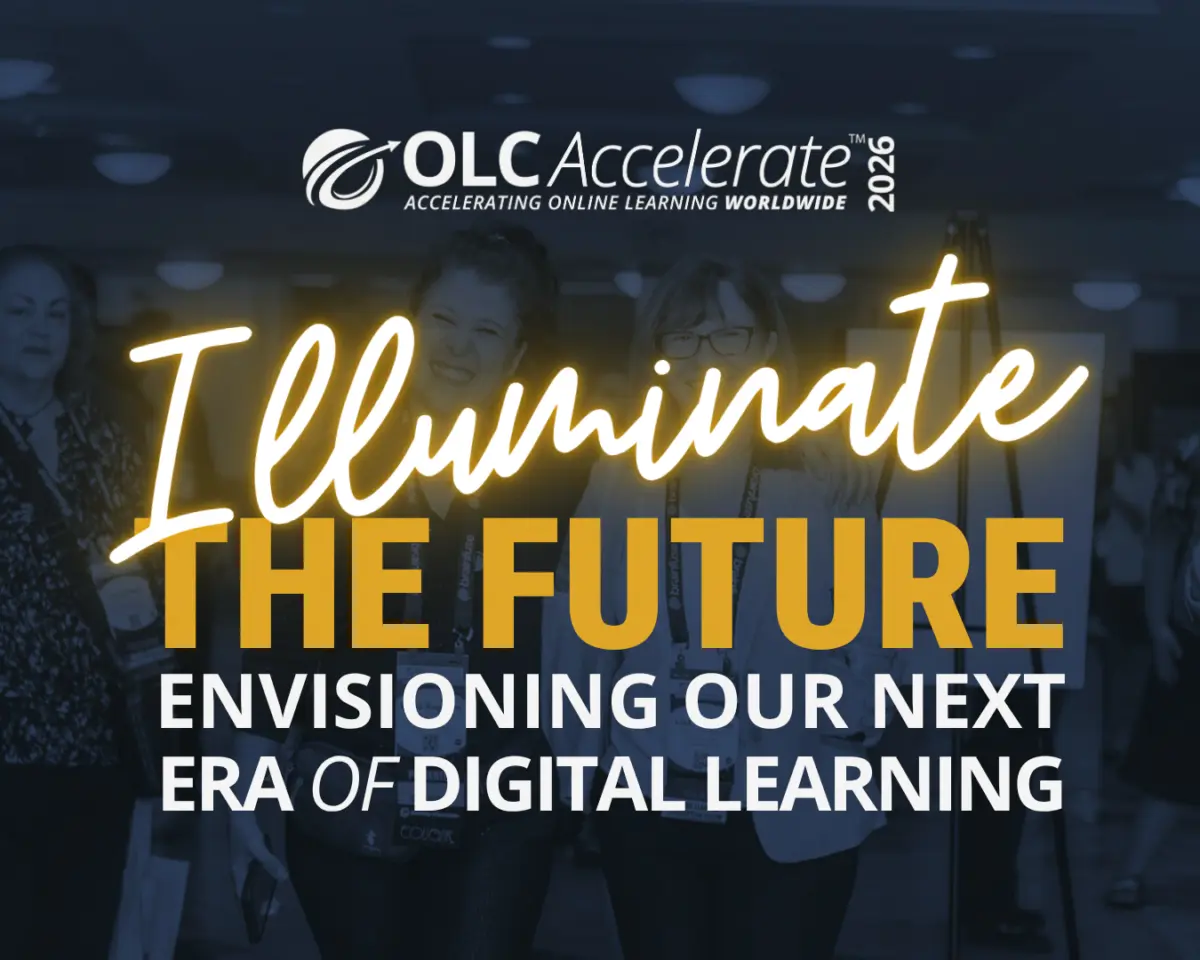
Now, as the higher education community looks ahead to the upcoming OLC Accelerate conference—themed Illuminate the Future: Envisioning Our Next Era of Digital Learning—the maturity of the field is fully on display. The conference serves as a mirror reflecting a community that has matured from wide-eyed adopters into strategic architects. The focus has decisively shifted from change as the headline to impact as the goal.
Supporting Context & Metrics: The Human Element in Digital Transformation
While technology dominates corporate headlines, empirical data and institutional case studies across higher education reveal a growing consensus: technological adoption without pedagogical grounding fails to improve student outcomes.
The Risk of Technological Isolation
Surveys of instructional designers and faculty developers consistently highlight "edtech fatigue" as a primary concern. When institutions introduce new digital tools without adequate professional development or clear alignment with learning objectives, student engagement often declines. Furthermore, rapid integration without guardrails risks exacerbating equity gaps, as under-resourced students may struggle with access, hardware limitations, or digital literacy hurdles.
Redefining Success Through Connection
The upcoming OLC Accelerate conference submissions underscore a deliberate counter-trend: an intense reinvestment in the human experience. Data from institutional retention studies show that students in online and hybrid programs achieve the highest success rates when courses intentionally cultivate a sense of belonging and community.
- Community-Centered Design: Rather than deploying automated tutoring bots that operate in silos, leading institutions are utilizing AI to free up faculty time, allowing educators to engage in deeper, one-on-one mentorship with students.
- Holistic Well-Being: Contemporary instructional design increasingly incorporates mental health touchpoints, flexible pacing, and trauma-informed pedagogical practices.
- Faculty Support Infrastructure: Recognizing that burnt-out educators cannot foster vibrant learning environments, institutions are dedicating significant resources to professional development programs that help faculty navigate constant technological shifts with confidence.
Official Statements and Perspectives from Leadership
The overarching philosophy guiding this new era of digital learning is perhaps best captured by the thought leaders and keynote speakers scheduled for this year’s premier events.
Alex Goryachev on "Educating for the Unknown"
At the heart of the OLC Accelerate keynote lineup is Alex Goryachev’s address, aptly titled Educating for the Unknown. Goryachev challenges educators to confront a sobering reality: how do we prepare today’s learners for career paths that do not yet exist, utilizing tools that were invented mere months ago, to solve systemic problems we cannot yet fully anticipate?
In reviewing institutional submissions for the conference, this challenge resonates across multiple tracks. Presenters are not attempting to gaze into a crystal ball; instead, they are focusing on foundational adaptability. The objective is to cultivate resilient learners who possess critical thinking, emotional intelligence, and metacognitive skills that transcend any single software application or platform.
Perspectives from the OLC Community
Long-time participants in the Online Learning Consortium frequently emphasize that the true value of these gatherings extends far beyond the scheduled breakout sessions.
"Every year, OLC Accelerate offers something more valuable than a collection of presentations," notes a leading voice within the instructional design community. "It gives us a chance to pause, step away from the urgency of our daily work, and ask bigger questions about where teaching, learning, and leadership are headed."
This sentiment underscores the collaborative nature of educational transformation. Innovation does not happen in isolation. Breakthrough pedagogical strategies are forged in the informal spaces—during hallway conversations after keynote addresses, across coffee breaks, and through shared problem-solving among colleagues facing identical structural challenges across different institutional contexts.
Future Outlook: Charting the Next Era of Digital Learning
As higher education prepares for the gathering in Orlando this November, the path forward is defined by several critical imperatives. The next era of digital learning will not be shaped by artificial intelligence or any other single technology in isolation; it will be forged by the intentional choices made by educators, administrators, and leaders.
1. Moving from Experimentation to Intentional Implementation
The phase of rapid, chaotic experimentation with new educational technologies is drawing to a close. Institutions are establishing rigorous evaluative frameworks to determine what works, for whom, and under what specific conditions. Educational technology is no longer adopted for its novelty; it must prove its capacity to enhance equity, engagement, and deep learning.
2. Deepening the Commitment to Human-Centered Design
As automation and machine learning become ubiquitous, the unique attributes of human educators—empathy, mentorship, critical guidance, and inspirational leadership—become vastly more valuable. The future of online learning relies on leveraging technology to amplify these human qualities rather than attempting to replace them.
3. Fostering Collective Wisdom and Open Sharing
The historic strength of communities like the OLC lies in their willingness to openly share successes, failures, and ongoing dilemmas. As the pace of technological evolution accelerates, no single institution possesses all the answers. Cultivating collective wisdom will remain essential for navigating the unknown regulatory, ethical, and pedagogical landscapes ahead.
Conclusion: Illuminating the Path Together
The future of education is not a distant horizon waiting to be reached; it is an active creation shaped by every syllabus written, every instructor supported, every policy refined, and every student empowered.
The tools will inevitably change. The software platforms of today will yield to the innovations of tomorrow. Yet, the foundational commitment to human learning, student success, and community resilience remains entirely constant. By shifting our collective gaze from "What’s new?" to "What’s meaningful?", higher education is poised not merely to adapt to the next era of digital learning, but to boldly lead it.

