
Executive Overview
In an era dominated by relentless digital stimulation, academic pressure, and rapid social transitions, children and teenagers are experiencing unprecedented cognitive and emotional demands. Modern education increasingly recognizes that academic achievement is inextricably linked to cognitive control—yet millions of students struggle daily with the foundational brain-based processes required to plan, focus, adapt, and self-regulate. Enter mindfulness: long celebrated as a simple tool for relaxation, contemporary neuroscience and behavioral research reveal it to be a powerful catalyst for developing executive functioning skills.
Executive functioning—often referred to as the command center of the brain—governs our ability to direct attention, exercise self-control, manage working memory, shift perspectives, and persevere through challenges. When these neural pathways are strong, children and young adults can navigate complex environments, handle setbacks, and achieve their goals seamlessly. When they are underdeveloped, students frequently experience academic burnout, emotional dysregulation, and behavioral friction.
This comprehensive report examines the symbiotic relationship between mindfulness practices and executive functioning. Drawing upon current educational insights, cognitive psychology, and practical classroom interventions, we explore how intentional moments of inward focus can fundamentally reshape a young person’s brain, transforming passive learners into resilient, self-directed thinkers.
Detailed Chronology: The Evolution of Mindfulness in Modern Education
To understand how mindfulness became a cornerstone of contemporary youth development, it is essential to trace its journey from ancient contemplative traditions to the modern classroom.
- The Pre-2000s Paradigm: For decades, formal education focused almost exclusively on academic instruction—reading, writing, and arithmetic—with the implicit assumption that cognitive skills like attention and impulse control would naturally develop over time. Students who struggled with focus or emotional outbursts were often viewed through a punitive or purely behavioral lens.
- The Early 2000s Neuroscientific Shift: Advancements in neuroimaging technologies allowed researchers to observe the brain in real-time. Scientists discovered neuroplasticity—the brain’s ability to reorganize itself by forming new neural connections. Studies began demonstrating that meditation and mindfulness practices could physically alter brain structures, particularly thickening the prefrontal cortex, the area responsible for higher-order cognitive functions.
- The 2010s Rise of Social-Emotional Learning (SEL): Educational systems worldwide began integrating Social-Emotional Learning frameworks. Schools realized that emotional regulation and self-awareness were not secondary traits, but rather the very foundation upon which academic learning is built. Mindfulness emerged as a low-cost, evidence-based intervention to support SEL initiatives.
- The 2020s and Beyond: Post-pandemic educational environments highlighted a massive surge in student anxiety, attention deficits, and emotional dysregulation. Educators and developmental psychologists increasingly turned to structured mindfulness programs—not merely as crisis-management tools, but as daily training regimens designed to actively build long-term executive functioning skills.
Supporting Context & Metrics: Unpacking the Six Pillars of Executive Function
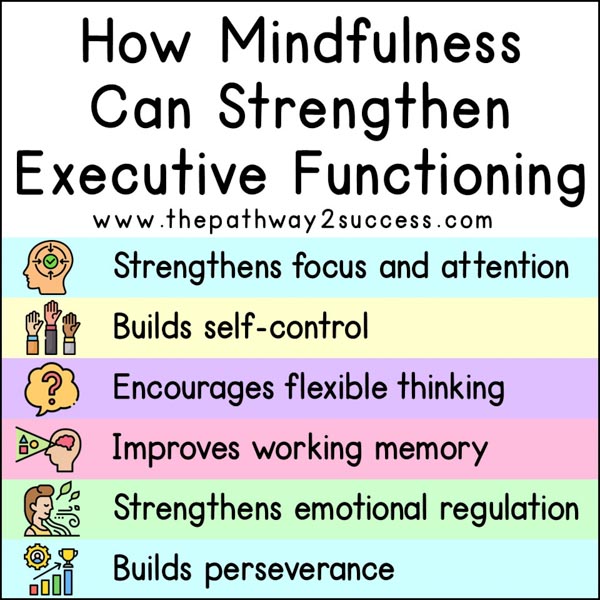
Executive functioning is not a single trait, but an interconnected suite of cognitive processes managed primarily by the prefrontal cortex. Mindfulness acts as a cross-training workout for each of these core pillars.
                  ┌───────────────────────────────┐
                  |      EXECUTIVE FUNCTIONING    |
                  |            PILLARS            |
                  └───────────────┬───────────────┘
         ┌────────────────────────┼────────────────────────┐
         ▼                        ▼                        ▼
┌──────────────────┐    ┌──────────────────┐    ┌──────────────────┐
|  Attention &     |    |   Self-Control   |    |    Emotional     |
|    Focus         |    |  & Inhibition    |    |   Regulation     |
└──────────────────┘    └──────────────────┘    └──────────────────┘
         ┌────────────────────────┼────────────────────────┐
         ▼                        ▼                        ▼
┌──────────────────┐    ┌──────────────────┐    ┌──────────────────┐
|  Working Memory  |    | Flexible Thinking|    |   Perseverance   |
|                  |    |                  |    |  & Grit          |
└──────────────────┘    └──────────────────┘    └──────────────────┘
1. Focus and Attention
- The Definition: Attention is the cognitive capacity to direct and sustain mental effort toward a specific person, task, or concept over a given duration.
- The Mindfulness Connection: Mindfulness exercises directly train the brain’s attentional "muscle." When a child focuses solely on their breath, they are anchoring their mind to the present moment.Inevitably, the mind wanders. The core mechanism of mindfulness occurs when the student notices this distraction and deliberately redirects their focus back to the breath. This repetitive cycle of noticing and returning fortifies the neural circuits responsible for sustained attention.
2. Self-Control and Inhibition
- The Definition: Self-control is the behavioral brake system of the mind—the ability to stop, pause, and evaluate a situation before acting on immediate impulses.
- The Mindfulness Connection: Mindfulness introduces a vital pause between an external trigger and an internal reaction. For instance, rather than impulsively reacting to a peer or a frustrating setback, a student trained in mindfulness learns to tap into a moment of internal stillness, effectively neutralizing reactionary behaviors in favor of deliberate, measured choices.
3. Emotional Regulation
- The Definition: Emotional regulation is the foundational skill of identifying, processing, and managing daily emotional states without letting them dictate one’s actions.
- The Mindfulness Connection: By practicing non-judgmental awareness, students learn to observe their feelings—such as frustration, anger, or disappointment—as transient weather patterns rather than overwhelming floods. Deep breathing and body-centering techniques deactivate the brain’s stress response (the amygdala), allowing the rational prefrontal cortex to re-engage.
4. Working Memory
- The Definition: Working memory functions as the brain’s mental RAM, allowing individuals to hold, manipulate, and utilize complex information over short periods (e.g., following multi-step multi-disciplinary instructions or solving multi-part math equations).
- The Mindfulness Connection: Chronic stress and mental clutter severely tax working memory. Mindfulness clears out extraneous mental chatter, providing a cognitive "clean slate." This reduction in cognitive load frees up vital mental bandwidth, enabling students to retain and process important academic instructions more efficiently.
5. Flexible Thinking
- The Definition: Cognitive flexibility is the capacity to adapt to unexpected changes, consider alternative perspectives, and view challenging situations from multiple angles.
- The Mindfulness Connection: Mindfulness encourages radical acceptance of present realities, even when those realities are uncomfortable. When students practice accepting thoughts and experiences without harsh judgment, they build the mental agility required to receive constructive criticism, pivot during unexpected changes, and adapt their mindsets toward growth.
6. Perseverance and Grit
- The Definition: Perseverance is the tenacity to stick with a difficult task, pushing through friction and discomfort to achieve a long-term goal.
- The Mindfulness Connection: Sitting quietly and focusing on the breath can feel genuinely difficult—especially for developing minds. By encouraging children to stick with a mindfulness exercise even when their minds resist, educators are cultivating micro-moments of perseverance. Over time, this endurance translates directly into academic and personal tenacity.
Official Strategies and Implementation Frameworks
Implementing mindfulness with youth requires moving beyond abstract concepts into tangible, engaging, and repeatable practices. Educators, parents, and youth leaders can leverage a variety of evidence-based strategies to seamlessly weave mindfulness into daily routines.
1. Foundational Mindful Breathing
Breathing is the ultimate portable anchor. Simple exercises like "Shape Breathing" or "Cooling Off the Pizza" teach children how to regulate their physiological state in seconds.
- Implementation: Instruct learners to assume a comfortable seated position, inhale slowly through the nose, and exhale gently through the mouth. When minds wander, gently guide them back to the physical sensation of air moving through their bodies.
2. Structured Mindfulness Lessons and SEL Curriculum
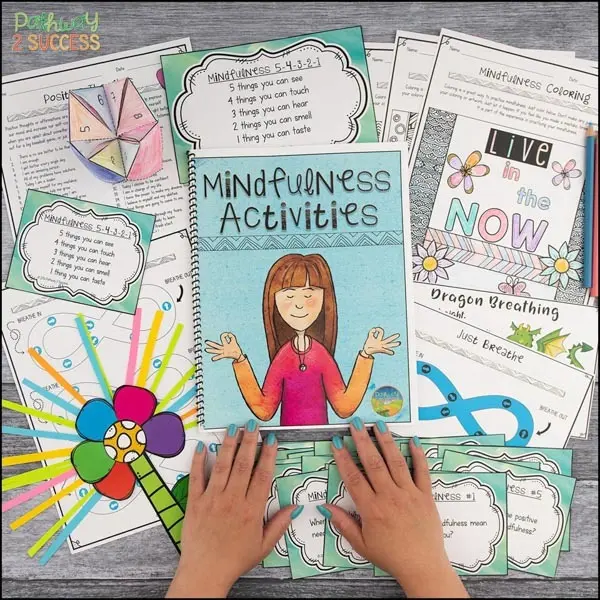
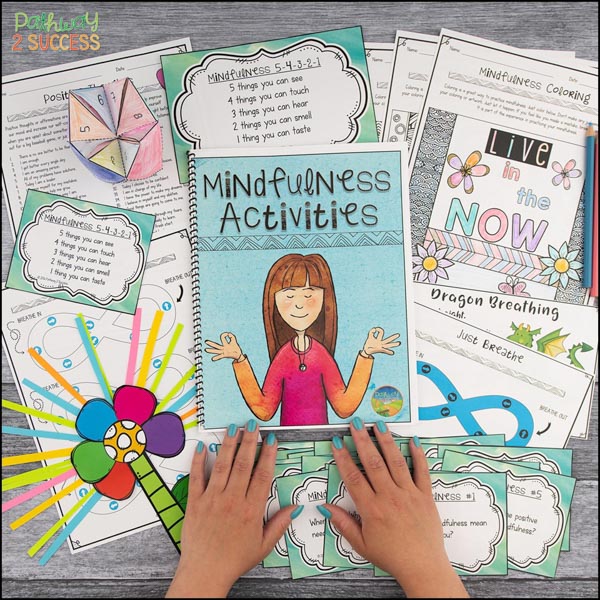
To maximize impact, mindfulness should be taught explicitly. Comprehensive SEL programs that include guided lessons, hands-on activities, discussion cards, and visual posters provide a structured pathway for long-term emotional development.
3. Therapeutic Literature
Storybooks serve as an exceptionally powerful bridge for exploring complex emotional concepts. Even older children and teens benefit greatly from narrative-driven discussions that normalize internal struggles and introduce mindful coping mechanisms.
4. Mindful Coloring and Creative Arts
For students who find seated meditation challenging, mindful coloring provides a kinetic bridge to inner calm. The objective is not artistic perfection, but absolute immersion in the tactile experience of coloring within the lines, observing colors, and syncing breath with movement.

5. Yoga, Stretching, and Movement
Integrating gentle somatic movements with mindful breathing allows youth to release physical tension stored in the body, reinforcing the mind-body connection during active periods of the school day.
6. Mindful Journaling
Morning journal entries offer a reflective sanctuary. By responding to targeted prompts, participating in guided reflections, or engaging in free-writing, students can externalize their thoughts, clear mental clutter, and set a grounded intention for the day.

7. Outdoor Mindfulness Excursions
Nature provides an endless array of sensory anchors. Outdoor walks, cloud-watching, gardening, and wildlife observation encourage children to engage all five senses, anchoring their attention firmly in the external environment.
8. Affirmation Practices and Mindful Observance
Starting the day with positive, grounding affirmations helps students reframe negative self-talk. Similarly, mindful observance—focusing entirely on the texture, weight, and color of a single everyday object like a pen or water bottle—trains the brain to master deep concentration amidst distractions.

Future Outlook: The Next Frontier in Youth Cognitive Development
As educational research continues to validate the profound neurological benefits of contemplative practices, the integration of mindfulness and executive functioning training is poised to shift from an optional "add-on" to a fundamental pillar of modern pedagogy.
Looking forward, several key trends are emerging:

- Data-Informed Wellness: Schools are increasingly tracking the holistic impacts of daily SEL interventions, noting measurable reductions in behavioral referrals alongside significant gains in standardized academic metrics.
- Lifelong Resilience Training: Equipping children with executive functioning tools early in life creates a preventative psychological buffer, preparing them to face the compounding complexities of higher education and modern career landscapes.
- Universal Accessibility: As digital and analog resources become more widely available, evidence-based mindfulness strategies are democratizing access to mental wellness tools, ensuring that students from all socioeconomic backgrounds can strengthen their cognitive core.
Ultimately, mindfulness is much more than a momentary break from chaos; it is an active, evidence-based framework for rewiring the developing brain. By systematically strengthening attention, self-control, emotional regulation, working memory, flexible thinking, and perseverance, we empower the next generation not just to cope with the world around them, but to lead it with clarity, resilience, and profound intentionality.

