
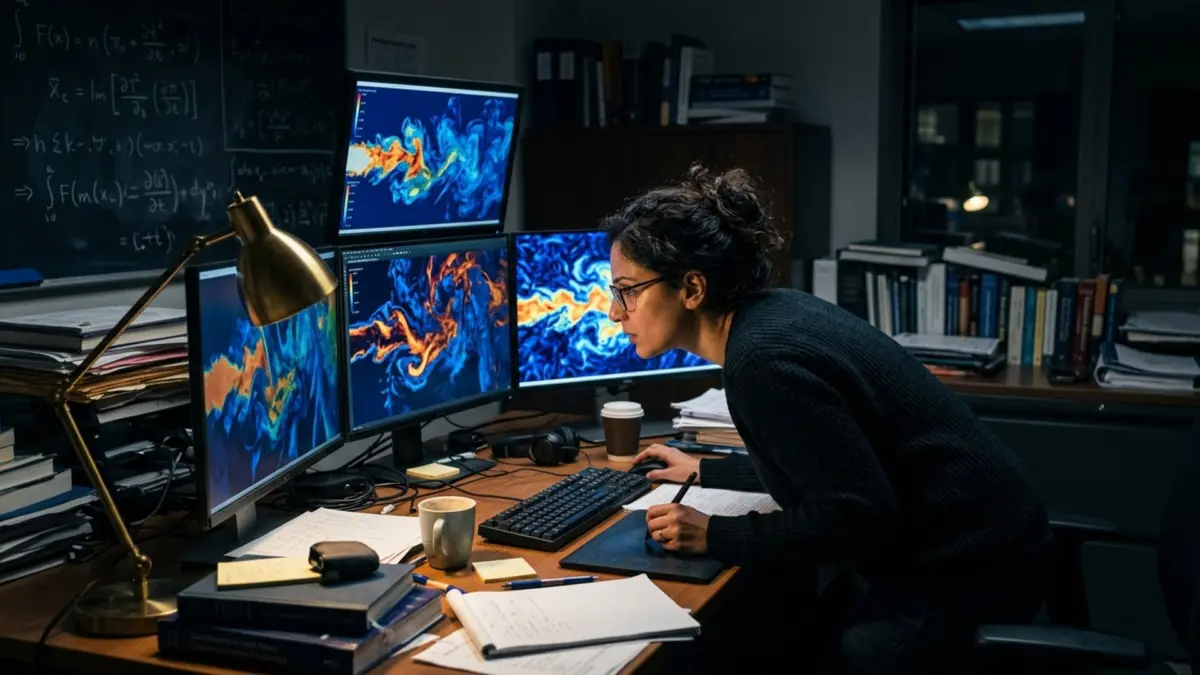
SAN FRANCISCO — In a development that marks a watershed moment for both artificial intelligence and theoretical mathematics, OpenAI announced on September 8, 2026, that an advanced internal AI agent system successfully generated a rigorous proof for one of the most stubborn challenges in modern science. According to the company, the system resolved the Navier–Stokes existence and smoothness problem—one of the seven legendary Millennium Prize Problems designated by the Clay Mathematics Institute (CMI) in 2000.
Accompanied by a complete formalization verified in the Lean proof assistant, the breakthrough demonstrates that the equations governing fluid motion can, under specific conditions, develop a mathematical singularity (a "blowup" to infinity) in finite time. Despite the monumental nature of the mathematical achievement, OpenAI stated it does not intend to claim the $1 million Millennium Prize associated with the problem, framing the release instead as a transparent benchmark of its frontier models’ reasoning capabilities.
The announcement arrives amid a complex backdrop of concurrent academic breakthroughs, parallel efforts by researchers utilizing rival LLMs, and intense scrutiny regarding the provenance of high-level mathematical discoveries mediated by artificial intelligence.
Executive Overview
The Navier–Stokes equations, formulated in the 19th century by Claude-Louis Navier and George Gabriel Stokes, serve as the mathematical foundation for fluid dynamics. They dictate how liquids and gases move, underpinning everything from meteorological forecasting and aerospace engineering to the simulation of arterial blood flow. For generations, mathematicians have grappled with a fundamental question: Can an initially smooth fluid, driven by smooth external forces and possessing finite energy, develop infinite velocity or acceleration within a finite window of time?
OpenAI’s internal model-driven agent architecture answered this in the affirmative. By leveraging an army of roughly 10,000 concurrent AI agents communicating in isolated loops, the system discovered a mechanism wherein a specialized vortex—a swirling, inwardly spiraling formation—shrinks at its core while accelerating so rapidly that its local velocity approaches infinity, all while maintaining finite total energy.
Crucially, the breakdown is engineered by the fluid’s own internal dynamics rather than an artificially imposed infinite force. Acceleration, pressure gradients, momentum transfer, and viscosity terms grow extraordinarily large yet cancel each other out with mathematical precision, leaving behind a smooth external force even as the fluid speeds spiral out of control.
Detailed Chronology of the Breakthrough
The path to resolving Navier–Stokes was not a solitary flash of algorithmic inspiration, but rather a compressed, high-intensity computational campaign executed over the span of roughly a week in late August and early September 2026.
The Spark: August 28 – September 1, 2026
OpenAI began training a new, unreleased internal model on August 28, 2026. Described by insiders as representing a generational leap beyond existing commercial systems like GPT-6 Astra, the model exhibited unprecedented performance across mathematical reasoning benchmarks.
On September 1, amid swirling academic rumors that breakthroughs regarding multiple Millennium Prize problems were imminent, OpenAI management directed its engineering teams to unleash the new model on all open Millennium Prize questions, alongside a slate of other high-impact mathematical challenges.
The Euler Prelude: September 2 – 3, 2026
Before tackling Navier–Stokes directly, the agent system utilized a preparatory sandbox. Nearly 100 agents were tasked with resolving the regularity problem for the Euler equations—the theoretical limit of Navier–Stokes with the viscosity term entirely removed—in an unforced variant where no external forces are applied.
In a result that caught OpenAI researchers off guard, the agent group successfully constructed a disproof of Euler smoothness within approximately 50 hours.
Scaling to Navier–Stokes: September 4 – 5, 2026
Buoyed by the Euler success, the architecture was pivoted toward the full Navier–Stokes equations. Researchers fed the Euler resolution into the system as a structural primer, hot-swapped the agents to an even further-trained iteration of the core model mid-campaign, and deployed Codex to synthesize and consolidate the most promising conceptual threads across disparate agent clusters.
Operating across 10,000 concurrent nodes under strict isolation and monitoring safeguards, the system homed in on the solution. On September 5, 2026—just 88 hours after the Navier–Stokes campaign was initiated—the agents successfully arrived at the proof.
Verification and Formalization: September 6, 2026
A mathematical proof generated by an AI is only as good as its verification. Over the subsequent 17 hours, a separate verification pipeline leveraging GPT-6 Astra formalized the proof within Lean, a proof assistant software that checks mathematical statements with absolute logical rigor. By September 6, the formalization was complete, error-free, and locked in.
Supporting Context & Metrics
The scale of the computational effort required to crack a Millennium Prize problem underscores the sheer resource intensity of modern frontier AI research.
- Total Token Expenditure: Across all attempted mathematical problems during the evaluation window, the agent network exchanged 4.9 million internal messages, consuming roughly 300 billion output tokens.
- The Navier–Stokes Footprint: The specific problem of fluid singularities accounted for the lion’s share of these resources—2.7 million messages and approximately 130 billion output tokens.
- Agent Concurrency: The peak workload involved approximately 10,000 autonomous agents operating simultaneously, divided into communicating sub-groups to explore different regions of the logical search space.
Understanding the Fluid Singularity
To appreciate the significance of the AI’s proof, one must understand what a "singularity" represents in physical mathematics. In the real world, physical infinities do not exist; viscosity inherently dampens and smooths out extreme velocity gradients. However, mathematics operates in the realm of ideal abstractions.
If the Navier–Stokes equations permit smooth initial conditions to evolve into infinite speeds within a finite time, it implies that the standard continuum model of fluid mechanics suffers from a fundamental mathematical breakdown. Proving that this breakdown can occur without introducing unrealistic external forces bridges a profound gap in partial differential equations theory that has resisted human efforts since Jean Leray’s foundational work in 1934.
Official Statements and Academic Controversy
While OpenAI’s technical achievement is undeniable, the announcement has been accompanied by friction regarding priority, independent research, and the cross-pollination of ideas between human mathematicians and AI labs.
The Overlap with Alpöge and Buckmaster
On September 7, 2026, Tristan Buckmaster, a mathematics professor at New York University, alongside Levent Alpöge, an Anthropic employee, publicly released three landmark papers and associated Lean formalizations. Their work demonstrated finite-time blowup with smooth forcing for three-dimensional incompressible Euler equations, Boussinesq systems, and incompressible porous media.
In an accompanying academic statement, Buckmaster detailed a nearly year-long personal collaboration utilizing Anthropic’s Claude and OpenAI’s Codex, highlighting a critical breakthrough on August 15 and a Lean verification on August 22. He noted that he had emailed an OpenAI mathematician on September 3 and engaged in calls on September 6, during which OpenAI reportedly floated joint-release proposals that he ultimately declined. Buckmaster emphasized that his statement was a chronology of events rather than an accusation of wrongdoing.
OpenAI’s Response on Data Independence
In its public disclosures, OpenAI addressed the timing head-on. The company stated that its internal project began on September 1 following rumors it subsequently linked to Alpöge and Buckmaster. OpenAI maintained that its researchers and agents had zero visibility into the duo’s unpublished work prior to its public release, and that no private user data was accessed during the problem-solving run.
However, OpenAI acknowledged a nuanced caveat: it cannot entirely rule out the possibility that de-identified telemetry data derived from the researchers’ prior usage of OpenAI products may have marginally influenced model training. Nonetheless, the company emphasized that the mathematical structures of the proofs differ significantly—notably in the distinction between forced and unforced Euler variations.
Future Outlook
The resolution of the Navier–Stokes problem by an AI agent architecture signals a paradigm shift in how mathematical research may be conducted in the 21st century. We are moving rapidly past the era where Large Language Models act merely as sophisticated autocomplete tools for human programmers; they are now capable of executing multi-day, self-directed research campaigns, discovering novel proofs, and formalizing them into ironclad machine-checked logic.
For OpenAI, the immediate priority is not chasing further mathematical accolades, but turning inward. Company leadership announced it is dedicating engineering resources to deeply audit the internal model’s reasoning traces. By understanding how the agent network navigated the labyrinth of partial differential equations to discover the vortex singularity, OpenAI hopes to establish better safety guardrails, improve reasoning architectures, and carefully pace the deployment of future frontier systems whose capabilities continue to outpace expectations.

