
Executive Overview
For millions of students and educators worldwide, Kahoot! is synonymous with high-energy classroom engagement. It is the Friday afternoon ritual, the ten-minute pre-lunch energizer, and the reliable hook that brings an entire room of distracted minds back to attention. Yet, for all its widespread adoption in modern pedagogy, the platform has historically been pigeonholed as a post-lesson reward or a superficial review tool—a fun, gamified way to check the temperature of a classroom without generating actionable, long-term instructional data.
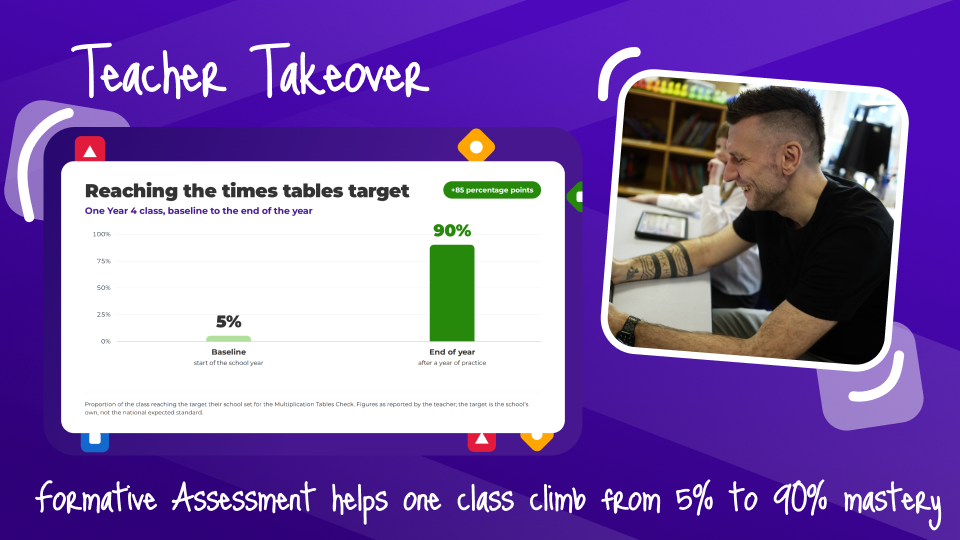
Enter Simon Hunt, a Year 4 teacher in Manchester, United Kingdom, and a long-standing Kahoot! Ambassador. Hunt’s pedagogical journey represents a paradigm shift in how digital game-based learning tools can be deployed. By reimagining Kahoot! not as an end-of-unit reward, but as a sophisticated pre-assessment, formative tracking mechanism, and progressive scaffolding tool, Hunt achieved staggering results. Over the course of a single academic year, the proportion of his nine-year-old students meeting the school’s rigorous target for the UK Department for Education’s (DfE) Multiplication Tables Check (MTC) skyrocketed from an anemic 5% to an astonishing 90%.
This investigative feature explores the mechanics of Hunt’s transformative classroom strategy. By moving away from conventional testing paradigms and leaning into the granular data generated by simple digital duplication, Hunt turned a popular quiz platform into an engine for mastery learning. His methodology offers a blueprint for educators seeking to bridge the gap between student engagement and measurable academic achievement.
Detailed Chronology: Rethinking the Lifecycle of a Lesson
To understand Simon Hunt’s success, one must first examine the conventional pedagogical lifecycle. Traditionally, teachers introduce a concept, spend weeks delivering lectures and worksheets, and finally administer a quiz at the end of the unit to evaluate learning outcomes. By that point, however, the instructional window has closed. If students harbor deep-seated misconceptions, discovery happens too late for remediation.
Hunt’s innovation began when he inverted this timeline. Instead of building a quiz to summarize a completed unit, he began constructing his Kahoots before teaching the material.
1. Pre-Assessment Without the Stakes
Ahead of a curriculum unit—such as a history module on the Romans or a numeracy block on times tables—Hunt builds a ten-question Kahoot! based entirely on the concepts he expects students to master by the end of a six-week block. Crucially, he deploys this quiz before a single lesson is taught.
Predictably, the results mirror what most teachers would expect: the vast majority of the class gets most of the answers wrong. But Hunt views this through a completely different lens. For him, the initial game is not an evaluation of failure; it is a baseline diagnostic tool.
Furthermore, Hunt removes the traditional competitive pressure from this initial diagnostic. By disabling points for speed during the pre-unit game, an answer holds the exact same weight whether a student submits it in two seconds or twenty.
"That pre-assessment information can actually change my lesson planning," Hunt explains. "There is little point spending several lessons teaching something the children already know. Equally, if the data highlights a misconception, I can make sure we tackle it."
2. Iterative Scaffolding: Building to Six Seconds
The true test of Hunt’s methodology came in preparing his Year 4 students for the UK’s statutory Multiplication Tables Check (MTC). Administered every June, the MTC requires nine-year-olds to answer twenty-five randomized multiplication questions drawn from the 2x to 12x tables, with a strict time limit of six seconds per question, typed directly onto a screen.
Historically, dropping young learners straight into a high-stakes, six-second digital test environment triggers widespread anxiety and panic. This systemic pressure was directly reflected in Hunt’s initial baseline assessments, where only 5% of incoming students met the school’s performance benchmark.
Rather than forcing students to endure high-pressure drills from day one, Hunt engineered a gradual, micro-scaffolding pipeline using Kahoot!:
- Pacing the Clock: Students began with multiple-choice multiplication questions paired with generous timers. Week by week, Hunt incrementally shaved seconds off the clock. Because the reductions were microscopic and visible to the class, students adapted to the psychological pressure of the ticking clock organically.
- Shifting the Mechanics: Once standard pacing was achieved, Hunt altered the question format rather than the timer. He transitioned students away from multiple-choice line-ups (where picking ’56’ out of four options relies on recognition) to the Type Answer format, mirroring the actual mechanics of the DfE exam.
- The Power of Duplication: Remarkably, this approach did not require complex software engineering or hours of curriculum redesign. Hunt simply duplicated his existing Kahoots, adjusted a single setting—either the timer or the input format—and replayed the games the following week.
By the time June arrived, the format held no surprises, the pace felt natural, and multiplication recall had become a game enjoyed rather than a test endured.
3. The Power of Repetition and Longitudinal Tracking
At the culmination of a learning unit, Hunt does something deceptively simple: he plays the exact same introductory game a second time. The questions are identical; nothing has changed.

In standard educational assessment, testing students on new or modified questions yields speculative data. By testing students on the exact same ten baseline questions, Hunt generates an empirical measurement of growth. Because students sign into the platform using consistent identifiers, the Kahoot! reporting suite lines up student metrics individually rather than flattening them into an anonymous class average.
This longitudinal tracking creates a data bridge that outlasts Hunt’s direct instruction. The granular performance reports are preserved and handed off to the students’ next teachers, ensuring the subsequent academic year begins with concrete diagnostic insights rather than speculative hunches.
Supporting Context & Metrics: The Data Behind the Transformation
The quantitative leap from 5% to 90% target achievement is not an isolated statistical anomaly; it is the direct result of leveraging formative data analytics. Modern educational technology platforms generate vast quantities of backend data, but educators frequently lack the bandwidth to parse it.
Leveraging the Automated Data Pipeline
Hunt credits the automated reporting features of Kahoot! with streamlining his workload. Within minutes of finishing a session, the platform generates a comprehensive breakdown highlighting:
- Class-Wide Gaps: Questions that caused widespread failure, signaling systemic instructional misunderstandings.
- Individual Trajectories: Specific students struggling with targeted mathematical subsets (e.g., struggling exclusively with the 7x and 8x tables while mastering the rest).
Armed with this diagnostic output, Hunt modifies his lesson plans in real-time. If the pre-assessment reveals that the class has already mastered a foundational concept, he bypasses redundant lessons entirely. Conversely, if a fundamental misconception surfaces in week one, he addresses it immediately—averting the academic crises that typically materialize in week six when remediation is no longer feasible.
Official Statements and Educator Insights
The philosophy underpinning Simon Hunt’s classroom success challenges conventional wisdom regarding educational technology. Rather than viewing gamification merely as an engagement tool, pioneering educators are increasingly treating digital platforms as rigorous diagnostic environments.
Reflecting on his evolution as a practitioner, Simon Hunt offers candid advice for fellow educators:

"A few years ago, I probably wouldn’t have thought of Kahoot! as an assessment tool. It was engaging, the children loved it, and it brought that little bit of competition into the classroom. Now, however, assessment is one of the main reasons we use it."
Emphasizing the importance of intentional pedagogical design, Hunt outlines three core principles for integrating gamified pre-assessments:
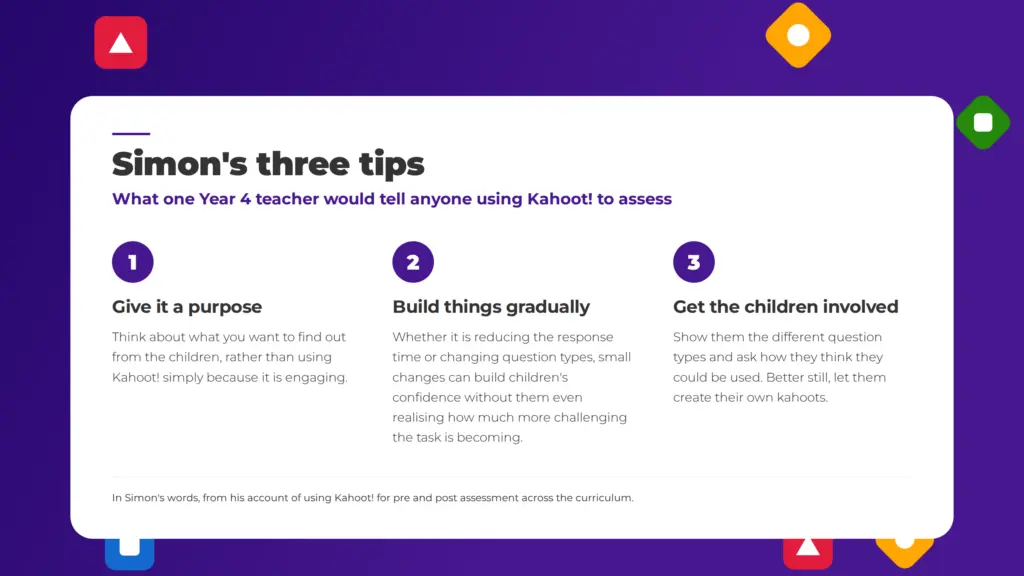
- Define Intent First: Decide precisely what information needs to be extracted before building or selecting a game, rather than playing simply because a game is engaging.
- Isolate Variables: Change only one parameter at a time—either the timer or the question type—allowing student confidence to scale alongside instructional difficulty.
- Involve the Learners: Hand creative control over to the students. By allowing learners to build their own Kahoots, educators foster metacognitive awareness, teaching children how to construct effective assessment questions themselves.
"We can see the progress, identify anything that still needs revisiting, and keep that information for the next teacher too. That, for me, is where Kahoot! becomes much more than a quiz," Hunt concludes. "For me, the data behind Kahoot! is just as useful as the game itself."
Future Outlook: The Evolution of Formative EdTech
Simon Hunt’s methodology points toward a broader transformation in primary and secondary education. As schools face mounting pressure to bridge learning gaps and prepare students for standardized, high-stakes digital testing environments, the demand for low-friction, high-yield diagnostic tools will only accelerate.
The traditional dichotomy between "learning" and "testing" is rapidly dissolving. Platforms like Kahoot!, traditionally relegated to the periphery of formal instruction as recreational novelties, are proving capable of serving as the backbone of data-driven instructional design. By treating gamified quizzes as dynamic feedback loops rather than static scorecards, educators can transform moments of play into milestones of mastery.
As more educators follow Hunt’s lead—inverting lesson timelines, isolating variables, and extracting actionable metrics from backend student data—the future of the classroom looks increasingly empirical, adaptive, and, above all, deeply engaging.

