By Lia Milgram, Managing Editor for ACTE Published in partnership with the Association for Career and Technical Education (ACTE)
Executive Overview
As the Association for Career and Technical Education (ACTE) proudly marks a monumental century of service, advocacy, and educational leadership, the foundational questions facing our field feel more urgent than ever. From September 2025 through May 2026, Techniques magazine embarked on an extensive, immersive editorial journey. Our team followed educators, program directors, policymakers, and community advocates as they grappled with the most enduring and complex challenges in Career and Technical Education (CTE): What does it genuinely take to build educational pathways that reach every single learner? How do physical learning spaces, emotional support systems, and immersive professional experiences actively shape what students believe is possible for their futures?
The best stories in CTE have never been solely about programs, state-of-the-art machinery, or standardized curricula. They are fundamentally about people—the educators who refuse to give up, the students who discover their potential against the odds, and the visionaries who build systems designed to last. Over the course of the 2025–2026 academic year, Techniques published a landmark series of articles cataloging these human victories and systemic struggles.
This retrospective report synthesizes eight defining features from that publishing year. It explores how modern CTE is breaking down the stigma of justice-impacted learning, redefining teacher retention, reimagining physical and virtual classrooms, and leveraging the power of documentary storytelling to secure the next hundred years of workforce development.
Detailed Chronology: A Year of Defining CTE Stories
The 2025–2026 publishing cycle captured a dynamic blueprint of modern educational reform. Below is the chronological record of the pivotal narratives that defined the year in review.
September 2025: Skills Over Stigma for Justice-Impacted Learners
High-quality CTE is, at its core, a promise of economic mobility and personal reinvention. For justice-impacted learners—individuals navigating the reentry process after incarceration—the stakes of that promise are exceptionally high, and the structural barriers are intensely real.
The September 2025 volume featured a powerful contribution written from direct, lived experience. The author, a former justice-impacted individual who successfully transitioned into education and reentry advocacy, offered a raw and compelling case for reform. The piece dismantled the punitive mindsets that often plague workforce programs, arguing instead for pathways that evaluate individuals based on their acquired competencies rather than their past mistakes. By prioritizing "skills over stigma," the article set an uncompromising tone for the academic year: true career and technical education must be radically inclusive.
October 2025: Leading the Change in Postsecondary CTE
The public narrative surrounding vocational and technical education is undergoing a massive cultural transformation, and the alumni of the NextLevel Postsecondary CTE Fellowship are at the vanguard of this shift. Representing institutions of diverse sizes across the United States, these educational leaders are actively dismantling outdated perceptions of blue-collar and technical careers.
In the October feature, these fellows shared a surprising and humble realization: their students had proven to be their greatest teachers. By listening closely to the evolving demands of the modern workforce and the lived realities of their classrooms, these leaders are proving that the future of postsecondary education relies on adaptability, cultural responsiveness, and an unwavering commitment to dynamic career pathways.
Work-based learning (WBL) programs are only as effective as the space they provide for authentic self-discovery. Traditional models often push students down rigid, linear tracks too early, stifling curiosity.
The joint November–December issue explored how meaningful career exploration depends heavily on giving students the freedom to question, refine, and redirect their career trajectories. Because individual students arrive with unique backgrounds, learning styles, and aspirations, WBL design cannot follow a one-size-fits-all model. This feature detailed practical frameworks for designing experiential learning that meets students precisely where they are and propels them toward what they previously believed was impossible.
January 2026: High-Quality CTE by Design Through Wraparound Supports
For decades, wraparound supports—such as mental health counseling, food pantries, emergency housing assistance, and child care—have been treated as supplemental or optional add-ons in educational settings. The January 2026 issue flipped this narrative on its head, arguing that comprehensive support services are central to student engagement and program completion.
When wraparound supports are embedded directly into the foundational design of a CTE program rather than retrofitted as an afterthought, a profound transformation occurs. Retention rates soar, student wellness improves, and the local communities relying on a steady pipeline of skilled talent reap the long-term economic benefits.
February 2026: Designing Robust, Meaningful Student Experiences
The strongest CTE programs begin with a clear curricular vision, but the physical spaces housing them must authentically reflect that vision. Unfortunately, budget constraints often lead educators to believe that specialized facilities require massive capital campaigns and brand-new construction.
The February edition offered a pragmatic, actionable roadmap for facilities design that maximizes existing footprints. By taking a fresh look at available spaces, schools can create environments where students immediately see themselves reflected in future careers. The right physical layout, lighting, equipment placement, and collaborative zones can spark professional identity formation the exact moment a student walks through the door.
March 2026: A Century of Storytelling and Advocacy at ACTE
Data is vital for proving return on investment and securing legislative funding, but stories are what make people remember why education matters. As ACTE celebrated its centennial anniversary in March 2026, Techniques published a deep dive into how the Association leverages the emotional resonance of documentary filmmaking as a powerful advocacy tool.
By capturing the human element of technical education, this initiative made the impact of CTE visible, relatable, and deeply personal. It successfully connected a century of visionary educational leadership to the modern students, instructors, and communities currently writing the next chapter of the movement.
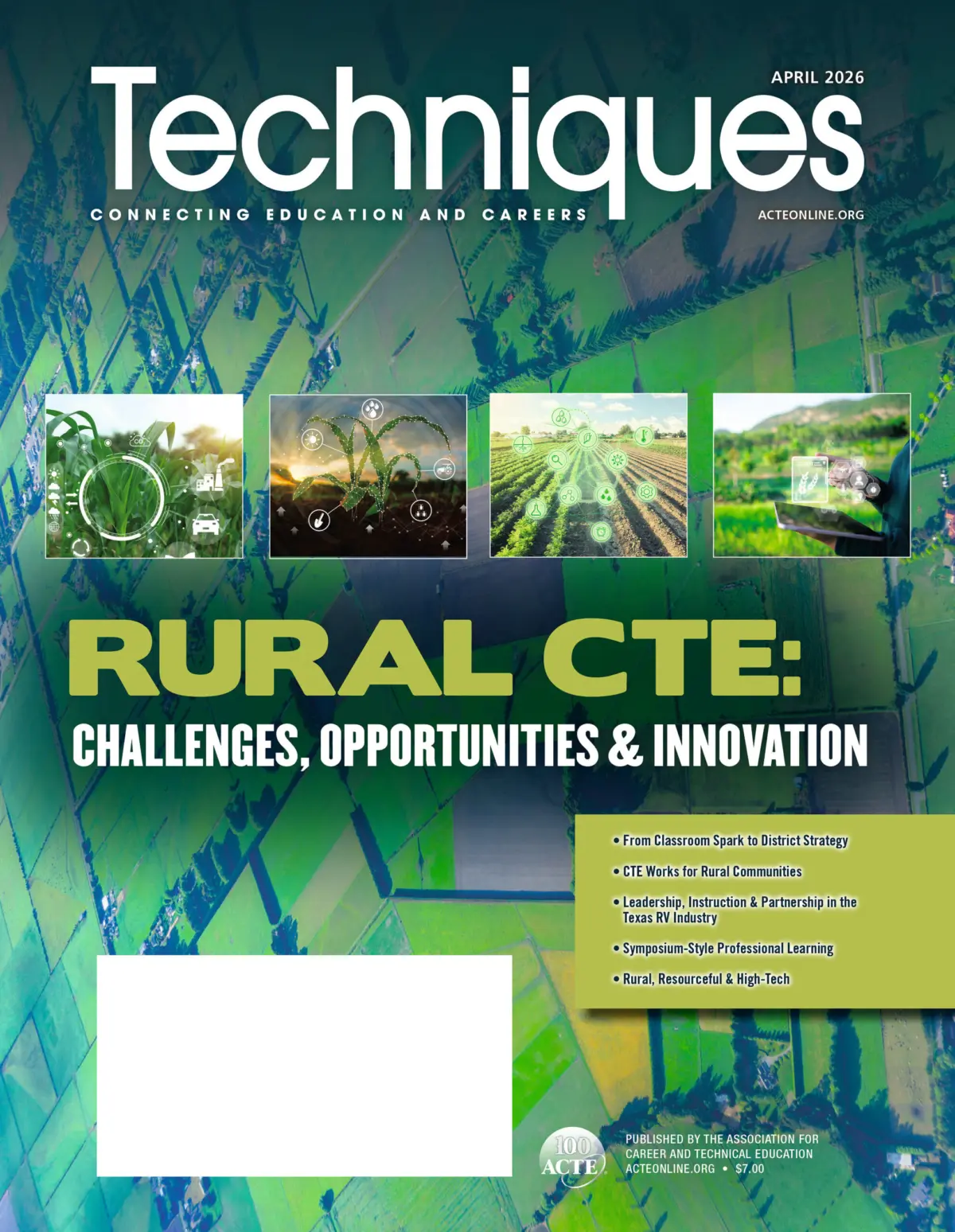
April 2026: Measuring Return on Investment in Rural CTE
Rural CTE programs face unprecedented headwinds. Shrinking tax bases, dwindling local workforces, and tightly restricted service areas often leave rural school districts fighting for survival, with community leaders constantly bracing for program closures.
The April feature provided rural administrators with a critical framework for translating localized program impact into hard data that state legislators and stakeholders understand. By linking student credential attainment directly to regional economic development and multi-generational community investment, the article offered a lifeline to rural programs struggling to justify their operational costs beyond standard graduation metrics.
May 2026: Solving the Teacher Retention Crisis
Perhaps no challenge is more urgent in modern education than staffing. Consider this stark scenario featured in May: an experienced professional leaves a lucrative career in insurance to answer the call of the classroom as a CTE teacher. Just two days into the academic school year, overwhelmed and unsupported, she resigns.
Drawing on original empirical research, the May 2026 issue examined a pattern that has drained technical programs of vital industry expertise. The author presented a concrete blueprint for CTE leadership focused on teacher induction. The core finding was clear: when teacher induction is treated as an immersive, ongoing developmental experience rather than an administrative checklist, industry experts stay. And when industry experts stay, students and programs thrive.
Supporting Context & Metrics: The State of CTE Today
To fully understand the weight of the insights published in Techniques during the 2025–2026 cycle, one must examine the broader socio-economic landscape of American education and workforce development.
The Skills Gap Realities: According to recent labor market analyses cited across multiple Techniques features, millions of skilled trade and technical positions remain unfilled nationwide due to a mismatch between traditional academic preparation and modern industry requirements.
The Power of Retention: Research highlighted in the May 2026 induction study underscores that alternative-route educators—those transitioning directly from industry into teaching—experience an attrition rate nearly 30% higher in their first three years than traditional educators, unless robust, industry-specific mentoring programs are established.
Rural Vulnerability: Rural school districts account for roughly half of all U.S. public school districts but often operate on razor-thin margins. Integrating localized return-on-investment (ROI) tracking, as outlined in the April 2026 issue, has helped rural programs secure millions in renewed state and federal grants.
Holistic Intervention: Data compiled from institutions utilizing embedded wraparound services (January 2026) demonstrates an average increase in program completion rates of 22%, proving that social and emotional support directly correlates with technical competency acquisition.
Official Statements and Perspectives
The dialogue captured in Techniques reflects a unified front among national thought leaders, practitioners, and advocates.
"The best stories in CTE are never only about programs. They are about the people inside them—what they built, what they believed, and what they refused to give up on."
— Lia Milgram, Managing Editor for ACTE
Reflecting on the centennial milestone, association leadership emphasized that the core mission of ACTE has remained remarkably consistent over the past one hundred years, even as the tools of the trade have evolved from steam engines to artificial intelligence.
"As ACTE marks 100 years of service, the question of what it takes to build pathways that reach every learner feels more relevant than ever. We are no longer just teaching trades; we are architecting futures, dismantling stigmas, and proving that career and technical education is the bedrock of a resilient democracy."
— Excerpt from ACTE Centennial Editorial Reflections
Furthermore, fellowship alumni echoed the sentiment that instructional leadership requires constant introspection:
"Our students have been our greatest teachers. When we open our classrooms to diverse perspectives—whether justice-impacted learners or non-traditional adult career changers—we aren’t just changing their lives; we are modernizing the very definition of professional success."
— NextLevel Postsecondary CTE Fellowship Participant
Future Outlook: The Next Century of Career and Technical Education
As we look beyond the 2025–2026 publishing cycle and march into ACTE’s second century, the path forward for Career and Technical Education is defined by both immense opportunity and profound responsibility.
Systemic Inclusivity: The lessons learned from justice-impacted education and non-traditional student pathways must become standard operating procedure. Educational equity cannot remain an institutional buzzword; it must be an enforced design principle that eliminates structural barriers to entry.
Redefining Professional Development: Solving the teacher retention crisis requires a complete overhaul of how we welcome industry professionals into education. By investing in comprehensive, mentorship-driven induction programs, schools can protect their greatest asset: experienced educators who speak the fluent language of modern industry.
Facilities as Philosophy: As educational architecture evolves, schools must continue to adopt flexible, resourceful facility designs that cost-effectively bridge the gap between classroom theory and real-world application, ensuring every student visualizes themselves in a viable career the moment they enter the room.
Amplifying Advocacy Through Narrative: Data will always secure the budget, but storytelling will secure the soul of the movement. Utilizing multimedia, documentary film, and human-centric journalism will remain vital in communicating the profound, generational impact of CTE to taxpayers, employers, and policymakers alike.
The journey documented by Techniques from September 2025 through May 2026 proves that Career and Technical Education is not merely a component of the American educational system—it is its beating heart. As we look to the horizon, the educators, leaders, and advocates featured in these pages have laid a resilient foundation for the next hundred years of innovation.
Want to see your work, research, or program highlighted in the next Year in Review? Learn more about writing for Techniques Magazine.