In an era defined by digital saturation, hyper-scheduled routines, and shrinking attention spans, educators, psychologists, and parents are increasingly searching for innovative ways to support cognitive development in children and adolescents. While traditional academic interventions rely heavily on classroom-based instruction, emerging pedagogical research points to an unexpectedly powerful alternative: the natural world.
The great outdoors—whether a sprawling national park, a neighborhood green space, or even a modest school courtyard—serves as the ultimate catalyst for cultivating executive functioning skills. These foundational, brain-based abilities are the command center of human cognition. They govern our capacity to plan, organize, initiate tasks, focus attention, regulate impulses, and adapt flexibly to changing environments.
Far from being merely a venue for physical exercise or a break from academic rigor, nature functions as an active cognitive partner. Scientific studies consistently demonstrate that spending time in natural environments reduces stress hormones, enhances mental health, and sharpens cognitive performance. By integrating nature-based activities into the daily routines of kids and teens, educators and caregivers can unlock a wealth of developmental benefits, bridging the gap between emotional well-being and academic achievement.
Detailed Chronology: The Paradigm Shift Toward Outdoor Cognitive Learning
Understanding how nature came to be recognized as a tool for neuro-cognitive development requires a look at how educational and psychological frameworks have evolved over the past several decades.
The Rise of Structured Interiors (Late 20th Century)
For decades, modern education trended toward increasingly indoor, structured environments. Driven by a push for standardized testing and technological integration, school days became heavily regimented. Recess times were trimmed, outdoor education programs faced funding cuts, and children spent the vast majority of their waking hours seated at desks or staring at screens. While this model prioritized rote memorization and direct instruction, it inadvertently sidelined critical non-cognitive skills.
The Attention Restoration Theory Breakthrough (1990s–2000s)
A pivotal turning point arrived with environmental psychology research, notably the formalization of Attention Restoration Theory (ART) by psychologists Rachel and Stephen Kaplan. Their work hypothesized that urban and digital environments demand "directed attention," which depletes mental resources and leads to cognitive fatigue. Nature, by contrast, invokes "soft fascination"—effortless attention sparked by natural stimuli like rustling leaves, flowing water, or moving clouds. This shift allows the brain’s prefrontal cortex to rest, recover, and rebuild its capacity for high-level executive control.
The Integration of Social-Emotional Learning (2010s–Present)
In recent years, the educational mainstream has broadly embraced Social-Emotional Learning (SEL) and trauma-informed practices. Researchers and educators began mapping executive functioning skills directly to emotional regulation and academic success. Concurrently, neurological studies began validating what naturalists and outdoor educators had long suspected: immersive experiences in greenspaces measurably alter brain chemistry for the better, mitigating anxiety and boosting cognitive flexibility. Today, nature-based executive function interventions are rapidly moving from alternative educational fringes into mainstream curricula worldwide.
Supporting Context & Metrics: Why Nature is the Ultimate Brain Trainer
To appreciate why outdoor interventions are so effective, one must examine the neurological architecture of executive functioning. These skills—managed primarily by the prefrontal cortex—allow individuals to navigate complex social landscapes, solve multi-step problems, and exercise self-control.
The Science of Stress Reduction and Cognitive Performance
The biological impacts of nature immersion are profound and measurable. According to research published by Harvard Health, spending as little as 20 minutes outside actively lowering stress hormone levels (such as cortisol). When the nervous system is calmed out of a chronic "fight-or-flight" loop, the brain is better equipped to handle complex processing and higher-order thinking.
A landmark study tracking over 20,000 participants found that individuals who spent a minimum of 120 minutes (two hours) per week in nature reported significantly higher levels of psychological well-being and vitality. Furthermore, comprehensive meta-analyses published in scientific journals confirm clear correlations between regular exposure to natural environments and improvements in:
Working Memory: The ability to retain and manipulate information over short periods.
Cognitive Flexibility: The capacity to switch between tasks and adapt to unexpected rules or changes.
Inhibitory Control: The skill required to resist impulsive reactions and maintain focus despite distractions.
Sleep Quality: A crucial biological prerequisite for optimal brain development in children and teens.
15 Immersive Nature Activities to Build Executive Functioning Skills
Integrating nature into cognitive development does not require complex expeditions. Below are over fifteen targeted activities designed to foster specific executive functions in children and adolescents, utilizing any available green space.
Implementation: Lead learners on a walk with the sole purpose of identifying phenomena that spark curiosity. Ask open-ended questions like, "Why do you think the clouds are moving that way?" or "How do birds communicate?" Encourage them to maintain a "wonder list" and research their findings later.
Implementation: Challenge participants to find a natural object corresponding to every letter of the alphabet, starting with ‘A’ (e.g., air, acorns, ants). This game teaches learners that they can consciously direct their attention and recover focus even when distractions arise.
3. Outdoor Mindful Breathing
Target Skills: Self-control, attention.
Implementation: Utilize tactile props like blowing bubbles or pinwheels outdoors, or practice seasonal breathing techniques such as bear or butterfly breathing. These sensory anchors help children develop internal self-regulation tools they can deploy anywhere.
Implementation: Guide kids through the entire lifecycle of a garden project. From researching plant types and soil requirements to listing tools (seeds, rakes, watering cans) and executing the labor, gardening teaches delayed gratification and perseverance.
5. Unstructured Free Play
Target Skills: Flexibility, attention, self-control, perseverance, time management.
Implementation: Provide a designated block of time for unscripted outdoor play. Unstructured time forces youth to negotiate social rules, solve collaborative challenges, and manage their own time and boundaries organically.
6. Nature Brain Breaks
Target Skills: Self-control, attention.
Implementation: Introduce short, nature-themed somatic breaks—such as standing like a hawk spreading its wings while taking slow, measured breaths. These breaks replenish mental stamina during long blocks of sedentary learning.
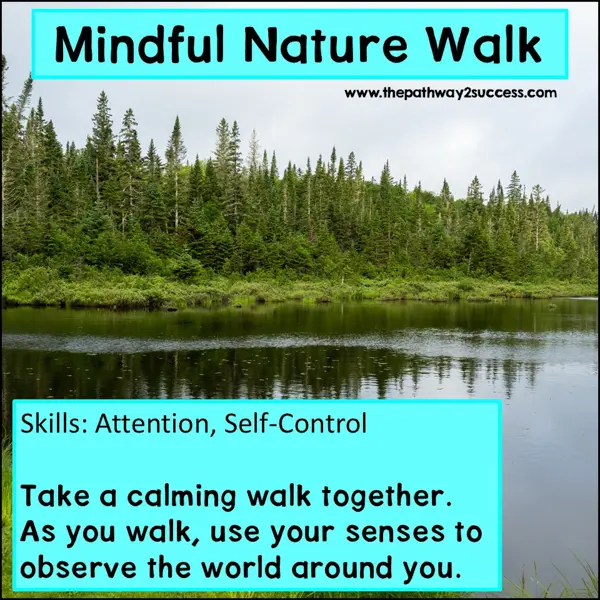
7. Mindful Nature Walk
Target Skills: Attention, self-control.
Implementation: Walk slowly and deliberately, pausing to engage all five senses. Ask participants to silently note what they see, hear, smell, and feel, concluding the walk by listing three distinct observations.
8. Start a Nature Journal
Target Skills: Time management, attention, flexibility.
Implementation: Dedicate a few minutes daily for students to sketch and write about an observed natural phenomenon in a blank notebook, nurturing consistency and reflective thought.
Implementation: Compile a list of specific outdoor items (e.g., pinecones, moss, feathers, puddles). Allowing youth to check off items activates background knowledge and goal-directed persistence.
10. Play Movement Games
Target Skills: Attention, self-control, working memory.
Implementation: Engage kids in active outdoor games like "Follow the Beat" (clapping rhythms to be repeated), "Stoplight," or "Simon Says" to practice auditory processing and impulse control.
11. Shades of Nature
Target Skills: Organization, attention.
Implementation: Armed with a clipboard, have participants find and categorize multiple natural items matching specific color palettes (e.g., various shades of green or brown), reinforcing visual discrimination and categorization.
12. Observe Wildlife
Target Skills: Attention, self-control.
Implementation: Find a stationary point of interest—such as an ant trail or a blooming flower—and practice prolonged, quiet observation. This builds profound inhibitory control and patience.
Implementation: Read and reflect on positive self-talk phrases paired with wildlife imagery. Supportive internal dialogue helps youth build emotional resilience and task initiation skills.
14. Use Live Wildlife Cams
Target Skills: Attention, flexibility.
Implementation: When outdoor access is restricted, utilize live webcams monitoring nesting ospreys, eagles, or zoo animals to practice long-term tracking and observational focus.
15. Community Clean-Up
Target Skills: Organization, task initiation, time management, empathy.
Implementation: Plan a park or schoolyard clean-up initiative. Working together to remove litter or rake leaves fosters executive organization while building social responsibility.
Official Statements & Expert Perspectives
Pediatricians, psychologists, and educational leaders increasingly advocate for the deliberate pairing of environmental exposure with cognitive training.
"When we isolate children inside climate-controlled, screen-heavy boxes for the entirety of their developmental years, we inadvertently starve their nervous systems of the sensory inputs they need to self-regulate," notes Dr. Elena Vance, a developmental neuropsychologist specializing in childhood cognitive growth. "Nature is not merely a recreational backdrop; it is a neurological gymnasium. The unstructured, multi-sensory demands of the outdoors force the prefrontal cortex to adapt, plan, and regulate in ways that indoor environments simply cannot replicate."
Educational reformers echo these sentiments, emphasizing that closing the achievement gap must involve closing the "nature deficit gap." Marcus Holloway, director of an urban outdoor education initiative, points out:
"We see transformation in children who struggle within traditional four-wall classrooms. When given a concrete task like planting a garden or navigating a scavenger hunt in a local park, their anxiety drops, their collaborative instincts kick in, and their capacity to stay on task multiplies. Nature levels the playing field for kids with executive functioning challenges."
Future Outlook: Integrating Ecology and Cognitive Science
As schools and families grapple with the long-term cognitive impacts of digital dependency and high-stress academic environments, the intersection of ecology and neuroscience offers a clear path forward. The future of childhood development lies in breaking down the artificial barrier between indoor learning and outdoor exploration.
Moving forward, forward-thinking educational institutions are beginning to design "green schools"—facilities featuring outdoor classrooms, sensory gardens, and mandatory daily green-time quotas. Policymakers are also exploring urban planning initiatives that ensure equitable access to parks for lower-income communities, recognizing that cognitive health is fundamentally tied to environmental justice.
Ultimately, building executive functioning skills does not require expensive software or complex clinical therapies. By simply stepping outside, observing the changing seasons, planting a seed, or taking a mindful walk through the grass, we provide children and teens with the raw materials they need to build stronger, more adaptable, and healthier brains. Nature remains humanity’s oldest, wisest, and most accessible classroom—waiting quietly to teach us how to focus, adapt, and thrive.