
EXECUTIVE OVERVIEW
In the landscape of early childhood education, foundational literacy remains the bedrock upon which all future academic achievement is built. As educational paradigms shift to align more closely with the Science of Reading, the focus on phonological awareness—the ability to recognize and manipulate the spoken parts of sentences and words—has intensified. Among the critical milestones in this developmental journey is syllable segmentation: the cognitive capacity to hear, isolate, and count the rhythmic beats within spoken language.
To bridge the gap between abstract phonological concepts and engaging classroom practice, early education specialists have unveiled a suite of seasonal literacy tools designed for preschool and kindergarten learners. Spearheaded by the introduction of the Spring Syllable Sort and expanded into a comprehensive 42-page Four Seasons Syllable Sort curriculum, these resources offer educators an interactive, play-based mechanism to reinforce early reading skills. By moving away from rote memorization and integrating tactile, picture-based sorting exercises, these frameworks provide young learners with a robust, multisensory approach to mastering structural word components.

DETAILED CHRONOLOGY: THE EVOLUTION OF EARLY PHONOLOGICAL INTERVENTIONS
The Shift Toward the Science of Reading
For decades, early childhood reading instruction experienced a pendulum swing between whole-language approaches and rigorous phonics drills. However, over the past ten years, cognitive scientists, linguists, and educators have coalesced around the "Science of Reading"—an expansive body of research that emphasizes explicit instruction in phonemic awareness, phonics, fluency, vocabulary, and comprehension.
Within this framework, phonological awareness is recognized as an essential precursor to phonics. Before a child can match a sound to a letter (grapheme-phoneme correspondence), they must first be able to distinguish individual sounds and word parts aurally. Syllable segmentation serves as the critical intermediate step in this hierarchy, bridging whole-word recognition with individual phoneme manipulation.
Development of the Seasonal Syllable Frameworks
Recognizing the demand for hands-on materials that reflect contemporary reading science, early childhood developers began conceptualizing thematic, multi-sensory tools that could seamlessly integrate into existing preschool curricula.

- The Spring Prototype (Early 2025): Educators noted a significant seasonal engagement drop during late winter and early spring transitions. To combat this, developers formulated the Spring Syllable Sort, pairing vernal vocabulary—such as flowers, raindrops, and butterflies—with structured counting and sorting tasks.
- Expansion to the Four Seasons Curriculum: Building upon the success of the spring-themed pilot, curriculum designers scaled the methodology across the entire calendar year. The resulting 42-page comprehensive pack extended phonological sorting into summer, autumn, and winter contexts, establishing a continuous, year-round framework for early literacy development.
SUPPORTING CONTEXT & METRICS: THE MECHANICS OF SYLLABLE SEGMENTATION
To fully appreciate the impact of these educational resources, one must examine the pedagogical mechanics governing how young children process language.
Multisensory Engagement: Clapping, Tapping, and Sorting
Children in pre-K and kindergarten (typically ages four through six) are in a prime developmental window for auditory discrimination. However, abstract auditory concepts can be difficult to grasp without physical anchors. The Spring Syllable Sort and its seasonal counterparts utilize physical kinematics—specifically clapping and tapping—to help students map physical movements to auditory beats.
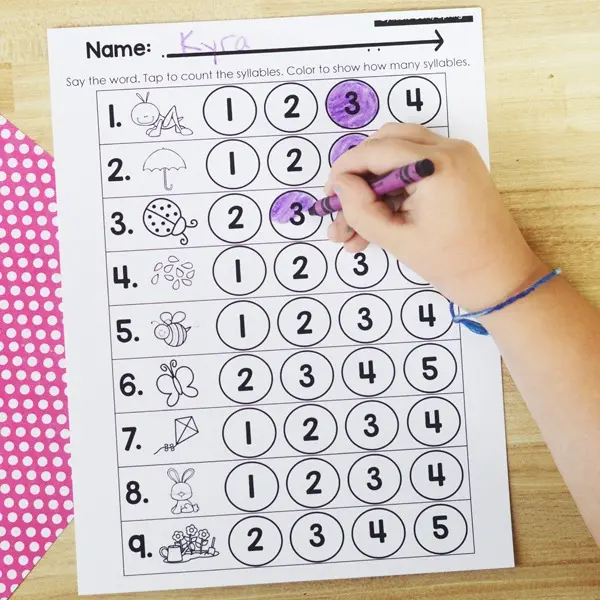
- Auditory Isolation: Students are presented with a picture card (e.g., ladybug). Before looking at any written text, they say the word aloud.
- Kinesthetic Feedback: Learners clap or tap their fingers for each distinct mouth movement or sound beat (la-dy-bug = three taps).
- Categorization: Students sort the cards into designated bins or columns corresponding to the counted number of syllables (one, two, or three-plus syllables).
Curricular Components and Materials
The efficacy of these print-and-play resources lies in their comprehensive design, ensuring that both teachers and parents have access to complete instructional loops. The core offerings include:

- Syllable Counting Cards: Designed with vibrant, season-specific imagery that appeals to young learners.
- Large Colorful Word Cards: Used for whole-group instruction and vocabulary introduction.
- Independent Practice Worksheets: Black-and-white response sheets that allow students to demonstrate independent mastery.
- Comprehensive Answer Keys: Ensuring rapid assessment and self-correction capabilities for educators.
OFFICIAL STATEMENTS & PEDAGOGICAL INSIGHTS
Early childhood reading specialists and curriculum designers emphasize that foundational literacy interventions must prioritize oral language proficiency before introducing complex orthographic rules.
"When we teach children to segment words by clapping or tapping, we are essentially training their brains to parse the continuous stream of speech into manageable cognitive units," explains a leading early literacy consultant. "By utilizing seasonal imagery rather than forcing children to decode unfamiliar written words immediately, we lower the cognitive load. This allows them to focus entirely on the phonological sound structure."
Furthermore, educators underscore the importance of vocabulary pre-teaching. According to instructional guidelines accompanying the Spring Syllable Sort, students must be familiar with the semantic meaning of an object before they can accurately segment its syllables.

"If a child does not recognize what a specific spring-themed illustration depicts, the exercise devolves into a guessing game," instructional notes advise. "Pre-teaching vocabulary ensures that cognitive energy is spent precisely where it is intended: on phonological awareness and auditory processing."
FUTURE OUTLOOK: THE ROAD AHEAD FOR EARLY CHILDHOOD LITERACY
As educational institutions continue to refine their reading curricula to meet post-pandemic learning recovery goals and rigorous literacy standards, the demand for high-yield, low-cost educational resources is projected to surge.
Integration Into Digital and Hybrid Learning Spaces
While physical printouts, tactile clip cards, and paper worksheets remain the gold standard for tactile motor development in pre-K and kindergarten classrooms, future iterations of seasonal literacy frameworks are anticipated to bridge physical materials with interactive digital displays. Smartboards and tablet-based sorting applications could soon replicate the physical "clapping and tapping" mechanics through interactive touch technologies.

Broadening Teacher Training and Professional Development
The widespread adoption of tools like the Four Seasons Syllable Sort highlights a broader trend: empowering educators—particularly paraprofessionals and early-career teachers—with ready-to-use, research-aligned materials. By reducing lesson-planning friction, these resources allow teachers to focus on individualized student intervention, observing which children struggle with auditory processing and providing targeted small-group support.
Ultimately, initiatives that transform foundational literacy into an engaging, seasonal exploration ensure that children not only develop the technical cognitive skills required for reading success, but also cultivate a lifelong enjoyment of language.

