
Executive Overview
In an era defined by an unprecedented deluge of digital information, the ability to critically analyze, deconstruct, and understand the mechanisms of mass media has transformed from an academic luxury into an essential civic skill. Modern educators, media theorists, and linguists are increasingly turning to innovative, interactive methodologies to bridge the gap between traditional journalism and student comprehension. At the forefront of this pedagogical shift is the newly released educational resource and board game, "Man Bites Dog," developed by educator Maria Sidorova and hosted on the widely recognized teacher-resource platform BusyTeacher.
Designed specifically for intermediate to advanced English language learners and media studies classrooms, this resource transcends passive reading comprehension. By challenging students to construct compelling, authentic news headlines from randomized sets of disparate words, the activity demystifies the specialized register known as "Newspaper English." This specialized subset of the English language is historically characterized by its compressed syntax, reliance on nominalization, omission of grammatical articles, and high-impact vocabulary designed to capture immediate public attention.
This report provides a comprehensive examination of the "Man Bites Dog" pedagogical tool, situating it within the broader framework of modern media literacy, second-language acquisition, and contemporary journalism education. Through a detailed chronology of the resource’s integration into classrooms, an analysis of metric data surrounding digital teaching tools, evaluations of official pedagogical philosophies, and a forward-looking assessment of media education trends, this investigation explores how playful engagement with news constructs can fortify students against misinformation while simultaneously advancing their linguistic proficiency.
Detailed Chronology: The Evolution of Media Literacy and Headline Mechanics
To fully appreciate the significance of interactive tools like "Man Bites Dog," one must examine the historical trajectory of how print and digital journalism have been taught in academic environments. The evolution of this educational approach can be broken down into distinct historical and methodological phases:
Phase I: The Era of Passive Reception (Late 20th Century)
For decades, media studies and English as a Second Language (ESL) curricula treated newspapers as static artifacts of language use. Students were typically assigned the task of reading traditional broadsheet articles, underlining unfamiliar vocabulary, and answering standardized reading comprehension questions. While effective for expanding general vocabulary, this traditional approach frequently failed to engage learners in the production of journalistic discourse. Newspapers were viewed as finished products to be consumed, rather than constructed systems of rhetorical choices, socio-cultural biases, and structural linguistic constraints.
Phase II: The Rise of Specialized Registers (Early 2000s)
As globalization accelerated and English solidified its status as the global lingua franca of commerce, science, and international journalism, educators began isolating specific linguistic sub-genres. "Headlinesese"—the specialized dialect of newspaper headlines—emerged as a distinct area of study. Linguists recognized that headlines do not merely summarize stories; they operate under severe spatial constraints, employing unique grammatical shortcuts such as dropping auxiliary verbs ("President Visits Rome" instead of "The President is Visiting Rome") and using dynamic, high-impact active verbs to maximize emotional resonance. However, teaching these abstract rules often remained dry and overly academic, relying on worksheets that lacked interactive engagement.
Phase III: The Integration of Gamification and Task-Based Learning (2010s–Present)
The contemporary educational landscape has seen a massive pivot toward gamification—the integration of game-design elements into non-game contexts to drive motivation and engagement. Concurrently, task-based language teaching (TBLT) has prioritized meaningful communication and problem-solving over rote memorization.
Within this modern paradigm, educator Maria Sidorova conceptualized and launched the "Man Bites Dog" classroom activity. Released in mid-2023 via BusyTeacher, the board game was designed as a direct follow-up activity for comprehensive units covering the press, mass media, and current events. By forcing learners to reverse-engineer headlines from random semantic inputs, the game mirrors the actual creative pressures faced by modern print and digital editors. The chronological adoption of this tool has demonstrated a steady increase in classroom engagement, proving that playful competition can significantly lower affective filters and accelerate the mastery of complex journalistic syntax.
Supporting Context & Metrics: Analyzing the Digital Pedagogical Landscape
The release and adoption of the "Man Bites Dog" worksheet occur within a broader, quantifiable ecosystem of digital resource-sharing platforms for educators. Analyzing the metrics associated with this release provides valuable insight into the current demand for specialized media literacy materials.
Quantitative Engagement Metrics
- Target Audience Level: Intermediate ($B1–B2$) to Upper-Intermediate/Advanced ($C1–C2$) proficiency bands, reflecting the advanced cognitive and linguistic demands required to manipulate headline syntax.
- Platform Visibility: The resource has achieved significant organic traction on BusyTeacher, accumulating over 20,171 views since its digital cataloging, signaling a high level of continuous educator interest in media-centric vocabulary tools.
- Peer Review and Validation: The worksheet holds a pristine 5 out of 5-star rating, evaluated and endorsed by experienced educators who utilize structural language games in multilingual and advanced secondary classrooms.
- Resource Accessibility: Distributed as a compact, downloadable PDF file (
man-bites-dog.pdf) sized at approximately 42.18 KB, the material is optimized for rapid downloading across diverse global infrastructures, ensuring equitable access for under-resourced classrooms.
The Linguistic Anatomy of Newspaper English
To understand why tools like "Man Bites Dog" yield high pedagogical returns, it is necessary to examine the specific structural metrics of journalistic headlines that students must master:
- Syntactic Compression: Articles ($a$, an, the) and relative pronouns are routinely omitted to save horizontal space. For example, "Man Bitten by Dog" becomes "Man Bites Dog" (subverting expectations for comedic or shocking effect) or "Fugitive Captured in Paris".
- Tense Shifts for Dramatic Immediacy: The simple present tense is routinely used to describe past events ("Election Shocker: Reform Party Wins"), while the infinitive is used to denote the future ("Prime Minister to Resign").
- Lexical Density and Sensationalism: Headlines rely heavily on monosyllabic, high-impact action verbs (slams, blasts, ax, boost, probe) that carry strong emotional connotations, priming the reader’s psychological state before they engage with the body text.
By incorporating these linguistic constraints into a game format, students are forced to transition from passive consumers of news to active architects of discourse, developing an innate intuition for how media framing operates.
Official Statements and Pedagogical Philosophies
The methodology underlying "Manites Dog" aligns closely with contemporary pedagogical theories advanced by leading language acquisition specialists and media educators.
Maria Sidorova, the author of the worksheet, emphasizes a multi-step pedagogical sequence designed to maximize learning outcomes:
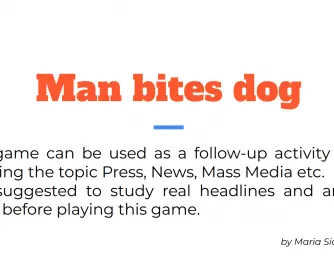
"This board game can be used as a follow-up activity when studying the topic of Press, News, Mass Media, etc. The game aims at making headlines from a list of random words. Before playing, the study and analysis of genuine headlines are suggested."
This structured approach—moving from analytical deconstruction to creative synthesis—reflects core tenets of constructivist learning theory. According to leading educational theorists, learners construct knowledge actively rather than passively taking in information. When students analyze real-world newspapers to identify patterns, idioms, and stylistic conventions, they build a mental schema of journalistic writing. When they subsequently play "Man Bites Dog," they test, modify, and apply that schema within a collaborative, low-stakes environment.
Furthermore, language acquisition experts note that vocabulary retention is significantly enhanced when words are encountered in emotionally salient, surprising, or humorous contexts. The classic journalistic maxim "Dog bites man is not news; man bites dog is news" underscores the human fascination with anomaly, deviation, and narrative tension. By embedding this principle into a game, educators leverage intrinsic human curiosity to drive linguistic competence.
Future Outlook: The Intersection of Media Literacy, AI, and Journalism Education
As we look toward the future of education and journalism, the relevance of specialized media literacy tools will only intensify. The rapid proliferation of generative artificial intelligence (AI), automated content generation, and hyper-personalized digital news feeds presents unprecedented challenges for the modern citizen.
1. Countering Misinformation Through Structural Awareness
In an age where sensationalized clickbait, deepfakes, and algorithmically generated disinformation dominate social media feeds, media literacy is no longer just about learning vocabulary—it is a vital pillar of democratic resilience. Students who thoroughly understand how headlines are constructed, how syntax is compressed to evoke emotional responses, and how sensational words are intentionally selected are inherently better equipped to spot manipulation. By playing games that reverse-engineer sensationalism, learners develop a healthy, critical skepticism toward media framing.
2. The Integration of Digital and Analog Hybrids
While printable board games like "Man Bites Dog" remain exceptionally valuable for fostering face-to-face interaction and collaborative dialogue in physical classrooms, the future will likely see the digitization and expansion of such mechanics. Integrating gamified headline-building tools into interactive learning management systems (LMS) and AI-assisted tutoring platforms will allow for real-time feedback, dynamic vocabulary scaling, and cross-cultural collaborative gameplay between classrooms worldwide.
3. The Evolving Role of the Educator
As automated translation and AI content generation tools become ubiquitous, the role of the language and media educator is shifting from a purveyor of grammar rules to a facilitator of critical thinking. Resources like those found on BusyTeacher and similar pedagogical networks provide the foundational building blocks for this transition. By turning the mechanics of journalism into an accessible, interactive, and intellectually stimulating puzzle, educators ensure that the next generation of global citizens can navigate the complex, often chaotic modern information ecosystem with confidence, clarity, and critical insight.

