

Executive Overview
In the ever-evolving landscape of modern education, the mechanics of instructional design remain the foundational bedrock upon which student academic success is built. Yet, for both novice educators stepping into their first classrooms and seasoned veterans looking to revitalize their approach, the task of planning a cohesive, rigorous unit of instruction can often feel overwhelming. Too frequently, lesson planning is treated as a reactive chore—a frantic scramble the night before delivery—rather than a proactive, strategic architectural process.
To combat this pedagogical challenge, leading educational platforms and curriculum strategists are returning to foundational principles. By adopting a systematic, reliable framework for unit construction, educators can transform abstract educational standards into dynamic, engaging learning experiences. This comprehensive guide explores a battle-tested, three-step framework for unit planning, emphasizing the power of backward design, targeted objective setting, and intentional alignment between assessments and daily learning activities. Designed not only as a primer for individual classroom transformation, this methodology also serves as the structural core of professional development initiatives aimed at curbing teacher burnout and maximizing student retention.
Detailed Chronology: The Evolution of Backward Design
The journey toward modern instructional planning has deep historical roots, evolving from unstructured, textbook-driven chapters to the highly methodical frameworks utilized by top-performing school districts today. To understand how contemporary unit planning operates, one must trace the shift from traditional forward planning to the revolutionary paradigm of backward design.
Phase 1: The Era of Content Coverage (Pre-1990s)
For decades, traditional lesson planning followed a linear, content-heavy trajectory. Teachers would open a textbook, look at the upcoming chapter, and ask themselves: "What information do I need to cover this week?" Instruction was dictated by page numbers rather than cognitive outcomes. Educators would deliver lectures, assign textbook questions, and finally—often as an afterthought—administer a summative quiz based exclusively on what had been discussed in class.
This forward-planning model suffered from a critical flaw: alignment issues. Because the final assessment was constructed after the teaching had occurred, tests frequently evaluated trivial details rather than core competencies. Furthermore, students were rarely provided with a clear conceptual destination, leaving them to navigate a disjointed series of daily lessons without understanding how individual pieces fit into the broader academic puzzle.
Phase 2: The Paradigm Shift of Understanding by Design (1991)
A monumental shift occurred in 1991 with the publication of Understanding by Design by educational theorists Grant Wiggins and Jay McTighe. Wiggins and McTighe introduced the concept of backward design, a framework that fundamentally inverted the traditional planning process. Instead of starting with content or activities, educators were challenged to begin with the end in mind.
Backward design established a three-stage sequential timeline:

- Identify Desired Results: Determine what students should know, understand, and be able to do by the end of the unit based on established standards.
- Determine Acceptable Evidence: Design the summative assessment before planning any daily lessons, establishing clear criteria for mastery.
- Plan Learning Experiences and Instruction: Design the sequence of daily lessons, activities, and formative checks that will actively bridge the gap between the student’s starting point and the summative assessment goals.
Phase 3: Modern Integration and Systematic Refinement (Present Day)
Today, instructional design has integrated backward design with data-driven decision-making and differentiated learning. Modern educators do not view backward design as "teaching to the test" in a restrictive, rote-memorization sense. Instead, they recognize that designing a high-quality, authentic assessment first allows teachers to engineer genuine student success. By defining clear, measurable objectives, modern unit planning turns the classroom into a purposeful environment where every lesson has a distinct, measurable trajectory.
Supporting Context & Metrics: Defining Standards, Curriculum, and Units
To successfully execute a backward design model, educators must first establish a shared vocabulary. Confusion often arises when terms like standards, curriculum, and units are used interchangeably. Disentangling these definitions is essential for creating structured, scalable instructional plans.
Dissecting the Pedagogical Hierarchy
| Term | Definition | Primary Function | Example |
|---|---|---|---|
| Standards | Broad educational goals or benchmarks mandated by state, local, or institutional bodies. | Define what must be learned. | "Students will practice safe food handling and kitchen safety." |
| Curriculum | The overarching roadmap and sequence of topics designed to meet multiple standards over a semester or year. | Organizes how broad standards are clustered into logical chunks of time. | A semester-long "Cooking Fundamentals" course divided into six distinct thematic blocks. |
| Unit | A focused collection of individual daily lessons centered around a specific subset of knowledge and skills. | Provides an intensive, deep-dive instructional window (e.g., 3 to 4 days or a few weeks). | A 4-day instructional sub-unit dedicated strictly to cross-contamination and food handling safety. |
The Complexity of Content Mapping
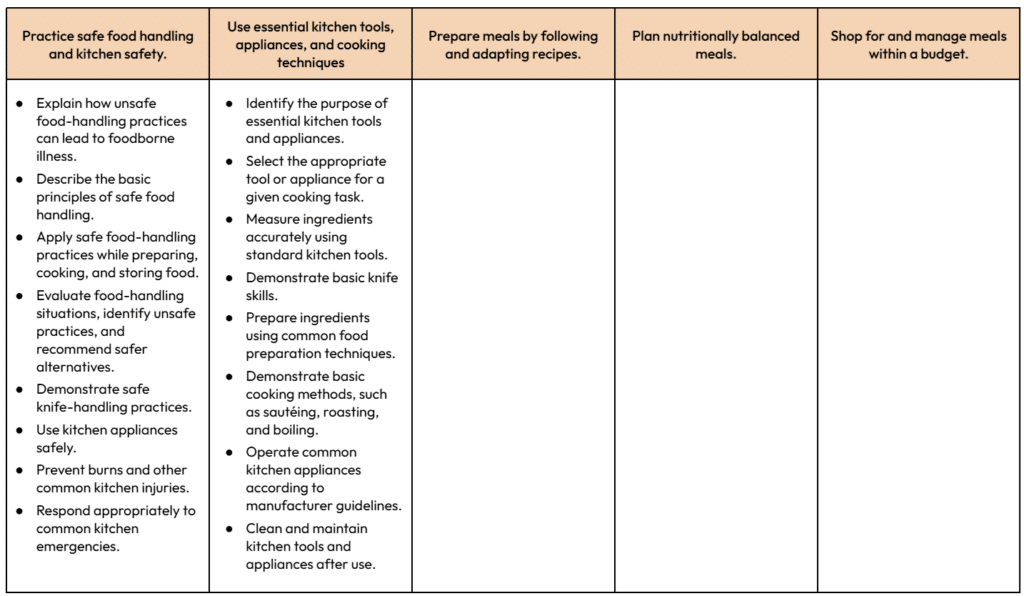
To visualize the sheer volume of data teachers manage, consider a hypothetical community education course titled Cooking Fundamentals. An instructor designing this course starts by establishing five broad instructional goals (standards). However, breaking down just the second standard—using essential kitchen tools, appliances, and cooking techniques—reveals a sprawling inventory of 15 to 30 distinct tools, coupled with extensive lists of operational skills and safety protocols.
Faced with this data density, an unstructured approach leads to cognitive overload for both teacher and student. Effective curriculum design requires categorizing these vast matrices into digestible, thematic units. In our culinary example, the overarching curriculum is systematically divided into six operational units:
- Food Safety
- Kitchen Tools and Appliances
- Food Prep and Cooking Techniques
- Everyday Meal Preparation
- Nutrition
- Grocery Shopping and Budgeting
By isolating the Food Safety unit—a concise, 3-to-4-day instructional window—educators can apply the three-step backward design process with pinpoint accuracy.
Official Guidelines & The 3-Step Unit Design Framework
Implementing a high-impact instructional unit requires strict adherence to a structured, repeatable process. Whether designing a short multi-day module or a sprawling multi-week academic unit, educators are advised to follow a rigorous three-step framework.
[ STEP 1: Set Measurable Objectives ]
                │
                ▼
[ STEP 2: Design Summative Assessment ]
                │
                ▼
[ STEP 3: Plan Daily Lessons & Activities ]
Step 1: Set Objectives and Frame the Big Picture
The foundation of any successful unit begins with the formulation of clear, measurable learning objectives. A common pitfall in objective writing is the use of non-observable cognitive verbs (e.g., understand, learn, appreciate). Because mental processes occur internally, educators cannot directly observe "understanding."
Instead, objectives must employ observable action verbs that require students to demonstrate mastery outwardly. For our focused Food Safety unit, the instructor establishes four precise, measurable objectives:
- By the end of this unit, students will be able to identify primary sources of cross-contamination in a domestic kitchen environment.
- By the end of this unit, students will be able to demonstrate proper handwashing and personal hygiene protocols before food handling.
- By the end of this unit, students will be able to classify foods according to their safe internal cooking temperatures.
- By the end of this unit, students will be able to explain the proper storage guidelines for raw versus cooked ingredients to prevent bacterial growth.
Framing via Essential Questions
Beyond cold objectives, instructional experts recommend anchoring the unit with a compelling title and an essential question. An essential question is open-ended, thought-provoking, and devoid of a simple "yes" or "no" answer. It frames the conceptual purpose of the unit.
- Unit Safe Food Handling
- Essential Question: "How do your daily choices in the kitchen directly affect the safety, health, and well-being of those consuming the food you prepare?"
Step 2: Design the Assessment Before Instruction
With clear objectives established, the educator moves directly to the second step: designing the summative assessment. Reversing the traditional workflow forces the instructor to answer a critical question: "If students have truly mastered these objectives, how will they prove it?"
In our culinary safety example, because the unit is compressed into a rapid 3-to-4-day window, a time-intensive project is impractical. Instead, the instructor constructs a targeted open-response performance assessment.
- The Assessment Structure: Students are presented with multi-faceted hypothetical scenarios detailing a home cook preparing a complex meal. Embedded within each narrative are subtle, real-world food safety violations (e.g., using the same cutting board for raw poultry and fresh vegetables without sanitizing, or leaving perishable dairy items at room temperature for extended periods).
- Evaluation Criteria: Students must successfully identify the violations, explain the underlying microbiological risks (such as Salmonella cross-contamination or the temperature danger zone), and articulate the correct corrective action.
This assessment moves far beyond rote memorization, evaluating the student’s capacity to transfer knowledge to novel, real-world situations.
Step 3: Plan the Daily Lessons and Learning Activities
Only after the destination (objectives) and the final proof of mastery (summative assessment) have been locked into place does the educator turn their attention to daily lesson planning.
Step 3 is where the instructor engineers the scaffolding required to bridge the gap. Every daily activity, formative check, direct-instruction lecture, and guided-practice session is explicitly mapped back to the summative assessment criteria.
- Day 1 Focus: Establishing hygiene protocols and exploring cross-contamination via fluorescent "glow-germ" lab activities.
- Day 2 Focus: Investigating temperature control, danger zones, and safe meat-cooking thresholds.
- Day 3 Focus: Analyzing storage hierarchies in refrigerators to prevent fluid dripping and cross-contamination.
- Day 4 Focus: Comprehensive review, formative peer-evaluations, and administration of the open-response scenario assessment.
Future Outlook: The Intersection of Curriculum Design and Professional Development
As the educational ecosystem continues to face systemic pressures—including teacher shortages, diverse learner populations, and the demand for higher academic rigor—the push toward structured, intentional instructional design has never been more urgent.
Educational researchers predict a massive surge in professional development models focused specifically on foundational planning skills. Institutions are realizing that handing teachers pre-packaged, scripted curricula often strips educators of their creative agency, while leaving them entirely unequipped when those materials fail to meet the unique needs of their specific student demographics. Conversely, empowering teachers with a transferable, step-by-step framework like backward design fosters long-term professional confidence.
Furthermore, digital integration is transforming how units are built and shared. Emerging pedagogical platforms and self-paced online professional development courses—such as Mastering the Lesson Plan—are bridging the gap between theoretical educational research and practical, day-to-day classroom execution. By giving educators modular tools to visualize standards, map out assessments, and sequence daily lessons, the modern teaching profession is moving away from frantic, midnight lesson planning toward a sustainable, highly professionalized model of instructional design.
Ultimately, the future of effective teaching relies on this core truth: when instruction is designed backward, student learning moves forward. By establishing clear standards, crafting authentic assessments, and intentionally engineering daily lessons, educators ensure that every minute spent in the classroom serves a meaningful, measurable purpose.

