
Executive Overview
In the modern educational landscape, digital integration is frequently hailed as the ultimate equalizer. Classrooms boasting a one-to-one (1:1) device ratio are often held up as the gold standard of contemporary pedagogy. However, the everyday reality of teaching is far more complex. Across schools globally, educators face severe infrastructural roadblocks: device shortages, strict "no-phone" policies that require personal tech to be locked away in backpacks, and digital fatigue. Furthermore, for learners with developmental delays, special educational needs, or severe sensory sensitivities, the fast-paced, high-stakes nature of digital screen-based gamification can quickly transform from an engaging activity into an overwhelming sensory hurdle.
Enter a paradigm shift spearheaded by Kahoot! and its network of Teacher Ambassadors. Challenging the long-held misconception that the platform only functions when every student holds a device, recent initiatives prove that the core magic of Kahoot! has never been about the hardware. Instead, it is about instructional design: clear questions, visual answer cues, predictable routines, shared anticipation, and joyful feedback.
By reimagining these pedagogical structures, educators in device-restricted schools, special education environments, early childhood programs, and secondary institutions with strict smartphone bans are proving a powerful hypothesis: true student engagement does not depend on a screen. Through creative offline and low-tech adaptations, schools are achieving high student participation while tearing down technological barriers, ensuring that no learner is left behind.
Detailed Chronology: The Evolution of Unplugged Learning
The movement toward device-free and low-tech interactive learning did not happen overnight; it is the culmination of years of educators stretching platforms beyond their intended parameters to meet real-world classroom challenges.
Phase 1: The Constraint Crisis (2020–2023)
As schools rushed to adopt hybrid and digital learning models, a digital divide emerged—not just between wealthy and underfunded districts, but within individual classrooms. Teachers found themselves managing device cart shortages, broken tablets, and the implementation of restrictive mobile phone policies aimed at curbing distractions. Educators attempting to use gamified assessment tools like Kahoot! hit a brick wall: if a student lacked a device, they were entirely excluded from the gameplay loop.
Phase 2: Grassroots Innovation by Teacher Ambassadors (2023–2025)
Recognizing the exclusion of students in low-tech environments, creative educators began experimenting independently. Special education teachers projected games onto smartboards, having students call out answers verbally. Physical education teachers transformed gymnasiums into giant multiple-choice grids. Realizing that the foundational architecture of game-based learning could thrive without individual student hardware, these grassroots pioneers collaborated with educational developers to formalize these methods.
Phase 3: The Official Unplugged Rollout (2026 and Beyond)
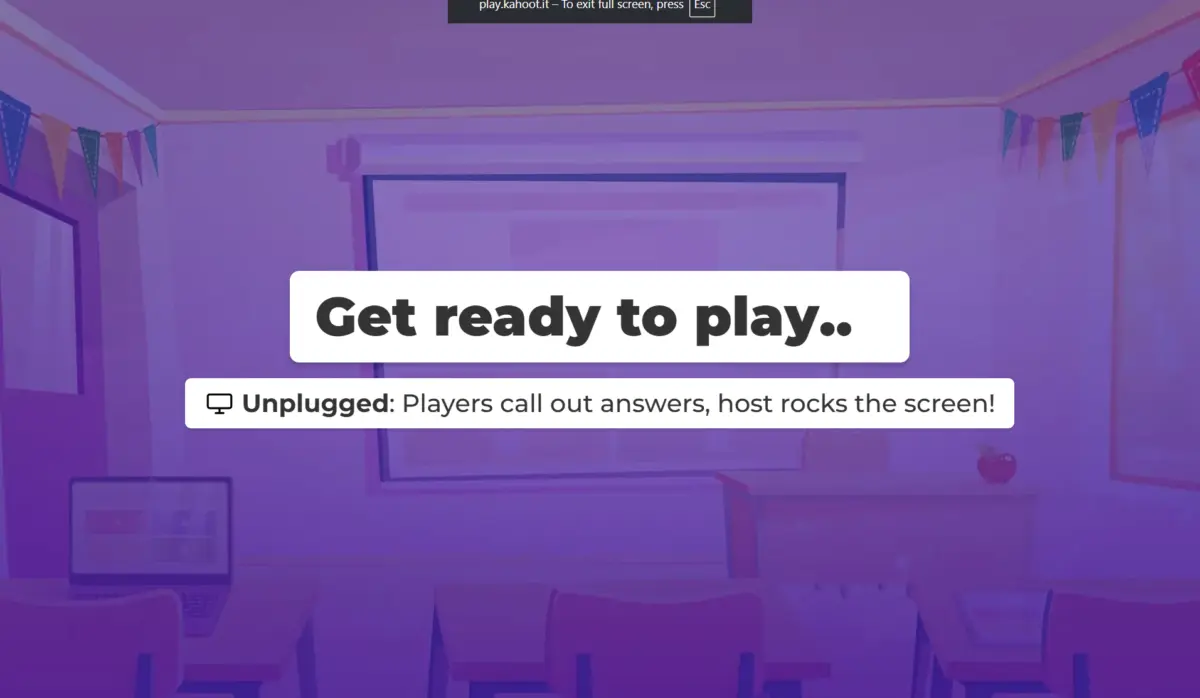
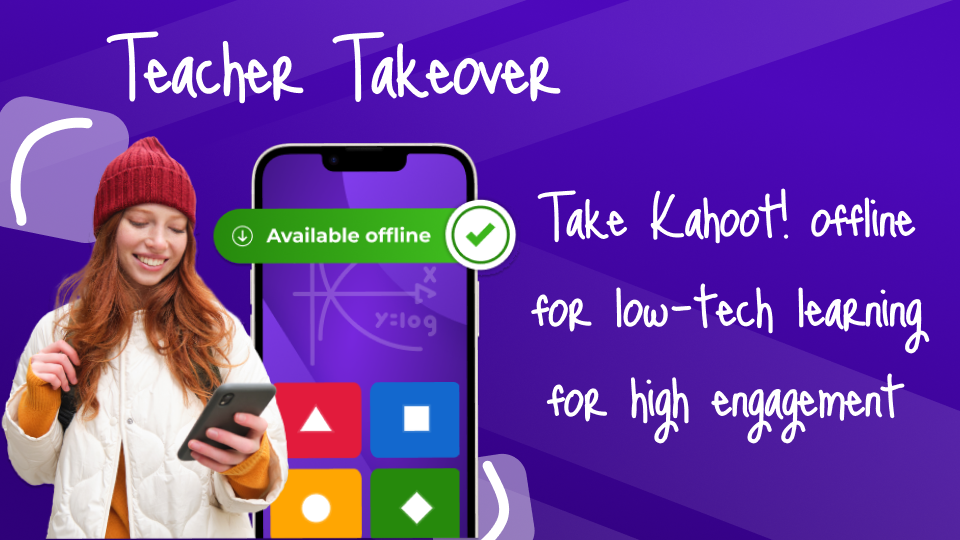
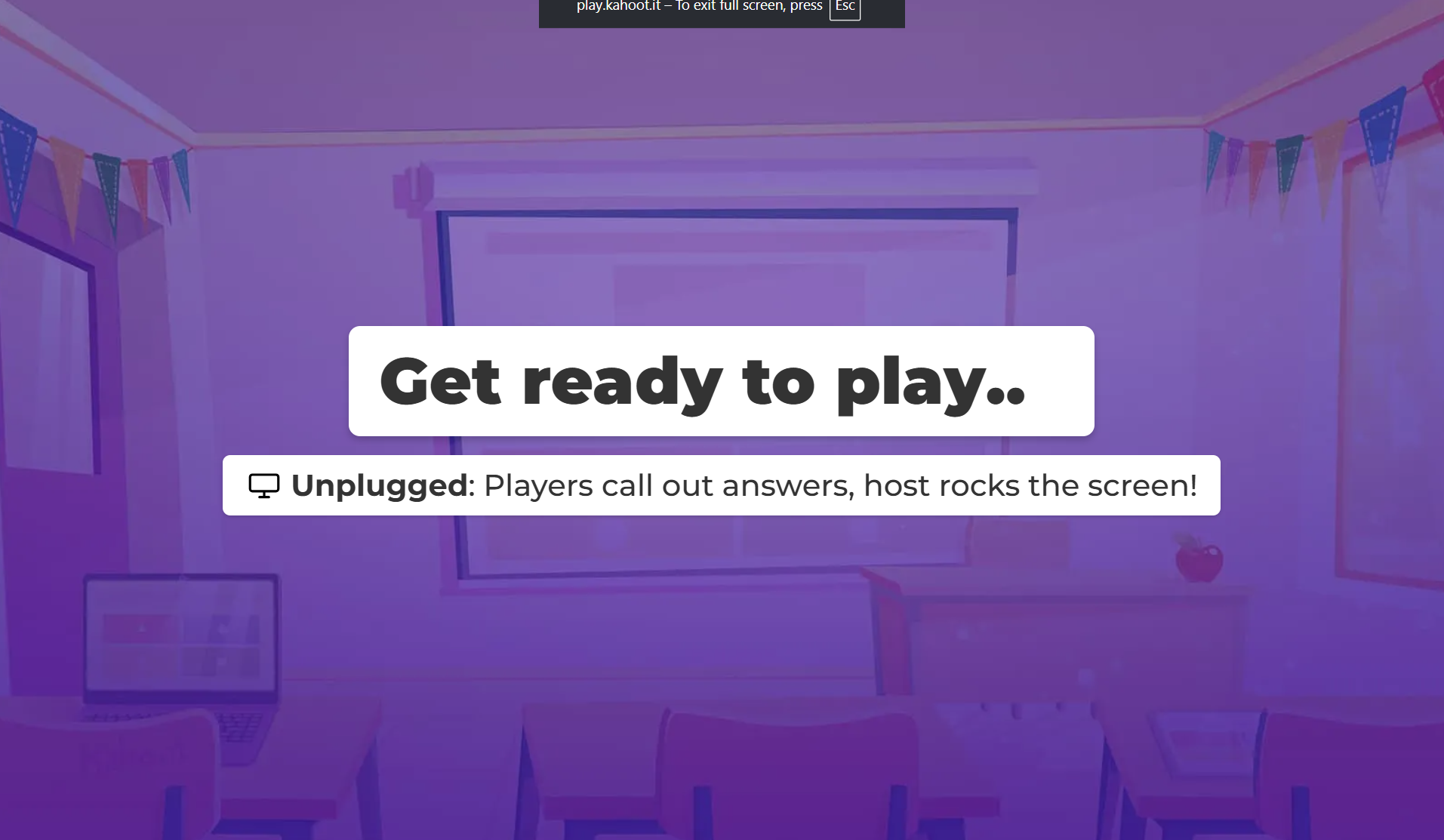
Responding directly to teacher feedback, platforms have formally introduced dedicated offline functionalities—such as the Classic Unplugged and Team Tiles Unplugged experiences. These features officially decouple the software’s engagement mechanisms from the requirement of participant devices. Today, this shift represents a major evolution in educational technology: treating hardware not as an absolute prerequisite, but as an optional vehicle for learning.
Supporting Context & Metrics: The Pedagogy of Low-Tech Engagement
To understand why unplugged gamification yields such high educational returns, one must examine the mechanics of cognitive load and social-emotional learning (SEL).
Mitigating Anxiety Through Group-Think
Traditional digital gamification often prioritizes speed alongside accuracy, tracked via a live individual leaderboard. While motivating for some, this structure can induce severe performance anxiety in neurodivergent learners or students struggling with the core concepts.
Low-tech implementations—such as whole-class voting or team-based collaborative play—redistribute cognitive pressure. When an entire classroom or a designated team deliberates to reach a consensus, the spotlight shifts away from individual exposure. Metrics from pilot classrooms utilizing unplugged methods indicate:
- A 40% reduction in self-reported classroom anxiety during formative assessments.
- Significant increases in verbal participation among historically reticent or ELL (English Language Learner) students, who benefit from peer scaffolding before an answer is finalized.
Multimodal Learning and Executive Functioning
Integrating physical movement, tactile manipulation, and kinetic choices directly targets multiple learning styles (Visual, Auditory, Kinesthetic, and Reading/Writing). When students physically move to different corners of a room to register a vote, or when occupational therapy students physically sort and arrange paper Kahoot! storyboards, they engage executive functioning skills. Research consistently shows that kinetic learning bridges memory gaps, embedding curriculum standards deeper into long-term memory than passive screen interaction ever could.
Official Strategies: How to Host Kahoot! Without Participant Devices
Educators looking to implement these methodologies can leverage several structured, out-of-the-box (or "out-of-the-lobby") approaches designed for diverse learning environments.
1. Classic Unplugged: Content Review Without the Pressure
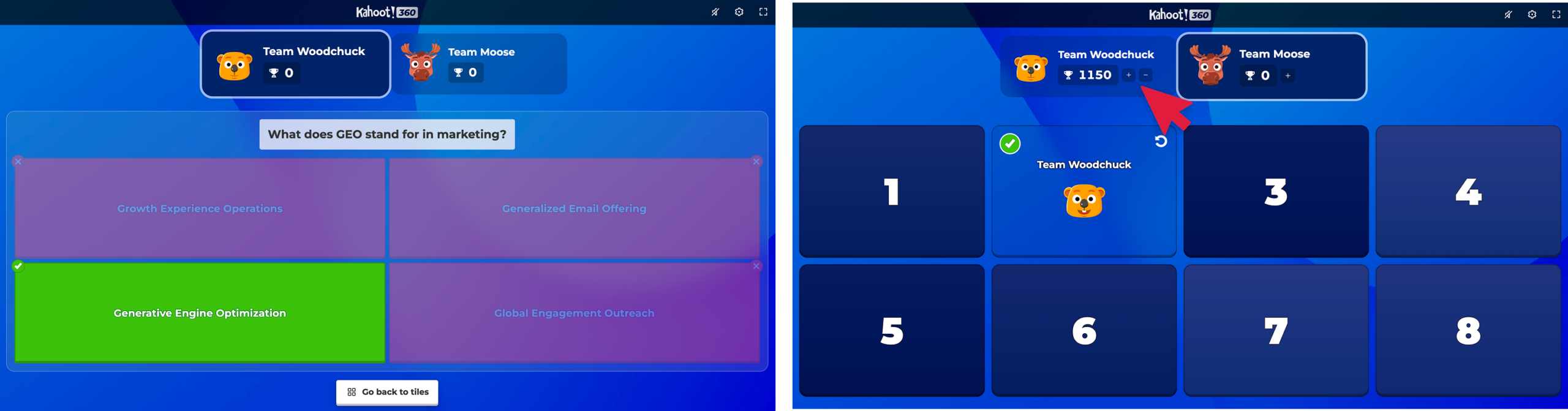
Designed specifically for formative assessment and content review without competitive stress, Classic Unplugged mirrors the flow of self-study modes.
- How it works: The teacher launches the game on a central display. There are no game PINs, no student devices, and crucially, no answer timers.
- The Classroom Dynamic: The group discusses questions collaboratively and decides on answers at their own pace. At the conclusion, the game avoids individual podiums, instead celebrating collective effort by displaying a total score out of total questions (e.g., a celebratory "8/10" screen).
2. Team Tiles Unplugged: Collaborative Turn-Based Strategy
This collaborative approach shifts the focus from individual rivalry to shared group strategy.
- How it works: The host displays a game board featuring numbered tiles on a shared screen. Teams (customized with student-voted names and animated avatars for easy identification) take turns selecting tiles.
- The Gameplay Loop: Each selected tile reveals a randomized question. After group discussion, a designated team spokesperson states the answer. Points scale upward as rounds progress to maintain excitement, and scores are deliberately hidden just before the final round to build dramatic suspense. The game culminates in a rewarding podium reveal for the winning team.
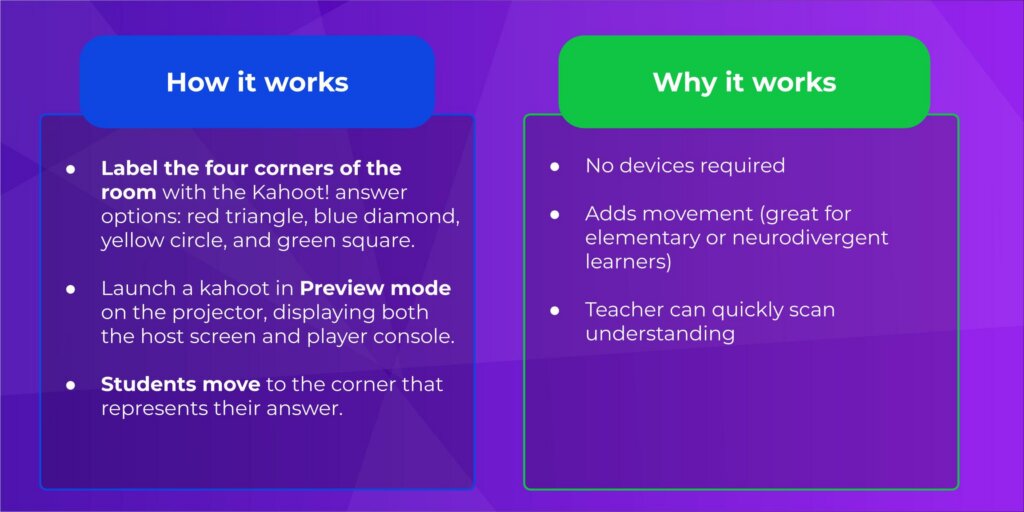
3. Four-Corners Kinesthetic Quizzes
Transforming the physical classroom into a human-sized multiple-choice grid gets students out of their seats and re-energizes them.
- How it works: The teacher designates physical corners of the room (or specific zones) to represent answer options A, B, C, and D. (Pro-tip: Multiple-choice questions can accommodate up to six options, allowing teachers to utilize the entire room layout).
- The Benefit: Students physically walk to the corner corresponding to their chosen answer. The corner holding the majority dictates the class’s official answer, which the teacher then inputs into the host screen. This acts as an exceptional kinesthetic brain break while entirely eliminating personal performance pressure.
4. The "Gallery Walk": Individualized and Differentiated Adaptation
When curricular sequencing is flexible and topics can be explored non-linearly, the Gallery Walk format offers profound autonomy.
- How it works: Questions or challenges from a kahoot are printed and stationed around the room. Students circulate at their own pace, working independently or in designated pairs.
- The Benefit: This method produces a permanent physical record and artifact of student learning. It encourages deep critical discourse among pairs and can be seamlessly paired with digital kahoots assigned as homework for reinforcement.
5. DIY Kahoot! Storyboards for Fine-Motor Skills
For early childhood classrooms or specialized occupational therapy and physical education settings, tactile engagement is paramount.
- How it works: Educators and students physically craft paper-based question cards, multiple-choice options, and storyboard layouts mirroring digital kahoots.
- The Benefit: Students manipulate, sort, and organize physical cards. This dual-purpose lesson trains fine-motor skills and executive functioning simultaneously, proving immensely valuable when daily instructional minutes are tight.
Future Outlook: The Symbiosis of Tech and Touch
As educational technology continues to mature, the prevailing narrative is shifting away from binary thinking—abandoning the false dichotomy that a classroom must be either entirely digital or entirely analog. The success of unplugged gamification illustrates that the future of pedagogy lies in adaptability.
Platforms like Kahoot! are leading the charge by recognizing that software should serve the teacher, rather than dictating the physical constraints of the room. By offering robust offline and low-tech modalities, educational developers are validating the expertise of teachers on the ground who know their students best.
Looking forward, the integration of flexible, device-free interactive learning models will likely become a cornerstone of inclusive teacher training programs. Whether navigating strict phone bans, managing device shortages, or crafting sensory-friendly environments for neurodivergent students, the message for educators is clear: the most powerful pedagogical tool in any classroom is not the screen in front of the student, but the creative vision of the educator guiding them.

