
EXECUTIVE OVERVIEW
As the holiday season approaches, educators and parents continually seek innovative ways to maintain educational momentum without sacrificing the wonder and joy characteristic of December. Balancing foundational skill development with seasonal festivities has long been a delicate pedagogical challenge. Enter the Christmas Ornament ABC Scavenger Hunt Game—an interactive, low-preparation literacy tool designed by early childhood specialists to bridge the gap between kinetic play and essential phonics instruction.
Far from a simple holiday distraction, this activity represents a growing shift in modern early childhood education toward gamified, movement-based learning. By integrating letter recognition and phonics practice into an active scavenger hunt, educators can combat the restlessness often seen in classrooms during the final weeks before winter break. This comprehensive overview examines the mechanics of the Ornament ABC Scavenger Hunt, the cognitive benefits of gamified physical learning in preschool and kindergarten settings, and the broader implications for differentiated early literacy instruction.

DETAILED CHRONOLOGY: THE DEVELOPMENT AND INTEGRATION OF KINETIC LITERACY GAMES
The journey toward interactive, theme-based literacy resources like the Christmas Ornament ABC Scavenger Hunt spans decades of educational research regarding motor skills and cognitive retention.
Phase 1: The Shift from Passive to Active Learning (Late 20th Century)
Historically, early childhood education relied heavily on desk-bound instruction, flashcards, and repetitive worksheet-based drills. However, educational theorists increasingly recognized that young children—particularly toddlers, preschoolers, and kindergarteners—process information more effectively through gross-motor engagement and spatial exploration.
Phase 2: The Rise of Thematic Curricula
To capture children’s intrinsic motivation, curriculum developers began leaning into seasonal motifs. Holidays like Christmas naturally elicit high levels of engagement. By harnessing this enthusiasm, educators discovered that thematic units could act as powerful vehicles for abstract concept mastery, such as recognizing arbitrary symbols like alphabet letters.

Phase 3: Introduction of Year-Long Scavenger Hunt Series
Recognizing the success of movement-based challenges, curriculum designers introduced continuous, year-long series centered around scavenger hunts. The Christmas Ornament ABC Scavenger Hunt emerged as a seasonal cornerstone of this broader methodological push, turning standard letter-recognition exercises into dynamic room-wide explorations.
SUPPORTING CONTEXT & METRICS: THE SCIENCE OF MOVEMENT AND PHONICS
To understand why a scavenger hunt model proves so effective for early learners, one must examine the intersection of physical movement, sensory input, and cognitive development.
The Kinesthetic Advantage in Preschool Education
According to developmental psychologists, children between the ages of three and six possess a high need for kinesthetic input. Restricting children to prolonged sitting can lead to cognitive fatigue and behavioral disengagement.

- Blood Flow and Brain Function: Physical activity increases cerebral blood flow, oxygenation, and the release of neurotrophic factors that support memory consolidation.
- Spatial Memory: Incorporating physical movement into a search for hidden or displayed objects activates spatial memory networks, helping students anchor abstract letter shapes to physical locations.
Differentiated Instruction Metrics
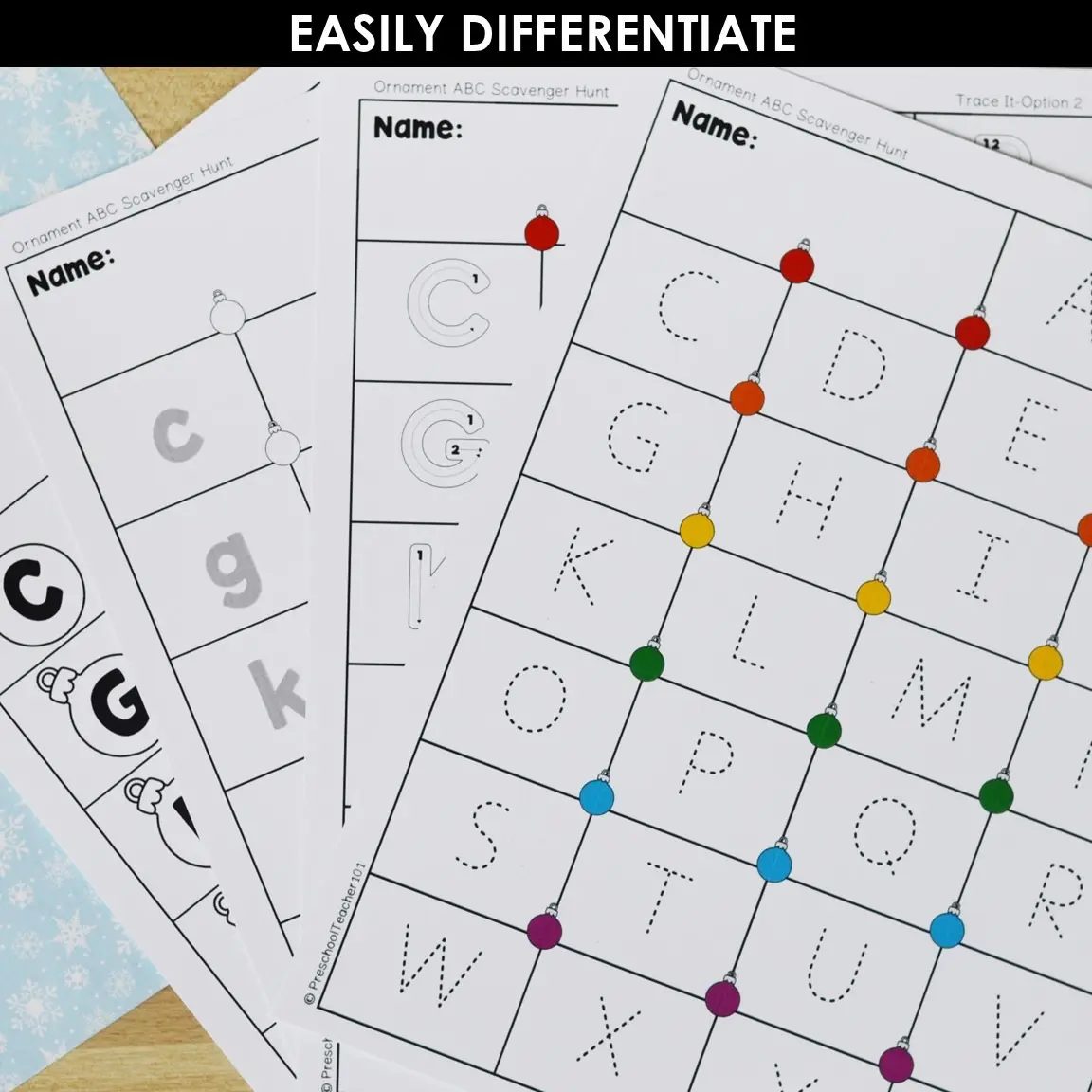
Classrooms are inherently diverse, housing students at various developmental milestones. The Ornament ABC Scavenger Hunt addresses this through customizable implementation:
- Targeted Interventions: Educators can isolate specific letter clusters (such as a child’s initials or difficult phonemes like b, d, p, and q) rather than forcing an entire classroom to tackle the full alphabet simultaneously.
- Flexibility in Recording: The availability of both coloring sheets and manipulative-based covering options (such as mini-erasers, counting cubes, or flat floral marbles) accommodates diverse fine motor skill levels and sensory processing needs.
OFFICIAL STATEMENTS AND PEDAGOGICAL INSIGHTS
Early childhood educators, curriculum specialists, and developmental experts have increasingly spoken out regarding the necessity of play-based learning frameworks.
"When children are allowed to move, explore, and play while interacting with letters, the anxiety associated with academic pressure diminishes," notes a leading preschool curriculum specialist. "A scavenger hunt transforms a test of memory into a game of discovery. The child is no longer just studying the letter ‘A’; they are hunting for it, tracking it, and celebrating its capture."

Furthermore, educators emphasize the importance of low-prep resources in modern classrooms. With teachers facing increasing administrative burdens and time constraints, tools that require minimal setup while yielding high instructional value are vital.
"Teachers do not need more complicated lesson plans in December; they need intuitive, adaptable resources that keep students focused," an elementary reading specialist explains. "The Ornament ABC Scavenger Hunt provides structural freedom. Whether utilized in a bustling classroom, a quiet home-school environment, or even adapted for outdoor play on a mild winter day, it meets the child where they are."
FUTURE OUTLOOK: THE TRAJECTORY OF GAMIFIED EARLY LEARNING
As educational technology and printable curricula continue to evolve, the demand for hybrid resources—those blending tactile printables with physical movement—remains robust.

Customization and Digital Integration
Future iterations of seasonal scavenger hunts are expected to incorporate even greater flexibility, allowing educators to instantly generate customized spelling lists, bilingual letter sets, and advanced phonics blends. However, the core tactile experience—holding a pencil, coloring a box, or placing a physical counter over a found letter—will likely remain central, preserving the crucial fine-motor development milestones necessary before formal writing begins.
Broadening Beyond the Holidays
While the Christmas Ornament ABC Scavenger Hunt captures a specific seasonal magic, the underlying methodology is expanding to encompass every month of the calendar year. From spring garden hunts to autumn leaf-counting alphabets, the framework proves that literacy instruction does not need to be sterile to be rigorous.
Conclusion
The Christmas Ornament ABC Scavenger Hunt Game serves as a prime example of how thoughtful educational design can honor a child’s natural love for play while simultaneously advancing fundamental academic skills. By turning letter recognition into an adventurous quest, educators and parents can ensure that the holiday season remains both joyful and intellectually enriching. For those looking to revitalize their December curriculum, resources like the 39-page comprehensive pack or free sampler options provide an accessible, highly effective pathway toward lifelong literacy.

