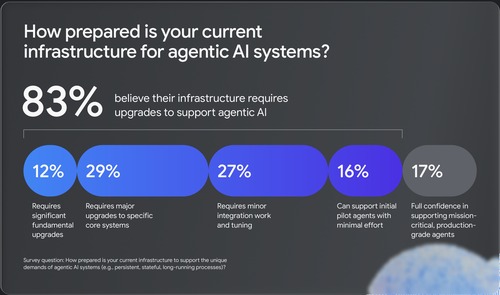
The enterprise technology landscape is undergoing a profound structural evolution. As artificial intelligence makes the definitive leap from static, prompt-based experimentation to dynamic, autonomous execution, businesses are discovering a formidable bottleneck: their underlying IT infrastructure. According to the newly released 2026 State of Infrastructure in the Agentic AI Era report from Google Cloud, a staggering 83% of organizations believe their current architecture requires substantial upgrades to successfully support production-grade agentic AI systems.
For years, corporate artificial intelligence strategies centered around foundational large language models (LLMs), basic chatbots, and isolated proofs-of-concept. However, the rise of agentic AI—autonomous systems capable of independent reasoning, continuous planning, and executing multi-step workflows across disparate legacy applications—places fundamentally different demands on enterprise tech stacks. Unlike traditional software or standard generative AI queries, a single agentic prompt can effortlessly trigger hundreds of downstream actions. These include browsing repositories, querying databases, writing code, and executing transactions across enterprise resource planning (ERP) and customer relationship management (CRM) systems.
This paradigm shift has exposed a critical infrastructure gap. Enterprises are no longer merely managing passive models that respond to a single user prompt; they are managing persistent, stateful, and potentially long-running digital workers. To handle these demands, enterprise infrastructure must evolve rapidly, integrating advanced orchestration, strict data governance, robust edge deployment capabilities, and continuous inference pipelines. This comprehensive report explores the findings of Google Cloud’s latest research, details the specific readiness gaps plaguing organizations, analyzes the architectural requirements of autonomous agents, and maps out the roadmap for IT leaders navigating this transformative era.
Detailed Chronology: From Static GenAI Experiments to Autonomous Agents
To fully understand the urgency surrounding the 2026 infrastructure gap, it is necessary to examine the rapid evolutionary trajectory of enterprise artificial intelligence over recent years.
2023–2024: The Generative AI Gold Rush and the Sandbox Era
When generative AI burst into the mainstream enterprise consciousness, the primary objective for Chief Information Officers (CIOs) and Chief Technology Officers (CTOs) was rapid experimentation. Organizations rushed to establish innovation sandboxes, testing the capabilities of commercial and open-source foundation models. During this initial phase, infrastructure concerns were largely abstracted away by managed cloud services and API endpoints. Companies evaluated AI based on model accuracy, token costs, and creative output. Infrastructure bottlenecks, while present, were often viewed as secondary challenges to be solved "later" once use cases proved their business value.
2025: The Awakening and the Infrastructure Reality Check
By 2025, the limitations of isolated experimentation became glaringly apparent. Google Cloud’s landmark 2025 infrastructure research—widely cited across the industry as a wake-up call—revealed that while nearly all enterprises were experimenting with generative AI, moving those pilots into secure, scalable production was a monumental hurdle. That research underscored the missing pieces in enterprise GenAI strategies: fragmented data governance, complex cloud integration hurdles, prohibitive computational costs, and the absolute necessity of hybrid and edge deployment strategies.
Yet, even as organizations began addressing these foundational data and cloud integration challenges, the very definition of enterprise AI began to shift beneath their feet. The industry quickly transitioned from static, reactive generation to proactive, goal-driven autonomy.
2026: The Agentic AI Era and the New Infrastructure Mandate
Entering 2026, the conversation has fundamentally shifted. Enterprises are no longer satisfied with AI tools that simply draft emails or summarize documents on demand. They are deploying autonomous agents designed to solve complex business problems end-to-end.
Google Cloud’s 2026 State of Infrastructure in the Agentic AI Era report captures this critical juncture. The research highlights that the infrastructure requirements for agentic workflows are vastly different from those of standard GenAI applications. Autonomous agents require persistent states, secure long-term memory, real-time access to multiple internal and external data sources, and the ability to sustain multi-step operational chains without human intervention at every turn. Consequently, the 83% readiness gap identified in the 2026 report represents a profound realization among enterprise leaders: legacy data centers and cloud configurations built for traditional web applications—or even first-generation GenAI models—are simply unequipped for the autonomous enterprise.
Supporting Context & Metrics: Unpacking the Infrastructure Readiness Gap
The data compiled in Google Cloud’s 2026 research provides a granular look at how prepared—or unprepared—global enterprises are for the agentic wave. The headline figure—that 83% of organizations require infrastructure upgrades—is further illuminated when broken down into specific tiers of readiness and operational need.
The Breakdown of Enterprise Readiness
Full Confidence (17%): Only a tiny fraction of surveyed organizations report complete confidence in their current infrastructure to support mission-critical, production-grade agentic AI systems without further intervention.
Minimal Effort Required (16%): A slightly smaller group indicates that their infrastructure can currently support initial, low-stakes pilot agents with minimal effort, though scaling these systems remains an open question.
Minor Integration and Tuning (27%): More than a quarter of respondents require minor integration work, minor software updates, and targeted performance tuning to bridge the gap between their current cloud environments and agentic requirements.
Major Upgrades to Specific Core Systems (29%): The single largest segment of organizations acknowledges that major architectural overhauls are needed for specific core systems—such as legacy databases, security perimeters, and data pipelines—before agents can operate safely.
Significant Fundamental Upgrades (12%): Alarmingly, over one in ten organizations admit that their underlying infrastructure is entirely outdated and requires fundamental, ground-up rebuilding to handle autonomous workloads.
Why Agentic Workloads Break Traditional Architectures
To understand why four out of five organizations fall short, one must examine the unique operational mechanics of autonomous agents. Traditional enterprise applications are deterministic: user inputs trigger predefined application logic, query specific relational databases, and return predictable outputs.
In contrast, agentic AI introduces non-deterministic, probabilistic execution loops. When an enterprise deploys an agent to optimize supply chain inventory, for instance, the agent must:
Perceive and Plan: Analyze real-time sales data, weather patterns, and shipping delays to formulate a multi-step execution plan.
Execute Across Boundaries: Query enterprise resource planning (ERP) systems, interact with third-party logistics APIs, and send authorization requests.
Maintain Context: Retain memory of previous decisions across long-running workflows that may span hours, days, or weeks.
Self-Correct: Monitor its own success criteria, identify errors (such as an API timeout or denied permission), and dynamically alter its strategy to achieve the goal.
This continuous cycle of reasoning, tool use, and state management creates unprecedented demands on network bandwidth, storage IOPS, database locking mechanisms, and security auditing tools. Without specialized infrastructure, agents risk hallucinating actions, creating infinite execution loops, violating data privacy regulations, or overwhelming legacy backend systems with runaway query volumes.
Official Statements and Industry Insights
As enterprises grapple with these architectural realizations, industry leaders are emphasizing that infrastructure readiness is the ultimate competitive differentiator in the age of AI.
Weighing in on the implications of the 2026 report, Nirav Mehta, Vice President of Product Management at Google Cloud, offered a clear directive for enterprise technology leaders:
"This report isn’t just a survey of the landscape; it’s a roadmap for establishing the new standard for production-grade autonomous systems."
Mehta’s perspective underscores that retrofitting old architectures is no longer a viable long-term strategy. As autonomous agents take on higher-stakes business functions—ranging from automated financial auditing and customer dispute resolution to autonomous software engineering and infrastructure management—the margin for error shrinks to near zero.
Industry analysts echo this sentiment, noting that the conversation among enterprise buyers has shifted away from model parameters and benchmark scores toward pragmatic engineering concerns. CTOs are increasingly asking vendors about latency, deterministic guardrails, verifiable observability, and cost-predictability for continuous inference workloads.
Furthermore, the 2026 research highlights the growing importance of power consumption and hardware efficiency. As agents run continuous inference loops 24/7, energy costs and sustainability targets have become primary factors in hardware selection. Enterprises are actively seeking accelerated computing infrastructure that delivers maximum performance per watt, driving investments in specialized tensor processing units (TPUs), advanced GPUs, and optimized green-data-center initiatives.
Future Outlook: The Roadmap for IT and Platform Teams
Navigating the agentic infrastructure gap requires a deliberate, strategic roadmap for IT leaders, enterprise architects, and platform engineering teams. Moving from experimental pilots to resilient, production-grade autonomous systems demands investments across several key pillars:
1. Advanced Orchestration and Observability
Because agentic workflows involve complex, non-linear sequences of actions across multiple tools, traditional application monitoring tools are insufficient. Platform teams must invest in advanced orchestration frameworks and deep observability platforms. These tools must provide real-time tracing of agent decisions, allowing human operators to inspect why an agent took a specific action, audit intermediate steps, and safely intervene or override the agent when necessary.
2. Modernized Data Architectures and Long-Term Memory
Agents are only as effective as the data they can access and remember. Enterprises must modernize their data estates, moving away from fragmented silos toward unified, high-performance data lakes and vector databases that support rapid semantic search and persistent context retention. Data governance policies must be baked directly into the data layer, ensuring that autonomous agents can only access information and execute transactions for which they have explicit authorization.
3. Distributed Edge Execution and Hybrid Cloud Flexibility
Not all agentic workloads belong in centralized hyperscale clouds. Many edge scenarios—such as autonomous manufacturing floors, retail logistics hubs, and remote field operations—require agents to operate with ultra-low latency and local resilience, even during intermittent network outages. The 2026 infrastructure roadmap emphasizes distributed execution frameworks that seamlessly span on-premises data centers, edge nodes, and multi-cloud environments.
4. Human-in-the-Loop Governance Frameworks
As agents assume greater autonomy, the governance challenge shifts from passive compliance to active operational safety. Organizations must establish clear governance frameworks that define the operational boundaries of agents. This includes hard stops for high-value financial transactions, automated compliance checks for data residency regulations, and seamless escalation protocols that route ambiguous or high-risk decisions to human experts.
Conclusion
The findings of Google Cloud’s 2026 State of Infrastructure in the Agentic AI Era report deliver a clear message to the global enterprise community: the era of easy AI experimentation has ended, and the era of rigorous architectural engineering has begun. With 83% of organizations acknowledging that their current infrastructure falls short, bridging this readiness gap is the defining challenge for IT leaders in the years ahead.
Organizations that proactively modernize their core systems, invest in robust orchestration and observability, secure their data pipelines, and prioritize power-efficient hardware will successfully harness the immense productivity and innovation potential of autonomous agents. Conversely, those that attempt to run production-grade agentic workloads on legacy infrastructure risk severe operational bottlenecks, security vulnerabilities, and competitive obsolescence. The path forward demands vision, investment, and a total commitment to building the resilient digital foundations required for the autonomous enterprise.