

Executive Overview
As artificial intelligence rapidly transitions from experimental chat interfaces to autonomous, action-oriented systems, enterprise IT infrastructure faces an unprecedented architectural stress test. Traditional enterprise infrastructure—historically siloed into rigid virtual machine (VM) clusters or fragmented container pools—was never designed to support the immense computational concurrency, low-latency requirements, and fluid data mobility demanded by agentic AI workloads.
To bridge this operational chasm, Nutanix has announced a sweeping set of enhancements to the Nutanix Cloud Platform (NCP), engineered specifically to anchor production-grade agentic AI. Centered around the immediate general availability (GA) of Nutanix Enterprise AI (NAI) 2.8, the upcoming release of the Nutanix Kubernetes Platform (NKP) 2.19, and the debut of Service Provider Central (SP Central), this comprehensive platform evolution introduces a "dual-native" architectural model. By treating virtual machines and containers as equal, first-class citizens under a unified management and governance plane, Nutanix aims to grant enterprises the freedom to deploy next-generation AI workflows directly adjacent to their existing business-critical applications and data stores.
Rather than forcing organizations to rip and replace legacy infrastructures or re-architect stable database systems into isolated, single-purpose deployment silos, the expanded Nutanix Cloud Platform provides a seamless bridge. It introduces sophisticated Model Context Protocol (MCP) server management, advanced private inference capabilities, expanded bare-metal Kubernetes orchestration, and centralized multitenant control. This article provides an in-depth, investigative look into these platform updates, evaluating their technological mechanics, architectural significance, and broader implications for the enterprise cloud landscape.
Detailed Chronology of Releases and Architectural Evolution
The rollout of these advanced enterprise capabilities follows a deliberate, highly coordinated engineering roadmap executed by Nutanix throughout August 2026. Understanding the chronological sequence of these developments highlights how the company systematically built out its agentic AI ecosystem from the foundational API layer up to full-scale infrastructure orchestration.
The Foundation: Open-Source MCP Server for NCP (August 10, 2026)
The groundwork for the current platform updates was laid on August 10, 2026, when Nutanix released its open-source Model Context Protocol (MCP) server for the Nutanix Cloud Platform. Designed as an extensible bridge between modern developer workflows and core infrastructure, this software leverages the robust Nutanix Prism v4 API.

By utilizing this open-source protocol, AI agents and prominent developer assistants—including GitHub Copilot, Claude Code, and Cursor—gain the programmatic ability to interact directly with the infrastructure platform. Crucially, this interaction is not an insecure "wild west" of programmatic execution; all agent-driven requests are funneled through the Prism v4 API Gateway. This gateway enforces stringent execution, governance, and security controls, incorporating granular role-based access control (RBAC), API rate-limiting throttling, fine-grained metering, and comprehensive auditing trails. This release established the bedrock for secure agent-to-infrastructure communication.
The Core Expansion: NAI 2.8 and Global Announcements (August 26, 2026)
Building directly upon the August 10 foundational release, Nutanix officially announced its major ecosystem enhancements on August 26, 2026. The centerpiece of this announcement is the immediate general availability of Nutanix Enterprise AI (NAI) 2.8, alongside the formal preview of Nutanix Kubernetes Platform (NKP) 2.19 and the general availability of Service Provider Central (SP Central).
- Service Provider Central (SP Central): Rolled out for immediate deployment, SP Central serves as a comprehensive, multitenant control plane. It is architected to unify infrastructure management, application delivery, cloud-native operations, and AI services across distributed enterprise estates or managed service provider environments.
- Nutanix Enterprise AI 2.8: Generally available immediately, NAI 2.8 introduces production-grade MCP server management within the Nutanix Agent Gateway, alongside powerful enhancements to private inference pipelines.
- Nutanix Kubernetes Platform 2.19: Tagged as "available soon," NKP 2.19 targets advanced container management across both virtualized environments and bare-metal physical servers, bolstered by a dedicated AI Applications Catalog.
Deep Dive: Technological Mechanics of NAI 2.8 and Agent Governance
Agentic AI systems differ fundamentally from traditional generative AI models. While a standard LLM simply responds to a static text prompt, an autonomous agent actively plans, executes multi-step workflows, queries external databases, and modifies system states using specialized tools. Managing these agents securely within a corporate network requires rigorous perimeter controls—a challenge that Nutanix addresses directly in NAI 2.8 through the evolution of the Nutanix Agent Gateway.
+-----------------------------------------------------------------+
|                       AI Agent Assistants                       |
|        (GitHub Copilot, Claude Code, Cursor, Custom Agents)     |
+--------------------------------|--------------------------------+
                                 | Secure API Calls
                                 v
+-----------------------------------------------------------------+
|                    Nutanix Agent Gateway                        |
|   - Centralized Governance & Policy Enforcement                 |
|   - Tool Permissions (User / API Key Level)                     |
|   - Rolling Updates for Local MCP Servers                       |
+--------------------------------|--------------------------------+
                                 | Controlled Routing
         +-----------------------+-----------------------+
         |                                               |
         v                                               v
+------------------------+                     +------------------------+
| Local MCP Servers      |                     | Remote MCP Servers     |
| (Hosted in NAI Env)    |                     | (External / Cloud)     |
+------------------------+                     +------------------------+
Centralized MCP Server Management in Agent Gateway
In NAI 2.8, the Nutanix Agent Gateway evolves from a basic routing proxy into a centralized command-and-control center for MCP servers. The Agent Gateway acts as an intermediary connection point mediating all traffic between autonomous AI agents and local or remote MCP servers.
From an administrative perspective, this architecture provides crucial governance controls:
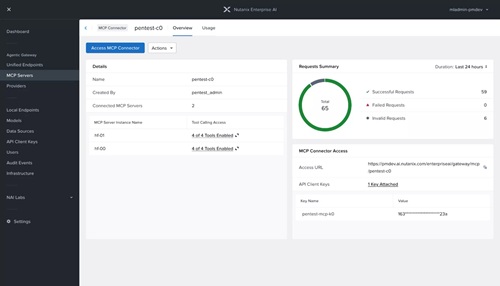
- Granular Tool Permissions: IT and security administrators can assign specific tool usage permissions down to individual users or distinct API keys. This ensures that a marketing-focused AI agent cannot inadvertently or maliciously trigger infrastructure-level commands reserved for systems administrators.
- Local and Remote Server Flexibility: Organizations can deploy MCP servers locally within their secure Nutanix Enterprise AI environment for ultra-low-latency, air-gapped security, or connect to trusted remote MCP endpoints.
- Lifecycle Management: Locally deployed MCP servers benefit from streamlined administrative tooling, including support for rolling updates that eliminate downtime during patches and upgrades.
Advancements in Nutanix Private Inference
Beyond agent governance, NAI 2.8 heavily fortifies private inference capabilities, catering to enterprises that demand strict data sovereignty and local model execution:
- Fine-Tuning: The platform now supports fine-tuning for models with fewer than 8 billion parameters, enabling organizations to customize open-source foundation weights using proprietary corporate data without leaking intellectual property to public cloud endpoints.
- NVIDIA NIM Microservices in Air-Gapped Environments: Enterprises operating in high-security, completely disconnected (air-gapped) environments can now seamlessly deploy, scale, and manage NVIDIA NIM microservices, maximizing the performance of underlying NVIDIA GPUs.
- Cutting-Edge Previews: NAI 2.8 introduces technical previews for multi-node and multi-GPU inference—engineered specifically to handle massive foundational models exceeding 100 billion parameters. Additionally, Key-Value (KV) cache offloading from expensive GPU memory to host CPU memory is introduced in technical preview, optimizing memory utilization for high-concurrency workloads. (Note: Nutanix formally cautions that all technical preview features must not be deployed into mission-critical production environments).
NKP 2.19: Bridging Virtualization, Bare-Metal, and Cloud-Native AI
As modern cloud-native architectures converge with high-performance machine learning pipelines, the boundaries between traditional virtualization and containerization continue to blur. With the impending release of Nutanix Kubernetes Platform (NKP) 2.19, Nutanix is delivering a unified container management fabric designed to span both virtualized hypervisors and physical bare-metal hardware.
NKP Metal and NKP on AHV
A standout capability of the NKP 2.19 release is NKP Metal, which extends the familiar, automated Nutanix operating model directly onto physical bare-metal servers. Utilizing native capabilities derived from Nutanix Foundation and Lifecycle Manager (LCM), NKP Metal automates complex operational workflows, including bare-metal node discovery, initial provisioning, and ongoing lifecycle management of operating systems and firmware.
For virtualized environments, NKP on AHV integrates seamlessly with the native Nutanix AHV hypervisor. When combined with Nutanix Flow, organizations can implement robust, network-level micro-segmentation to isolate autonomous AI agents, preventing unauthorized lateral movement across the network in the event of an agent compromise. Furthermore, NKP has officially achieved CNCF Kubernetes AI Conformant Platform certification, validating its adherence to rigorous cloud-native interoperability and AI workload standards.
The AI Applications Catalog
Deploying complex machine learning frameworks on Kubernetes has historically required deep expertise in container orchestration, storage configuration, and networking. NKP 2.19 addresses this friction by introducing a curated AI Applications Catalog.

This pre-validated catalog allows platform engineers and data scientists to rapidly deploy complex AI and data-processing software stacks with a single click. Notable software packages available out-of-the-box via the catalog include:
- Kubeflow: For orchestrating scalable, production-grade machine learning pipelines on Kubernetes.
- Milvus: A high-performance, distributed vector database engineered to power semantic search and Retrieval-Augmented Generation (RAG) pipelines for AI agents.
- Slurm: A robust, enterprise-grade workload manager traditionally used in high-performance computing (HPC) clusters, now accessible within the containerized stack to schedule massive training and inference tasks.
Supporting Context and Strategic Metrics
To fully appreciate the gravity of Nutanix’s platform expansion, one must examine the broader macro-trends reshaping enterprise IT budgets and architectural strategies in 2026.
For years, early enterprise AI deployments followed a fractured, hyperscale-centric playbook. Organizations felt pressured to extract their valuable corporate data from secure on-premises data centers and migrate it into specialized, public cloud AI silos. However, this approach introduced significant friction points:
- Data Gravity and Latency: Moving petabytes of enterprise data across wide-area networks to reach cloud-based AI inference engines proved cost-prohibitive and introduced unacceptable latency for real-time agentic interactions.
- Security and Compliance: Regulatory frameworks (such as GDPR, HIPAA, and emerging global AI acts) demand uncompromising data sovereignty and auditing. Exposing proprietary customer data to external SaaS AI endpoints created unacceptable compliance liabilities.
- Operational Silos: Managing AI applications on entirely separate infrastructure stacks fractured IT operations, forcing systems administrators to maintain parallel, non-integrated skill sets, monitoring tools, and security policies.
Nutanix’s "dual-native" architectural strategy—treating VMs and containers as first-class, co-equal infrastructure primitives—directly targets these pain points. By enabling organizations to run agentic AI workflows immediately adjacent to the existing relational databases, ERP systems, and enterprise data lakes already housed on the Nutanix Cloud Platform, enterprises eliminate redundant data transfer costs while slashing inference latency.
Official Industry Perspectives and Leadership Commentary
The strategic rationale behind the new platform updates was underscored by executive leadership during the rollout announcements.

Thomas Cornely, Executive Vice President of Product Management at Nutanix, emphasized the company’s core philosophy regarding enterprise technological integration:
"Enterprise AI should not require customers to rebuild the systems that already run their business."
Cornely’s statement encapsulates the core value proposition of NAI 2.8 and NKP 2.19. By building governance, inference acceleration, and container orchestration directly into the established Nutanix control plane, the company is shielding enterprise customers from the disruptive operational tax of building bespoke AI infrastructure from scratch.
Industry analysts tracking the enterprise cloud sector have noted that Nutanix’s aggressive embrace of the Model Context Protocol (MCP) positions the company uniquely ahead of the curve. While many infrastructure vendors are still struggling to provide basic GPU virtualization, Nutanix is moving up the stack—solving the harder, governance-heavy problem of how autonomous software agents securely access, query, and modify enterprise infrastructure without compromising operational stability or security compliance.
Future Outlook: The Road Ahead for Enterprise Agentic AI
As enterprises transition from proof-of-concept AI projects to fully autonomous, mission-critical agentic deployments, the underlying infrastructure must be inherently resilient, observable, and secure. The introduction of NAI 2.8, NKP 2.19, and SP Central marks a significant maturation milestone for the Nutanix Cloud Platform.

Looking forward, several key trajectories will define the success of this architectural approach:
- Mainstreaming of Technical Previews: As multi-node/multi-GPU inference for 100B+ parameter models and KV cache offloading graduate from technical preview to general availability, Nutanix will unlock even greater performance density for ultra-large enterprise language models running on-premises.
- Deeper Ecosystem Integration: Expect further expansion of the open-source MCP server integrations, allowing an even wider array of developer environments, IDE plugins, and third-party AI frameworks to interact securely with Nutanix Prism v4 APIs.
- Unified Edge-to-Core-to-Cloud Governance: With SP Central establishing a multitenant control plane, enterprises and managed service providers will increasingly lean toward unified operational models that seamlessly manage distributed edge computing nodes, core enterprise data centers, and private cloud environments from a single pane of glass.
Ultimately, Nutanix’s strategy signals a profound shift in how enterprise infrastructure vendors view the artificial intelligence boom. By refusing to treat AI as an isolated, exotic workload requiring entirely separate operational silos, Nutanix is successfully positioning its cloud platform as the natural, intelligent operating system for the autonomous enterprise of tomorrow.

