
Executive Overview
For millions of students and educators worldwide, Kahoot! is instantly recognizable as the ultimate classroom icebreaker. It is the high-energy digital tool deployed during the final ten minutes before the lunch bell, the spirited Friday review session, or the dependable mid-lesson reset designed to capture wandering attention. Across diverse curriculums and age groups, the platform’s cheerful interface, vibrant colors, and real-time leaderboards have earned a reputation as the gold standard for student engagement.
However, beneath the playful competition and upbeat soundtracks lies a deeply powerful, yet frequently underutilized, educational utility: data-driven formative assessment.
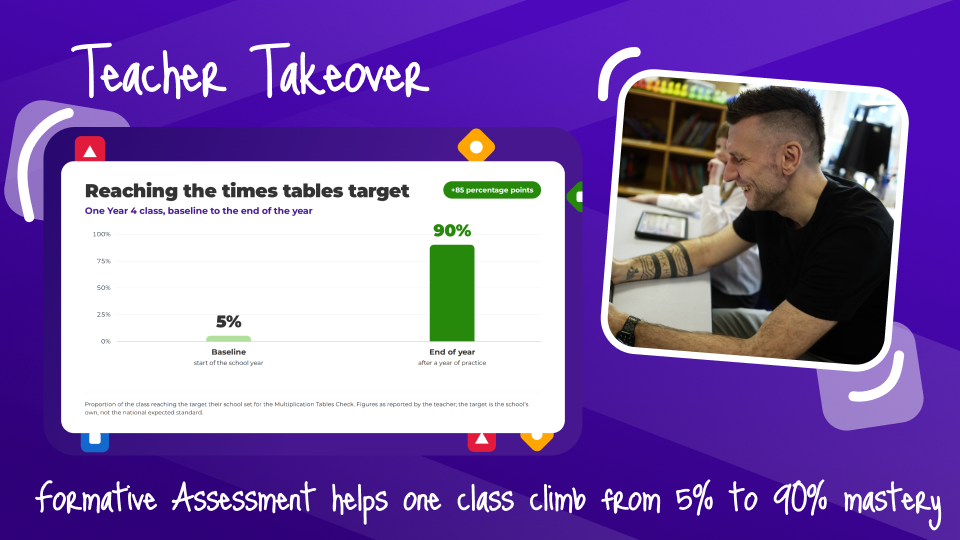
For Simon Hunt, a Year 4 teacher in the United Kingdom and a long-standing Kahoot! Ambassador, viewing the platform purely as an interactive game was a missed opportunity. By fundamentally shifting how he deployed the software—using it not just as a summative reward at the end of a unit, but as a diagnostic pre-assessment tool at the very beginning—Hunt unlocked a dramatic transformation in his students’ academic outcomes. Over the course of a single academic year, the percentage of his students meeting the rigorous targets for the United Kingdom’s official Multiplication Tables Check (MTC) skyrocketed from a baseline of 5% to an astonishing 90%.
This in-depth report explores Hunt’s pedagogical pivot, detailing how strategic instructional design, gradual cognitive load scaling, and the intelligent extraction of learning analytics can convert casual gameplay into measurable academic mastery.
Detailed Chronology: Rethinking the Quiz
To understand the magnitude of Hunt’s achievement, one must examine how the tool is traditionally integrated into primary education. Historically, educators rely on quizzes as a summative measure—a terminal endpoint designed to evaluate how much information students absorbed over a multi-week instructional period.
Hunt operated under this traditional framework for years. He utilized the software to inject adrenaline into tired classrooms, acknowledging that his students loved the competitive element. Yet, a fundamental mindset shift occurred when he began experimenting with chronological inversion: starting the instructional unit with the end-of-unit quiz.
Phase One: The Pre-Instruction Baseline
Ahead of introducing a new curriculum unit—such as a history module on the Romans or an intensive mathematics block—Hunt builds a ten-question diagnostic kahoot. Crucially, these questions do not cover the material he plans to teach that week; instead, they target the precise concepts he expects the class to master six weeks into the future, once the unit concludes.
He administers this assessment before teaching a single minute of the content. As expected, the vast majority of the class struggles, frequently getting most of the answers incorrect. For Hunt, however, this initial failure is the entire objective. The baseline assessment is not designed for students to pass; it is designed to map the intellectual terrain of the classroom. It highlights what students intuitively know, where critical misconceptions lie, and which advanced questions a surprising subset of learners can already navigate independently.
To ensure this diagnostic remains stress-free, Hunt deliberately disables the platform’s competitive scoring mechanism during the first run. Points are stripped from the equation, meaning an answer yields the exact same value whether submitted in two seconds or twenty. By removing the time penalty, the data reflects genuine cognitive retention rather than rapid thumb-twitching, shielding students from the anxiety of competing over unlearned material.
Phase Two: Dynamic Lesson Plan Revision
Once the diagnostic report is generated, Hunt engages in the step that separates traditional instruction from truly responsive teaching: he rewrites his lesson plans based on the live data.
"That pre-assessment information can actually change my lesson planning," Hunt explains. "There is little point spending several lessons teaching something the children already know. Equally, if the data highlights a misconception, I can make sure we tackle it."
The automated reporting backend of the platform instantly categorizes class-wide struggles alongside individual student performance metrics. Armed with this granular insight, Hunt can truncate two planned lessons on a concept his students have already mastered, redirecting that valuable instructional time toward remediating fragile foundational concepts. By catching conceptual misunderstandings in week one rather than week six, he prevents learning gaps from hardening into permanent roadblocks.
Supporting Context & Metrics: Conquering the Multiplication Tables Check
The ultimate stress test for Hunt’s methodology came in the form of the Multiplication Tables Check (MTC), a standardized national assessment administered by the UK Department for Education (DfE) to all Year 4 students every June.
The High-Stakes Pressure Cooker
The parameters of the MTC are unforgiving:

- Format: Twenty-five randomized questions drawn from the 2x through 12x multiplication tables.
- Pacing: Exactly six seconds allotted per question.
- Delivery: Typed numerical input directly onto a digital screen.
For nine-year-olds, dropping straight into a timed, high-stakes national assessment with a restrictive six-second timer is a recipe for acute test anxiety. When Hunt evaluated his incoming cohort using initial baseline diagnostics, only 5% of the students met the school’s internal MTC target. Panic, cognitive overload, and time-pressure paralysis were crippling their mathematical recall.
Gradual Cognitive Load Scaling
Recognizing that six seconds is an intimidating constraint, Hunt engineered a systematic, stepped approach to build student resilience and speed simultaneously. Rather than forcing students to sprint from day one, he eased them into the format through incremental adjustments:
- Comfortable Timers and Multiple Choice: Students began their multiplication practice using multiple-choice questions paired with generous time limits.
- Gradual Speed Increments: Over successive weeks, the timer was incrementally reduced. Because the decrease happened in micro-steps visible to the class, the descent toward the six-second threshold felt natural rather than jarring.
- Format Mutation: Once the class mastered the six-second pace in a multiple-choice format, Hunt introduced the real variable: changing the interaction type. Students shifted from selecting pre-rendered answers from a lineup to typing numerical values independently from memory—mirroring the exact interface of the official DfE exam.
- Iterative Duplication: By simply duplicating his pre-existing kahoots, adjusting a single setting (timer or input type), and replaying them the following week, Hunt kept workload minimal for himself while maximizing adaptability for his students.
By the time June arrived, the format held zero surprises. The rigorous pacing felt entirely ordinary, and students had spent months building multiplication fluency through play rather than rote misery. Consequently, the percentage of his students meeting the school’s target leaped from 5% to an incredible 90%.
Official Statements & Pedagogical Philosophy
Hunt’s methodology highlights a broader evolution in how educators perceive EdTech tools. No longer viewed merely as digital babysitters or engagement gimmicks, interactive learning platforms are increasingly recognized as sophisticated data-collection engines.
Reflecting on his journey, Hunt emphasizes the longitudinal value of preserving assessment data:
"We can see the progress, identify anything that still needs revisiting, and keep that information for the next teacher too. That, for me, is where Kahoot! becomes much more than a quiz."
By ensuring students log in consistently under identifiable profiles, individual reports line up cleanly across the academic year. This longitudinal tracking ensures that when students transition to a new grade level every September, their incoming teachers inherit concrete diagnostic profiles rather than speculative hunches.

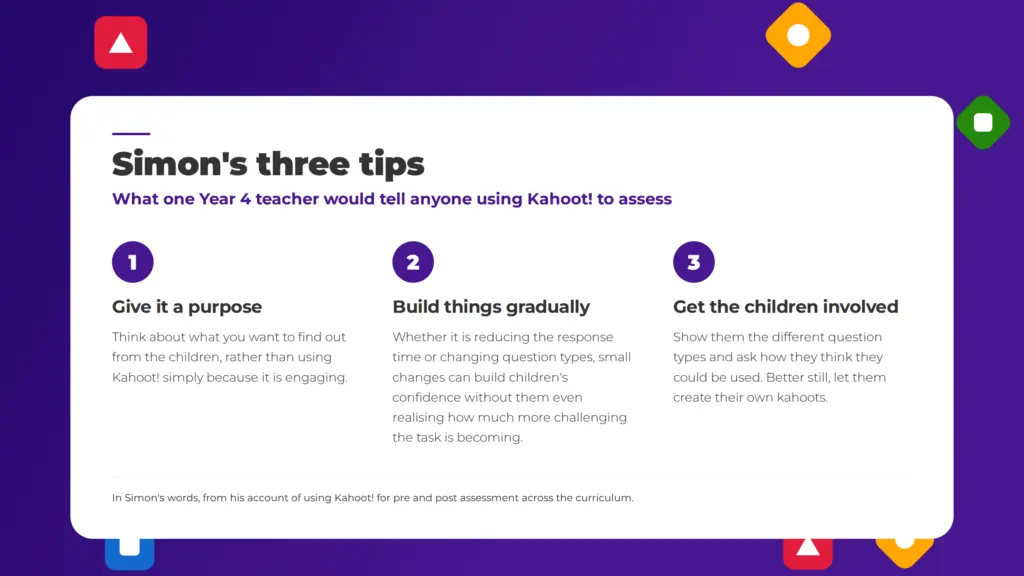
Simon Hunt’s Three Core Rules for Educators
For teachers looking to replicate this success, Hunt offers three practical guidelines:
- Define the Diagnostic Goal First: Determine precisely what data you need to extract before building a game, ensuring every question serves an analytical purpose.
- Vary One Variable at a Time: Never alter both the timer and the question format in the same week. Allow student confidence to adapt incrementally to rising difficulty.
- Empower Student Creators: Hand the content-building process over to the learners. Allowing students to design their own educational games deepens their metacognitive understanding of how questions are structured and evaluated.
Future Outlook: The Evolution of Diagnostic Gamification
The dramatic success observed in Hunt’s Manchester classroom points toward a broader paradigm shift in primary and secondary education. As administrative demands on teachers increase and instructional time remains strictly finite, the integration of real-time formative assessment tools into everyday lesson flows is transitioning from an innovative luxury to an instructional necessity.
Future developments in educational software are expected to lean heavily into automated data synthesis, leveraging artificial intelligence to analyze student response patterns and proactively suggest targeted intervention materials. However, as Hunt’s methodology proves, sophisticated technology does not require an overhaul of pedagogical theory; rather, it demands a willingness among educators to look past the surface-level entertainment value of digital tools and tap into the rich, actionable data streams flowing beneath.
By transforming a classroom energizer into a precision diagnostic engine, educators can bridge the gap between student engagement and academic mastery—ensuring that play and progress are no longer mutually exclusive, but mutually reinforcing.

