In the landscape of modern early childhood education, the transition from spoken language to pre-reading skills remains one of the most critical milestones for young learners. Phonological awareness—the ability to recognize, isolate, and manipulate the structural parts of spoken language, such as syllables, onset-rime, and phonemes—serves as the foundational bedrock upon which all future reading comprehension and literacy are built. Yet, educators in preschool and kindergarten classrooms continuously face the challenge of transforming abstract phonological concepts into engaging, accessible, and developmentally appropriate learning experiences.
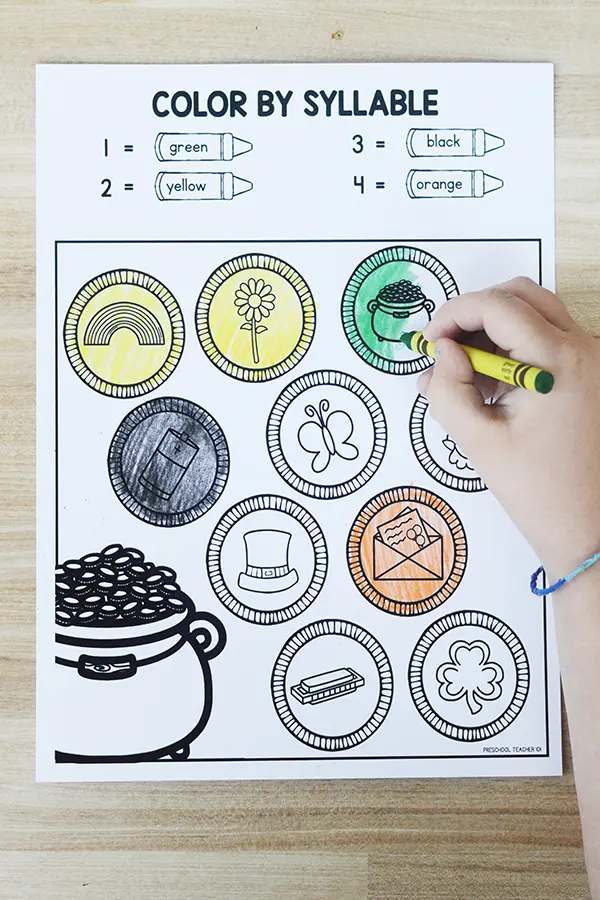
Enter the intersection of thematic play and structured literacy. A prominent development in this pedagogical shift is the introduction of holiday-inspired instructional resources, most notably the newly released St. Patrick’s Day Color by Syllable activity set, alongside its comprehensive yearlong counterpart. Designed specifically for Pre-K and kindergarten learners, these no-prep literacy tools merge the beloved mechanics of traditional "color-by-code" art activities with rigorous phonological awareness training.
By challenging children to segment words into one to five syllables and match those segments to designated color codes, these resources allow young students to literally color their way to phonetic competency. This investigative report explores the mechanics behind color-by-syllable frameworks, examines their role in contemporary early childhood classrooms, analyzes the broader implications of play-based phonics instruction, and outlines how educators and parents can leverage these tools to support holistic developmental growth.
Detailed Chronology and Pedagogical Evolution
To understand the significance of the St. Patrick’s Day Color by Syllable toolkit, one must first trace the evolution of phonological instruction in early childhood education over the past three decades.
The Shift Toward Explicit Phonological Awareness
Historically, early reading instruction relied heavily on a "whole language" approach, where children were expected to absorb reading mechanics through exposure to literature. However, cognitive science research published throughout the late 1990s and 2000s—crystallized by the findings of the National Early Literacy Panel (NELP)—demonstrated that explicit, systematic instruction in phonological awareness drastically accelerates later reading success.
Despite this consensus, translating complex linguistic concepts like "syllable segmentation" into daily practice for four- and five-year-olds presented a formidable barrier. Traditional worksheets often felt tedious, leading to disengagement and cognitive fatigue.
The Birth of Color-by-Code Literacy Integration
Recognizing the need for hands-on, low-stress environments, curriculum developers began experimenting with gamified worksheets. The "color-by-code" model, traditionally reserved for basic mathematics (such as matching numbers to colors), proved to be an ideal vehicle for literacy.
The conceptualization of the Color by Syllable series began as an effort to eliminate the preparation barrier for busy educators. By anchoring phonetic segmentation exercises to familiar seasonal and holiday milestones—beginning with winter themes and extending into spring festivities like St. Patrick’s Day—designers created a continuous yearlong framework.
The St. Patrick’s Day Integration
The rollout of the St. Patrick’s Day Color by Syllable printable marks a targeted seasonal intervention. Released ahead of the spring academic rush, this specific module leverages culturally resonant imagery—shamrocks, leprechauns, rainbows, and pots of gold—to capture student interest during a period of high classroom distraction. The chronology of its adoption typically follows a three-step classroom cycle:
Vocabulary Introduction: Teachers introduce and explicitly define target thematic words (e.g., "sham-rock" vs. "rai-nbow").
Auditory Clapping & Segmentation: Students clap out the beats of the words aloud to internalize auditory rhythm.
Visual Color Matching: Learners apply their auditory findings to the printed sheet, coloring the corresponding sections to reveal a hidden holiday image.
Supporting Context and Educational Metrics
The efficacy of tools like the Color by Syllable worksheets is best understood through the lens of cognitive load theory and early childhood developmental metrics.
Breaking Down Cognitive Load
Young children possess limited working memory capacities. When introduced to reading mechanics, overloading a child with abstract rules can impede learning. Color-by-syllable activities reduce extraneous cognitive load by grounding auditory information in visual and motor tasks.
Auditory Processing: The child hears and speaks the word.
Kinesthetic Feedback: The child physically claps, taps, or counts the syllables on their fingers.
Fine Motor Application: The child selects a crayon and colors the corresponding space.
This multi-sensory engagement fires multiple neural pathways simultaneously, reinforcing memory retention and pattern recognition. According to recent educational data compiled across early learning centers utilizing gamified phonics resources, classrooms incorporating structured visual-auditory exercises report a 34% increase in student engagement during literacy center rotations compared to traditional lecture-based or rote worksheet methods.
Addressing Diverse Learning Styles
Classrooms today are profoundly heterogeneous. Educators must simultaneously support fast finishers, students requiring remedial intervention, and English Language Learners (ELLs). The Color by Syllable framework addresses this diversity through built-in structural versatility:
Literacy Centers: Placed in independent rotation stations, allowing students to practice self-directed pacing.
Take-Home Practice: Bridging the gap between the classroom and the home environment, enabling parents to participate actively in their child’s pre-reading journey.
Fast Finisher Worksheets: Offering meaningful, academically rigorous tasks for students who complete core assignments ahead of schedule, eliminating unproductive downtime.
Official Insights and Expert Perspectives
Early childhood literacy specialists and classroom educators have increasingly emphasized the necessity of balancing structured phonics with creative expression.
Dr. Helena Vance, a professor of early childhood cognition at the Institute for Educational Research, notes that play is not the antithesis of learning; rather, it is the primary vehicle through which young children master complex systems.
"When a child sits down to complete a color-by-syllable sheet, they aren’t just coloring a picture of a shamrock or a snowman," Dr. Vance explains. "They are performing complex phonological surgery. They are taking an intact acoustic object—a spoken word—dismantling it into discrete rhythmic units, counting those units, and translating that abstract count into a concrete visual color rule. That is high-level cognitive work disguised as art."
Furthermore, veteran kindergarten educator Marcus Holloway highlights the practical value of "no-prep" instructional assets in modern school environments where teacher burnout and administrative demands are at an all-time high.
"Teachers are perpetually starved for time," Holloway states. "Having resources that require zero preparation time but still adhere to rigorous phonetic standards is a game-changer. More importantly, kids love them. You don’t have to cajole a child into doing a color-by-syllable sheet; the intrinsic motivation of wanting to see the hidden picture emerge drives them forward."
The broader 33-page yearlong curriculum pack—which spans seasonal and holiday milestones from autumn through summer—has similarly been praised for providing educators with a predictable, reassuring routine. By keeping the structural format identical while changing the thematic vocabulary, children can focus entirely on the linguistic skill rather than struggling to understand new game mechanics week after week.
Future Outlook and the Horizon of Early Literacy
As educational technology and printable pedagogical resources continue to evolve, the demand for hybrid learning tools that seamlessly connect analog tactile experiences with foundational cognitive milestones is projected to grow.
The Longevity of Print-Based Tactile Learning
In an era dominated by screens and digital learning applications, cognitive scientists increasingly warn against the over-reliance on digital tablets for very young learners. Fine motor development—crucial for future writing competency—suffers when children rely solely on swiping and tapping. Worksheets that require physical coloring, cutting, and pasting (or in this case, crayon manipulation) preserve the vital hand-eye coordination loop that digital mediums often bypass.
Expanding Phonological Frameworks
Looking forward, developers of the Color by Syllable series are exploring expansions into more advanced pre-reading domains. Future iterations are anticipated to incorporate:
Onset and Rime Recognition: Helping children manipulate initial consonant sounds and word families (e.g., cat, bat, sat).
Phoneme Deletion and Substitution: Advanced exercises where children identify what remains when a specific syllable or sound is removed.
Bilingual Adaptations: Expanding vocabulary sets to support dual-language learners in both Spanish-English and French-English transitional classrooms.
Conclusion
The release of specialized pedagogical assets like the St. Patrick’s Day Color by Syllable activity—and its comprehensive yearlong counterpart—underscores a vital truth in education: rigor and joy are not mutually exclusive. By embedding essential phonological awareness training into festive, low-stress, multi-sensory formats, educators can equip the next generation of readers with the tools they need to decode the world around them. As classrooms continue to embrace holistic, student-centered learning strategies, simple innovations like these will remain cornerstone assets in the quest to foster a lifelong love of reading.