

Executive Overview
As the artificial intelligence landscape transitions rapidly from experimental proofs-of-concept and isolated pilots into mission-critical, enterprise-wide deployments, a formidable bottleneck has emerged. The primary obstacle to realizing the full economic and operational value of modern artificial intelligence is no longer algorithmic capability, model intelligence, or prompt engineering. Instead, it is the underlying data center, cloud, and edge infrastructure.
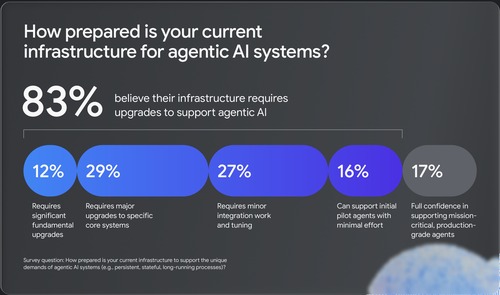
According to the groundbreaking 2026 State of Infrastructure in the Agentic AI Era report released by Google Cloud, a staggering 83% of organizations worldwide acknowledge that their current infrastructure requires substantial upgrades to successfully support production-grade agentic AI systems.
Unlike traditional generative AI (GenAI) workloads—which typically operate on request-and-response paradigms—agentic AI introduces a fundamentally different operational footprint. Autonomous agents are persistent, stateful, and capable of sustained, long-running reasoning loops. A single initial prompt issued to an agentic system can effortlessly trigger hundreds of complex downstream actions, requiring the AI to independently browse web resources, execute database queries, and write data across disparate enterprise systems like Customer Relationship Management (CRM) and Enterprise Resource Planning (ERP) platforms.
This dramatic shift from static generation to autonomous execution exposes a profound infrastructure gap. Enterprises that successfully navigated the initial waves of GenAI experimentation are now discovering that legacy cloud architectures, siloed data repositories, and rigid orchestration tools are entirely unequipped to handle the rigorous demands of autonomous agents operating at scale. This comprehensive report explores the anatomy of this infrastructure readiness gap, the precise technical demands driving the upgrade cycle, the evolution of enterprise IT strategies, and the roadmap organizations must follow to build a resilient foundation for the agentic era.

Detailed Chronology: From Static GenAI Experiments to Autonomous Agents
To fully comprehend the gravity of the 2026 infrastructure crisis, it is vital to trace the technological trajectory that led enterprises to this juncture. The journey of artificial intelligence in the enterprise has accelerated at an unprecedented pace over the past several years, shifting from novelty text generation to deeply integrated enterprise automation.
The 2025 GenAI Baseline: Identifying the Missing Piece
In early 2025, Google Cloud’s landmark infrastructure research revealed a landscape dominated by widespread enthusiasm and broad experimentation. Virtually every major enterprise surveyed was experimenting with generative AI in some capacity. However, those foundational studies highlighted a critical warning: infrastructure was the missing piece in enterprise GenAI strategies.
At that stage, organizations grappled primarily with basic data governance, integration hurdles, cost efficiencies, and the nascent requirements of hybrid cloud and edge deployments. The focus was largely transactional—spinning up large language models (LLMs) to draft emails, summarize documents, or write basic code snippets. While these applications required significant compute power, they were largely stateless, transactional, and insulated from core enterprise transaction engines.
The Agentic Shift of 2026: From Static to Autonomous
By 2026, the paradigm shifted decisively from passive generation to active, autonomous execution. Organizations were no longer content with AI that merely talked about tasks; they demanded AI agents that could perform tasks end-to-end.
This evolution gave rise to agentic workflows. Instead of an employee prompting an LLM to generate a report, an autonomous agent is deployed to monitor market trends, autonomously compile data from external APIs, cross-reference internal sales metrics in a legacy CRM, draft a strategic financial forecast, and execute approvals within an ERP system—all without human intervention at every step.
This transition fundamentally altered the resource profile of AI workloads. The 2026 research highlights that moving agents from sandboxed test environments into production requires addressing complex MLOps pipelines for continuous inference, massively distributed execution models at the network edge, and power consumption constraints that now dictate hardware procurement decisions. The conversation has officially moved from supporting broad GenAI to powering continuous, reasoning autonomous systems.
Supporting Context & Metrics: The Anatomy of the Readiness Gap
The numbers revealed in the 2026 State of Infrastructure in the Agentic AI Era report paint a stark picture of an enterprise ecosystem caught between ambition and technical reality. While 83% of organizations recognize the need for upgrades, the report breaks this readiness gap down into nuanced tiers of required remediation, exposing deep structural vulnerabilities.
Breaking Down the Readiness Tiers
- Full Confidence (17%): A meager 17% of surveyed organizations reported absolute confidence in their current infrastructure stack to support mission-critical, production-grade agentic AI systems without major modifications.
- Minimal Effort / Initial Pilots (16%): Sixteen percent indicated that their infrastructure can adequately support initial pilot agents with minimal effort, though scaling these deployments remains an open question.
- Minor Integration and Tuning (27%): Over a quarter of organizations (27%) stated they require targeted integration work and systematic performance tuning to transition agents from staging to production.
- Major Upgrades to Core Systems (29%): Nearly three-tenths of respondents (29%) reported that major architectural upgrades to specific core systems—such as databases, networking layers, or security protocols—are non-negotiable prerequisites.
- Significant Fundamental Overhauls (12%): Alarmingly, 12% of enterprises admitted that their underlying infrastructure is entirely inadequate, requiring significant, fundamental overhauls before they can even realistically contemplate deploying agentic workloads.
+-------------------------------------------------------------------------+
|                AGENTIC AI INFRASTRUCTURE READINESS BREAKDOWN            |
+-------------------------------------------------------------------------+
| [17%] Full Confidence (Mission-Critical Ready)                          |
| [16%] Minimal Effort (Pilot Stage Only)                                 |
| [27%] Minor Integration & Tuning Required                               |
| [29%] Major Upgrades to Specific Core Systems                           |
| [12%] Significant Fundamental Overhauls Required                        |
+-------------------------------------------------------------------------+
Why Agentic Workloads Break Traditional Infrastructure
The root cause of this widespread readiness gap lies in the unique operational characteristics of autonomous agents compared to traditional applications and legacy GenAI models:

- Persistent Statefulness and Long-Running Execution: Traditional web applications are typically stateless, relying on external databases to hydrate state per request. Agentic AI, however, requires continuous state tracking over extended operational cycles. An agent may execute a multi-step workflow over hours or days, maintaining an active working memory of its objectives, intermediate findings, and historical decisions.
- Exponentially Amplified Workload Volume: As noted by Google Cloud researchers, a single prompt can cascade into hundreds of autonomous API calls, sub-agent spawning events, and database queries. This creates unpredictable, spiky compute and network demands that overwhelm traditional auto-scaling policies designed for human-triggered web traffic.
- Complex Legacy System Integration: Agents do not exist in a vacuum; they must interface with decades-old enterprise software, including on-premises mainframes, rigid relational databases, and modern cloud-native microservices. Bridging the latency, security, and protocol gaps between high-speed AI inference engines and sluggish legacy back-ends is a massive engineering challenge.
- Multi-Environment Security and Data Residency: Production agents operate across hybrid clouds, on-premises data centers, and distributed edge locations. Maintaining strict data governance, zero-trust security postures, and regulatory compliance (such as GDPR or HIPAA) across autonomous, self-directing workflows requires advanced orchestration frameworks that most enterprise IT teams have yet to implement.
Official Statements and Industry Insights
The release of the 2026 infrastructure report has triggered widespread discussion among industry leaders and enterprise architects regarding the future of cloud computing and enterprise automation.
Emphasizing the strategic implications of the findings, Nirav Mehta, Vice President of Product Management at Google Cloud, offered a clear directive for enterprise technology leaders:
"This report isn’t just a survey of the landscape; it’s a roadmap for establishing the new standard for production-grade autonomous systems."
Mehta’s assessment underscores that treating agentic AI as a mere software plugin is a recipe for operational failure. Organizations must systematically re-architect their foundational IT infrastructure to accommodate the autonomous paradigm.

Industry analysts echoing Google’s findings point out that developer and platform engineering teams face an unprecedented convergence of demands. Moving forward, these teams must invest heavily in specialized orchestration and observability tooling. These tools are critical for coordinating multi-step agent workflows, intelligently managing data movement between autonomous agents and immutable legacy systems, monitoring agent behavior in real-time to prevent hallucinations or runaway loops, and establishing seamless human-in-the-loop intervention mechanisms when agents encounter anomalous situations.
Future Outlook: Building the Autonomous Enterprise
As enterprises look toward the remainder of the decade, closing the 83% infrastructure gap will separate market leaders from organizations stalled in perpetual pilot purgatory. Successfully crossing this chasm requires a deliberate, multi-faceted strategic approach across hardware, software, and organizational design.
1. Modernizing the Data Architecture
Autonomous agents are only as smart as the data they can access and interpret in real-time. Enterprises must transition from fragmented data silos to unified, low-latency vector databases and knowledge graphs. This data layer must provide instant, secure access to both structured enterprise records (ERPs, CRMs) and unstructured repositories (documents, emails, audio files) while adhering to strict data lineage and governance standards.
2. Investing in Advanced Orchestration and MLOps
Deploying a fleet of autonomous agents requires sophisticated control planes. Organizations must adopt advanced MLOps and LLMOps frameworks capable of managing continuous inference, monitoring agent drift, and providing granular observability. Developers need robust debugging tools to trace why an agent made a specific decision across a chain of hundreds of autonomous steps, ensuring accountability and auditability.

3. Sustainable Hardware and Edge Distribution
As power consumption becomes an increasingly dominant factor in hardware selection and data center economics, enterprises must optimize their compute footprints. Furthermore, as agentic workflows push closer to the point of action—such as retail stores, manufacturing floors, and autonomous logistics hubs—investing in distributed, edge-ready infrastructure will be paramount to minimizing latency and bandwidth costs.
4. Human-Centric Governance and Security
Autonomous does not mean unsupervised. Building robust infrastructure for agentic AI demands the integration of native guardrails, automated circuit breakers, and intuitive human-in-the-loop intervention interfaces. This ensures that enterprise agents remain aligned with business policies, ethical standards, and regulatory mandates.
Conclusion
The transition to agentic AI represents the most profound shift in enterprise computing since the advent of cloud technology. Google Cloud’s 2026 State of Infrastructure in the Agentic AI Era report serves as an urgent wake-up call. With 83% of organizations recognizing that their infrastructure falls short, the mandate for CIOs, CTOs, and platform engineers is unequivocal: foundational modernization is no longer optional. By proactively addressing the unique demands of persistent, stateful, and autonomous workloads today, enterprises can build the resilient, high-performance infrastructure required to thrive in the autonomous era of tomorrow.

