
Executive Overview
The rapid, unannounced arrival of generative artificial intelligence in modern classrooms has transformed the educational landscape faster than any textbook revision or policy manual could anticipate. Tools like ChatGPT, Claude, and specialized educational algorithms have flooded the academic sphere, leaving teachers to navigate an unprecedented digital frontier without a definitive roadmap. For an overextended workforce already burdened by administrative overhead, lesson planning, and differentiated instruction, AI offers the tantalizing prospect of a virtual teaching assistant—capable of drafting a dynamic lesson plan in seconds, generating personalized practice sets for struggling learners, and reclaiming hours of evening grading time.
Yet, this technological leap brings profound friction. The very same systems that accelerate lesson preparation can also effortlessly generate unearned, five-paragraph essays, fabricate historical citations, or hallucinate misinformation under the guise of authoritative fact. Educators now find themselves caught between two extremes: the utopian promise of hyper-personalized, data-driven instruction and the dystopian reality of rampant academic dishonesty, ambiguous district policies, and unreliable detection software.
Rather than succumbing to reactionary, blanket bans that only drive student experimentation underground, forward-thinking educational institutions are beginning to view artificial intelligence through a more pragmatic lens. By establishing clear boundaries, cultivating a mandatory habit of rigorous fact-checking, and integrating AI literacy directly into the curriculum, schools can position generative tools not as a replacement for human intellect, but as a catalyst for critical thinking. This comprehensive report examines the current state of artificial intelligence in K-12 education, analyzing where these tools genuinely excel, where they critically fail, and how teachers can maintain professional judgment in an increasingly automated world.
Detailed Chronology: The Swift Integration of GenAI in Education
The Sudden Disruption (2022–2023)
The landscape of educational technology shifted seismically in late 2022 with the public launch of OpenAI’s ChatGPT. Unlike legacy learning management systems (LMS) or adaptive math software designed for specific pedagogical outcomes, generative AI introduced open-ended, conversational text creation to the masses. Within weeks, students discovered that complex prompts could yield comprehensive essays, while teachers realized their traditional homework assignments—designed to measure independent synthesis—were easily bypassed.

Initial reactions across school districts were swift and defensive. Fearing an epidemic of plagiarism and the erosion of foundational writing skills, many major urban school districts enacted immediate, blanket bans on AI tools, blocking access on school networks and personal devices alike. However, these prohibitions quickly proved difficult to enforce. Virtual private networks (VPNs), cellular data networks, and homework completed outside of school hours meant that students continued to experiment with generative AI regardless of institutional restrictions.
The Shift Toward Integration and Policy Development (2023–2025)
Recognizing the futility of prohibition, educational bodies began calling for a more nuanced approach. The U.S. Department of Education’s Office of Educational Technology stepped up tracking efforts, emphasizing that technological integration is an inevitable evolution rather than a temporary trend. Comparisons drawn by tech leaders—such as OpenAI CEO Sam Altman equating generative AI to the handheld calculator—gained traction. Just as mathematics education adapted to the calculator by shifting away from manual arithmetic toward conceptual problem-solving, educators began exploring how writing and critical thinking instruction needed to evolve in an age of automated text generation.
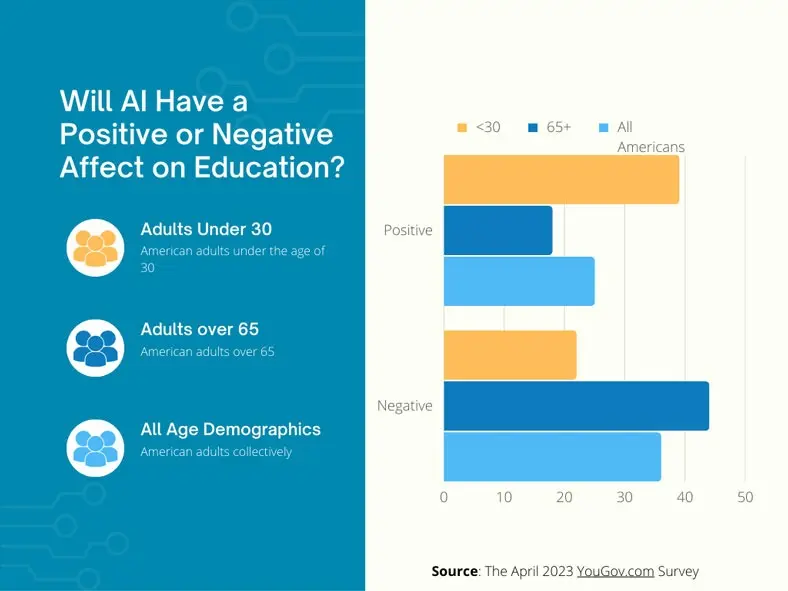
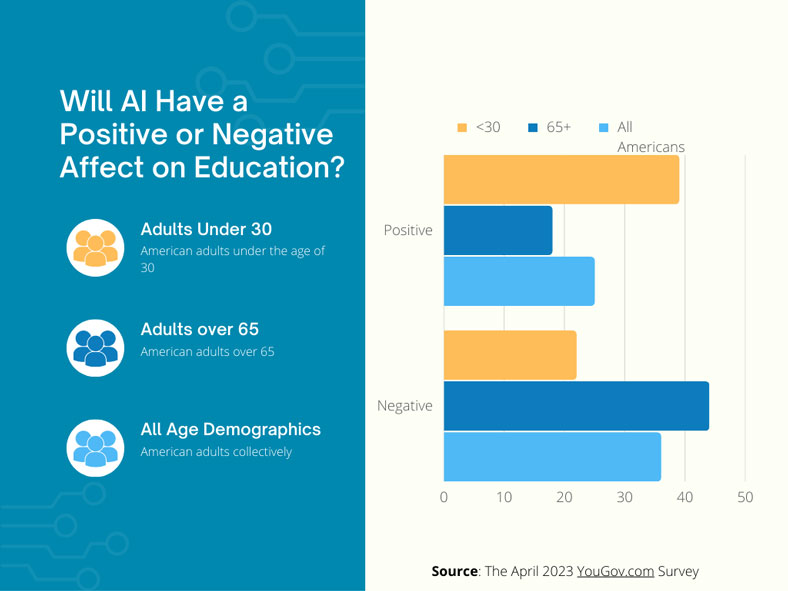
Data from a pivotal 2023 YouGov survey underscored this shifting sentiment among the American public. The findings revealed that 52% of U.S. adults believed schools should focus on teaching students to use AI appropriately, compared to only 24% who favored strict prevention and policing. Furthermore, 61% of respondents deemed AI-related competencies at least somewhat necessary for students’ future career readiness.
The Modern Reality (2025–Present)
Today, the conversation has moved past the binary of "ban versus embrace." Schools are actively grappling with localized policy frameworks that vary wildly from district to district, and occasionally from one classroom to the next. Educators are increasingly supported by professional workshops, collaborative planning sessions, and evolving software ecosystems that attempt to balance productivity with academic integrity. Yet, the foundational challenge remains: how to harness artificial intelligence as a powerful educational lever without sacrificing the irreplaceable human elements of teaching.
Supporting Context & Metrics
To understand the operational reality of teachers navigating this transition, one must examine the intersection of workload, emerging technologies, and professional compensation.
The Dual Nature of AI Utility: Help vs. Shortfall
When properly integrated, generative AI functions effectively as a supplementary instructional assistant. Educators leverage these models for specific, bounded tasks:
- Differentiated Instruction: Instantly rewriting complex textbook passages into multiple reading levels for English Language Learners (ELL) or students with special education needs.
- Brainstorming and Prompt Engineering: Generating diverse sets of discussion questions that challenge students to analyze a literary text’s tone, pacing, or underlying structure.
- Administrative Relief: Drafting initial outlines for parent newsletters, syllabus updates, or general classroom rubrics.
However, the technology’s technical limitations present distinct hazards. Generative models operate on probabilistic text prediction rather than factual retrieval, meaning they are prone to "hallucinations"—confidently presenting false dates, fabricated scientific studies, or incorrect historical citations as absolute truth. This necessitates a mandatory verification step. Teachers and students alike must cross-reference AI-generated claims against authoritative, peer-reviewed sources.
Furthermore, the integrity ecosystem surrounding AI remains deeply flawed. While detection platforms like Winston AI and Turnitin attempt to identify machine-generated text, even industry-leading tools acknowledge limitations, including false positives that can unfairly penalize honest students. Turnitin’s own guidelines explicitly state that its AI detection indicator should not be used as the sole basis for disciplinary action regarding academic misconduct.

Key Labor and Economic Metrics
The integration of AI occurs against a backdrop of evolving labor dynamics within the American education system. According to data from the U.S. Bureau of Labor Statistics (BLS) and projections from Projections Central, the economic and employment landscape for teachers is characterized by steady demand alongside persistent systemic pressures:
- National Median Salaries (May 2025 BLS Data):
- Elementary School Teachers: $63,820 annually.
- Middle School Teachers: $64,370 annually.
- High School Teachers: $72,040 annually.
- (Note: Actual compensation varies significantly by state, municipal district, and individual educator credentialing.)
- Employment Projections (2024–2034): Projections Central estimates that employment for core K-12 instructional roles will experience modest shifts, while substantial annual job openings will persist. These openings are driven primarily by natural workforce attrition—including retirements and career transitions—rather than technological displacement by artificial intelligence.
Official Statements and Educational Frameworks
Educational agencies and advocacy organizations have steadily refined their stances on generative technology, moving away from panic toward structured digital citizenship.
The prevailing consensus among educational technologists is that AI literacy must be treated as an essential component of modern media literacy. Rather than viewing students as passive consumers of AI outputs, progressive curricula explicitly incorporate the tool’s shortcomings into instructional design.
A prime example of this pedagogical shift is the implementation of structured classroom activities designed to demystify AI. In high school English and history classrooms, innovative educators now deploy exercises where students intentionally prompt an AI to write an essay on a specific topic, only to task the students with auditing the output. Students must identify logical fallacies, verify historical dates against library databases, rewrite superficial paragraphs with original analysis, and cite authentic sources. By treating the AI-generated text as a flawed first draft rather than a finished product, educators transform a potential vector for plagiarism into a rigorous lesson in critical thinking and fact-checking.
Moreover, professional organizations emphasize that administrative policies must be transparent. Because school board guidelines differ drastically across regions, teachers are continually advised to verify district-specific compliance frameworks before assigning projects that involve generative software.
Future Outlook: The Indispensable Human Element
As artificial intelligence continues to mature, speculation regarding its ultimate impact on the teaching profession frequently crosses into existential anxiety. Will algorithms eventually render human educators obsolete?
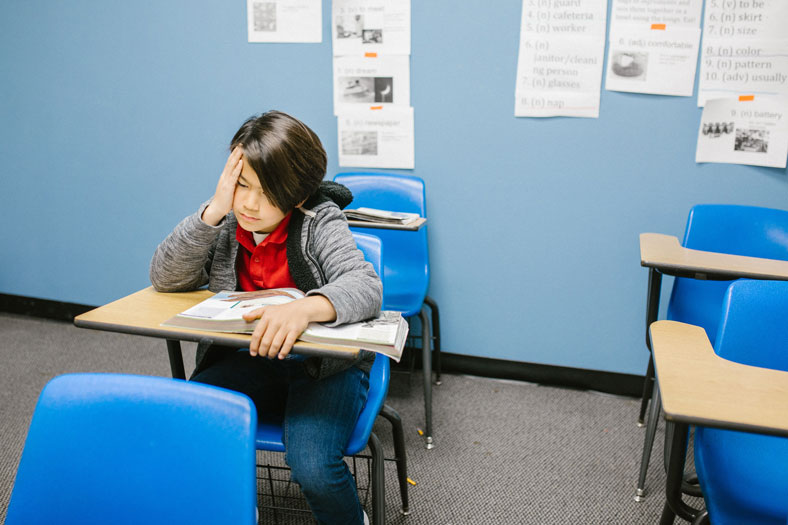
Current trajectories suggest a definitive "no." While machine learning models excel at pattern recognition, linguistic synthesis, and rapid text generation, they remain fundamentally incapable of performing the core, relational duties that define effective teaching. An algorithm cannot read the subtle body language of a frustrated student slumped in the back row, nor can it build the empathetic, trust-based rapport required to guide a troubled adolescent through an emotional crisis. It cannot exercise the real-time, nuanced pedagogical judgment necessary to pivot an entire lesson plan when a classroom’s engagement suddenly shifts.
The future of education is not defined by human replacement, but by human augmentation. Teachers who successfully adapt to the AI era are discovering that offloading repetitive administrative tasks and first-draft generation frees up valuable cognitive bandwidth. This reclaimed time can be reinvested where it matters most: delivering personalized, human-to-human feedback, mentoring students through complex social-emotional growth, and fostering deep, authentic intellectual curiosity.

Ultimately, artificial intelligence is destined to remain a powerful instrument in the educational toolkit—demanding vigilance, demanding structural oversight, and above all, demanding the steady, irreplaceable hand of a skilled educator to guide its application.

