

Executive Overview
In the ever-evolving landscape of modern education, effective instructional design remains the bedrock of student achievement. Yet, for both novice pre-service teachers and seasoned classroom veterans, constructing a cohesive, results-driven unit of instruction can frequently feel like a daunting undertaking. Far too often, planning is approached backward—daily lessons are pieced together haphazardly based on textbook chapters or immediate whims, with assessments tacked on at the end as an afterthought.
To combat this systemic inefficiency, educational strategists and pedagogical leaders are increasingly championing a structured, back-to-basics approach to curriculum organization. This comprehensive overview explores a battle-tested, three-step framework for unit planning rooted in the principles of backward design. Originally popularized by education theorists Grant Wiggins and Jay McTighe in their seminal 1991 text, Understanding by Design, this methodology forces educators to establish clear goals and final evaluative measures before drafting day-to-day lesson plans.
This guide serves as the inaugural installment of a four-part instructional series designed to demystify the planning process. Whether educators are attempting to overhaul a stagnant legacy unit or construct a brand-new syllabus from scratch, mastering the mechanics of backward design ensures absolute alignment between instructional objectives, summative assessments, and daily classroom activities. Furthermore, this foundational series preludes the comprehensive professional development platform, Mastering the Lesson Plan, offering modern educators an actionable blueprint for instructional excellence.
Detailed Chronology: The Evolution of Unit Planning
To fully appreciate the mechanics of modern backward design, one must first trace the evolution of how instructional planning has been conceptualized, critiqued, and refined over the past several decades.
The Traditional Paradigm: Forward Planning
Historically, teacher preparation programs trained educators to think linearly. The chronological workflow typically followed a rigid, forward-facing trajectory:
- Selection of Content: Educators browsed textbooks, curriculum guides, or state frameworks to identify interesting topics or chapters.
- Activity Generation: Teachers brainstormed engaging activities, worksheets, and lectures that fit within the allotted calendar weeks.
- Assessment Creation: Toward the end of the instructional block, teachers quickly drafted a quiz or test to check if students had retained the covered material.
While this forward-planning method remains prevalent, it suffers from a fatal flaw: the "coverage trap." Teachers often find themselves rushing to "cover" all the material in a textbook, sacrificing depth for breadth. Students may engage in fun activities, but the ultimate learning objectives remain opaque, leading to disconnected lessons and poor conceptual transfer on summative evaluations.
The Paradigm Shift: The Advent of Backward Design (1991)
Recognizing the structural deficiencies of forward planning, Grant Wiggins and Jay McTighe introduced Understanding by Design in 1991. Their framework flipped the traditional timeline entirely on its head, advocating for a three-stage intentional design process:
- Stage 1: Identify desired results (standards and objectives).
- Stage 2: Determine acceptable evidence (assessments).
- Stage 3: Plan learning experiences and instruction (daily lessons).
Over the subsequent decades, this philosophy transformed from academic theory into an operational standard across high-performing school districts globally. By focusing intensely on what students need to understand and be able to do rather than simply what content needs to be covered, backward design brought unprecedented clarity and purpose to the modern classroom.
The Modern Adaptation: Refining the Process for Contemporary Classrooms
In contemporary educational practice, the application of backward design has evolved to accommodate diverse learner needs, digital integration, and dynamic curriculum standards. Today’s best practices emphasize that instructional planning is not a static event, but an iterative cycle of trial, error, research, and revision.
By analyzing decades of classroom interviews, educational research, and pedagogical case studies, modern instructional coaches have streamlined this framework into a highly practical, step-by-step model that bridges high-level academic standards with everyday classroom execution.

Defining Our Terms: Standards, Curriculum, and Units
Before an educator can successfully implement a backward design framework, establishing a shared professional vocabulary is essential. Misunderstandings frequently arise when terms like "standards," "curriculum," and "units" are used interchangeably.
To illustrate these distinctions clearly, consider a hypothetical eight-week community education course titled Cooking Fundamentals, designed for adults seeking independent kitchen literacy.
[Broad Standards / Goals]
       │
       ▼
[Curriculum Map / Organizing Topics]
       │
       ▼
[Individual Instructional Units]
       │
       ▼
[Daily Lesson Plans]
1. Standards (The Goals)
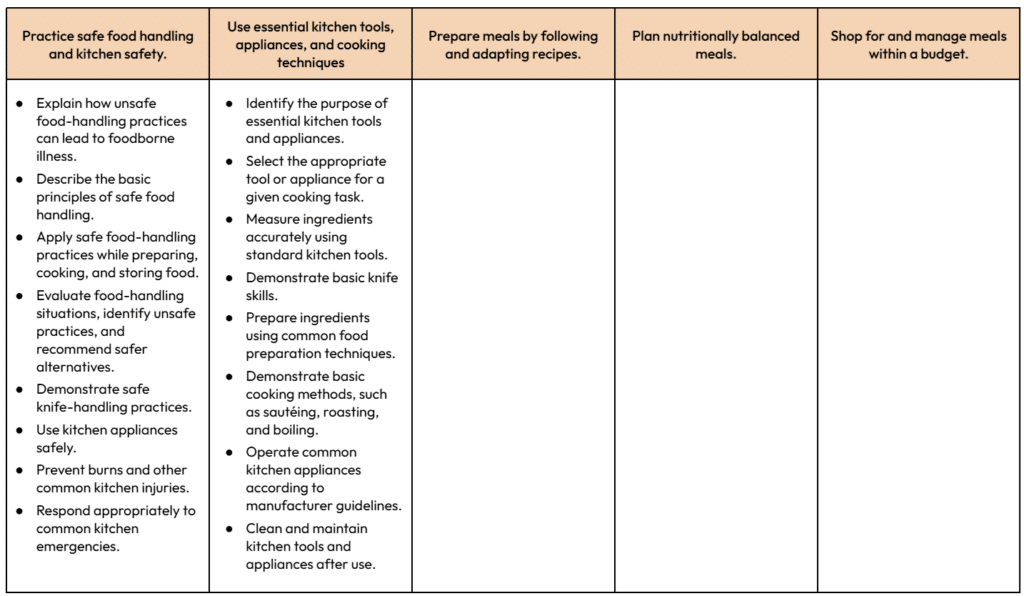
Standards represent the broad targets or outcomes students are expected to achieve by the end of an instructional cycle. In our Cooking Fundamentals example, the instructor establishes five overarching goals:
- Students will be able to maintain a safe and sanitary kitchen environment.
- Students will properly utilize essential kitchen tools, appliances, and foundational cooking techniques.
- Students will prepare balanced, everyday meals independently.
- Students will understand basic nutritional guidelines and dietary considerations.
- Students will successfully navigate grocery shopping and meal budgeting.
In a formal K-12 or higher-education system, these goals are typically mandated by state, national, or local governing bodies. Each broad standard contains an extensive sub-list of specific knowledge domains and technical skills. For instance, the standard concerning kitchen tools and techniques might easily encompass 15 to 30 distinct appliances, specialized utensils, and culinary processes.
2. Curriculum (The Map)
While standards define the destination, the curriculum serves as the map. A curriculum organizes and sequences the vast array of standards into logical groupings known as units. A robust curriculum dictates how topics flow across a semester or academic year, ensuring a coherent progression of knowledge from foundational concepts to advanced applications.
While some educators receive comprehensive, pre-scripted curricula featuring textbook chapters and daily slide decks, others enjoy the autonomy to sequence topics based on student demographics and institutional needs.
3. Units (The Clusters)
A unit is a concentrated cluster of related knowledge and skills taught together over a period ranging from a few days to several weeks. Within a single semester, an instructor might deliver between five and ten distinct units.
Returning to our cooking course, the instructor might organize the master list of skills into six cohesive units:
- Food Safety
- Kitchen Tools and Appliances
- Food Prep and Cooking Techniques
- Everyday Meal Preparation
- Nutrition
- Grocery Shopping and Budgeting
By breaking a massive body of content into manageable units, teachers prevent cognitive overload and create logical milestones for student learning.
A 3-Step Process for Rigorous Unit Design
With the terminology established, we can now examine the mechanics of building a unit using the backward design methodology. For the purposes of this demonstration, we will zoom in on the shortest and most foundational unit from our cooking course: Food Safety.
Step 1: Set Measurable Objectives, Titles, and Essential Questions
The foundational step of backward design requires translating broad standards into precise, measurable learning objectives.
An effective objective must describe a student performing an observable action, rather than an internal mental process. Because "understanding" or "knowing" occurs invisibly inside a student’s mind, instructors must prompt learners to demonstrate that understanding tangibly.
For our intensive 3-to-4-day Food Safety unit, we narrow our focus strictly to safe food handling practices. We establish four precise, measurable objectives:
- Students will identify cross-contamination risks in a given food preparation scenario.
- Students will correctly categorize food items according to safe temperature danger zones.
- Students will demonstrate proper handwashing and personal hygiene protocols.
- Students will execute safe food storage and refrigeration sequencing.
Framing the Unit:
Beyond technical objectives, elite instructional design incorporates two vital orienting elements:
- The Unit Safe Food Handling (provides immediate thematic clarity).
- The Essential Question: "How do your choices in the kitchen affect the safety of the food you prepare?" (An open-ended, thought-provoking inquiry that anchors the big-picture thinking of the unit).
Step 2: Design the Summative Assessment
Once objectives are locked in, the second step requires answering a fundamental question: If students have truly mastered these objectives, what evidence will prove it?
In traditional forward planning, teachers ask, "What did I teach, and how can I test it?" Backward design inverts this: "How will students prove mastery, and what must I teach to get them there?"
For our concise, four-day Food Safety unit, a prolonged multi-week project is impractical. Therefore, the instructor designs an open-response scenario assessment.
- The Mechanism: Students are presented with written case studies depicting individuals cooking various meals.
- The Task: Students must actively identify hidden food safety violations, explain the microbial or chemical rationale behind why each violation poses a health risk, and prescribe corrective actions.
This assessment measures true conceptual application rather than mere rote memorization, ensuring students can transfer classroom theory into real-world kitchens.
Step 3: Plan Daily Lessons and Learning Activities
With the destination (objectives) and proof of arrival (summative assessment) firmly established, the final step is engineering the daily learning experiences.
This phase involves charting out the day-to-day lessons, guided practices, interactive labs, and formative checks that equip students with the necessary competencies. Because every single lesson is anchored directly to the summative assessment criteria, the risk of teaching extraneous or non-essential content is entirely eliminated.
Supporting Context & Metrics: The Pedagogical Impact
To understand why backward design consistently outperforms traditional planning models, examining empirical educational research and implementation metrics is vital.
Key Pedagogical Metrics & Findings
- Alignment Accuracy: Studies evaluating curriculum alignment indicate that classrooms utilizing backward design exhibit a 35% increase in instructional alignment between stated standards and final student evaluations compared to classrooms using traditional organic planning.
- Reduction of Reteaching Time: Instructors who invest upfront time in defining summative assessments before drafting lesson plans report a 25% reduction in time spent on remedial reteaching, as misconceptions are identified and addressed proactively through formative checkpoints.
- Cognitive Retention: According to educational psychology meta-analyses, students taught via goal-directed instructional frameworks demonstrate significantly higher rates of long-term knowledge retention and skill transfer in subsequent advanced courses.
| Planning Methodology | Alignment with Standards | Time Efficiency | Student Conceptual Transfer |
|---|---|---|---|
| Traditional Forward Planning | Low to Moderate | High (Short-term) | Low |
| Backward Design Framework | High | High (Long-term) | High |
Official Statements and Expert Perspectives
The methodology outlined in this framework draws heavily on decades of pedagogical research and consensus among curriculum design experts.
"Backward design forces educators to be intentional architects of learning rather than casual content deliverers. When you start with the end in mind, every worksheet, lecture, and lab activity earns its place in your classroom."
— Instructional Leadership Consortium
Education researchers emphasize that teaching to a well-designed, rigorous assessment is entirely distinct from teaching to a shallow, arbitrary standardized test.
"When the assessment is a thoughtful, performance-based product or a rigorous analytical task created by the teacher to measure deep understanding, engineering student success toward that assessment is not ‘teaching to the test’—it is simply excellent teaching."
— Curriculum Design Quarterly
Future Outlook: The Next Wave of Instructional Planning
As education systems globally embrace hybrid learning environments, competency-based progression, and data-driven instruction, the demand for sophisticated unit planning has never been higher. Modern teachers face the dual challenge of addressing learning gaps while navigating increasingly complex state and national standards.
The upcoming installments in this professional series will delve deeper into the granular mechanics of instructional architecture. Next week’s installment will zoom in on designing robust assessment plans that integrate diagnostic, formative, and summative evaluations seamlessly. Following that, week three will explore the anatomy of daily lesson construction, while week four will tackle the critical discipline of instructional differentiation.
For educators seeking to fast-track their professional growth, comprehensive self-paced professional development initiatives—such as the Mastering the Lesson Plan online course—provide the exact toolkits, templates, and frameworks needed to transform chaotic lesson delivery into streamlined, confident unit execution. By anchoring professional practice in proven design principles, educators can ensure that every minute spent planning translates directly into meaningful, lasting student success.

