In the contemporary educational landscape, literacy dominates policy debates, curriculum overhauls, and professional development seminars. Yet, these high-stakes conversations typically remain hyper-focused on the mechanics of reading—phonics, fluency, and reading comprehension. Tragically, writing instruction is frequently sidelined, treated as a secondary byproduct of literacy rather than its vital, equal counterpart.
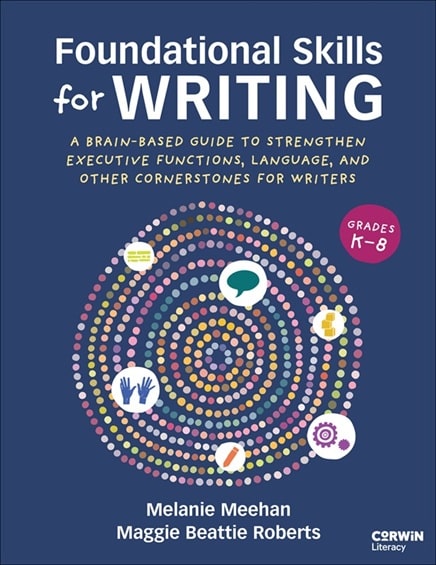
This systemic oversight has left educators unequipped to handle the deep neurological and cognitive demands required to transform a student’s thoughts into written text. To combat this disconnect, curriculum expert Melanie Meehan and literacy consultant Maggie Roberts have released a groundbreaking new text: Foundational Skills for Writing: A Brain-Based Guide to Strengthen Executive Functions, Language, and Other Cornerstones for Writers.
The authors argue that writing is not merely an intuitive communication exercise; it is an intensely complex cognitive event. When students struggle to write, it is rarely due to a lack of creativity. Instead, their working memories and executive functions are overwhelmed by underdeveloped foundational skills—such as handwriting, spelling, oral language articulation, and cognitive flexibility. To remedy this, Meehan and Roberts have introduced "Minute Moves," an innovative collection of rapid, high-impact instructional strategies. Designed to fit seamlessly into transitions, warm-ups, or brief schedule gaps, these micro-interventions build the neural pathways necessary to automate foundational writing skills, freeing up vital cognitive energy for higher-order composition.
Detailed Chronology and Methodological Framework
The journey toward Foundational Skills for Writing spans decades of frontline classroom observation, curriculum design, and literacy coaching. Meehan, a former curriculum coordinator who now operates an in-person writing center, and Roberts, a former middle school teacher and literacy consultant with nearly twenty years of classroom support experience, witnessed firsthand the increasing cognitive friction students experienced when facing blank pages.
Earlier this month, their collaborative framework hit bookshelves, offering a paradigm shift away from traditional, marathon writing blocks toward targeted, micro-skill development. The authors realized that asking children to compose complex essays without automatizing baseline transcription, syntax, and cognitive flexibility is akin to demanding that an athlete run a marathon without first learning how to walk.
Breaking Down the Mechanics of Writing
The framework outlined by Meehan and Roberts categorizes writing readiness into three primary pillars:
Transcription Skills: Encompassing handwriting, keyboarding, spelling, and gross/fine motor development.
Oral Language: The foundational speaking and listening precursors that govern sentence construction and vocabulary access.
Executive Functioning: The cognitive control centers managing working memory, cognitive flexibility, and inhibitory control.
To target these pillars without overwhelming instructional time, the authors designed eight specific "Minute Moves." These activities require minimal preparation and take just 60 to 90 seconds to execute, yet they yield significant cognitive dividends.
Spelling and Morphological Minute Moves
Traditional spelling instruction often relies on rote memorization and weekly Friday tests, a method that frequently fails to transfer into authentic writing. Meehan and Roberts advocate for a shift toward morphological awareness—helping students see words not as isolated strings of letters, but as interconnected families driven by deep semantic roots.
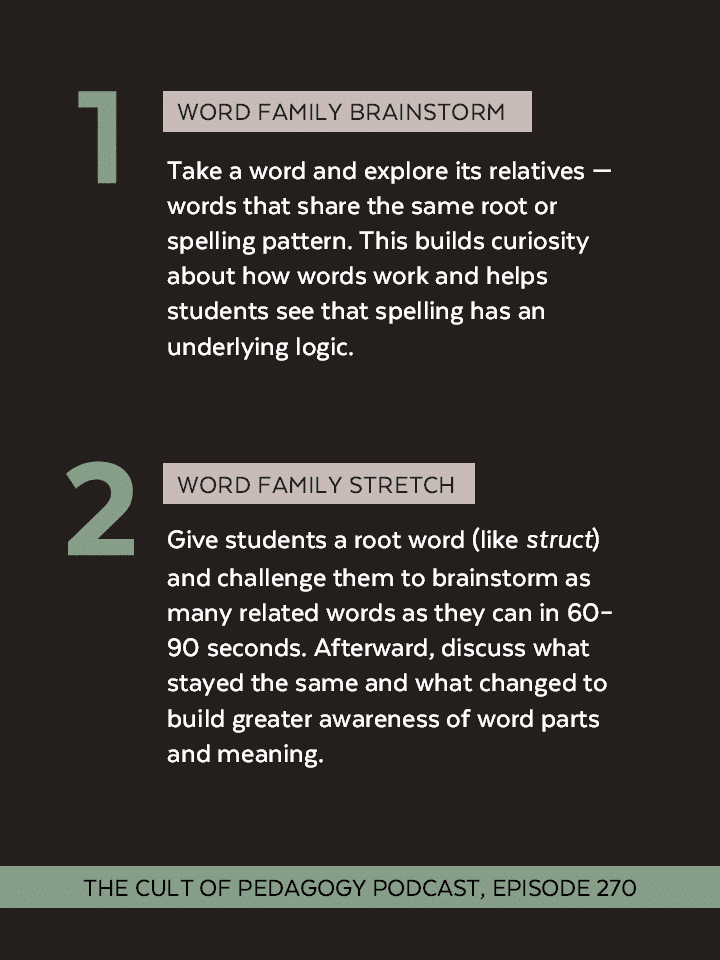
1. Word Family Brainstorm
Drawing inspiration from spelling researcher Rebecca Treiman, this strategy encourages students to view words as inherently fascinating. Rather than teaching confusing homophones like two, to, and too in an isolated cluster, educators link two to its semantic relatives: twin, twine, and twenty. This reveals a deep conceptual pattern regarding "twoness." Similarly, struggling with a complex word like decision can be demystified by tracing it back through decide, incision, concise, and scissors—all sharing a Latin root meaning "to cut."
2. Word Family Stretch
In this timed 60-to-90-second challenge, students are given a root—such as struct (meaning "to build")—and race to generate as many related words as possible (structure, destruction, construct, structural, instruct). The critical pedagogical moment occurs during the post-brainstorm debrief, where students analyze what changed, what stayed the same, and how prefixes and suffixes modified the core meaning. This distinguishes "bound" roots (which cannot stand alone) from "free" roots (like form), anchoring academic vocabulary deeply in the student’s working memory.
3. Prefix Swap
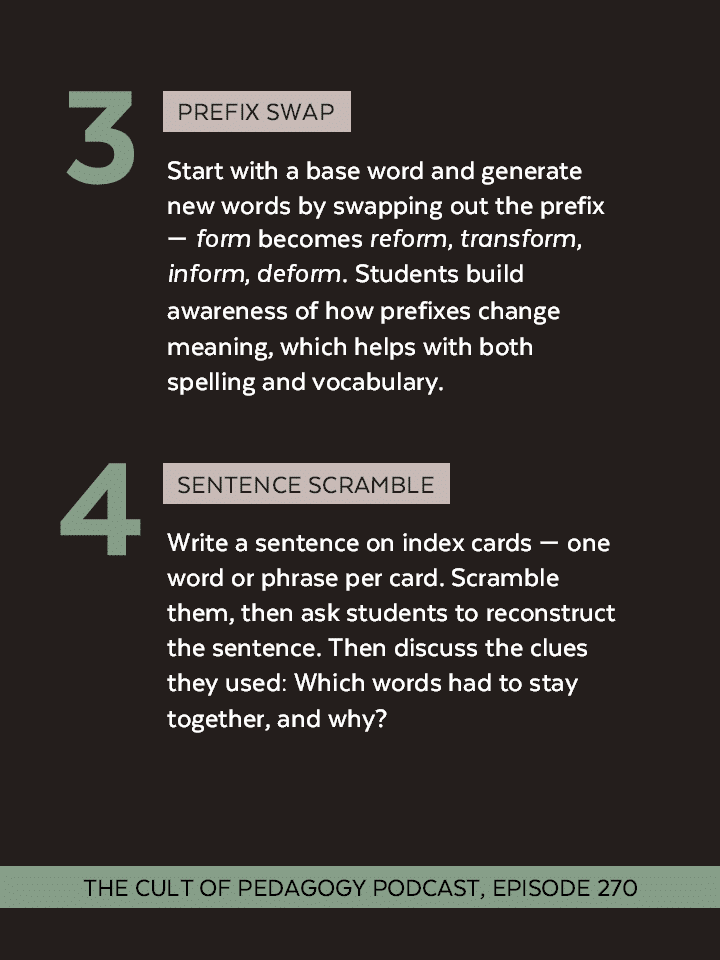
Building directly upon morphological exploration, this exercise tasks students with altering a base word by systematically swapping prefixes—transforming form into reform, transform, inform, and deform. This method proves exceptionally powerful for multilingual learners, who often recognize familiar morphemes (such as bene or mal) from their native languages, instantly unlocking complex English terms like benevolent and malevolent.
Sentence Construction and Syntactic Minute Moves
Once transcription and spelling become automated, students must navigate the structural architecture of sentences. Many children write in choppy, isolated simple sentences because processing complex syntax consumes all available cognitive bandwidth.
4. Sentence Scramble
By breaking a sentence down into individual physical index cards (one word or phrase per card), educators give students tangible objects to manipulate. Once students physically arrange the words into a coherent sentence, they engage in a metacognitive debrief: How did you figure out the order? Which words had to stay together? Instructors can escalate the difficulty by removing punctuation, introducing distractor words, or challenging students to extend the sentence independently.
5. Sentence Expander
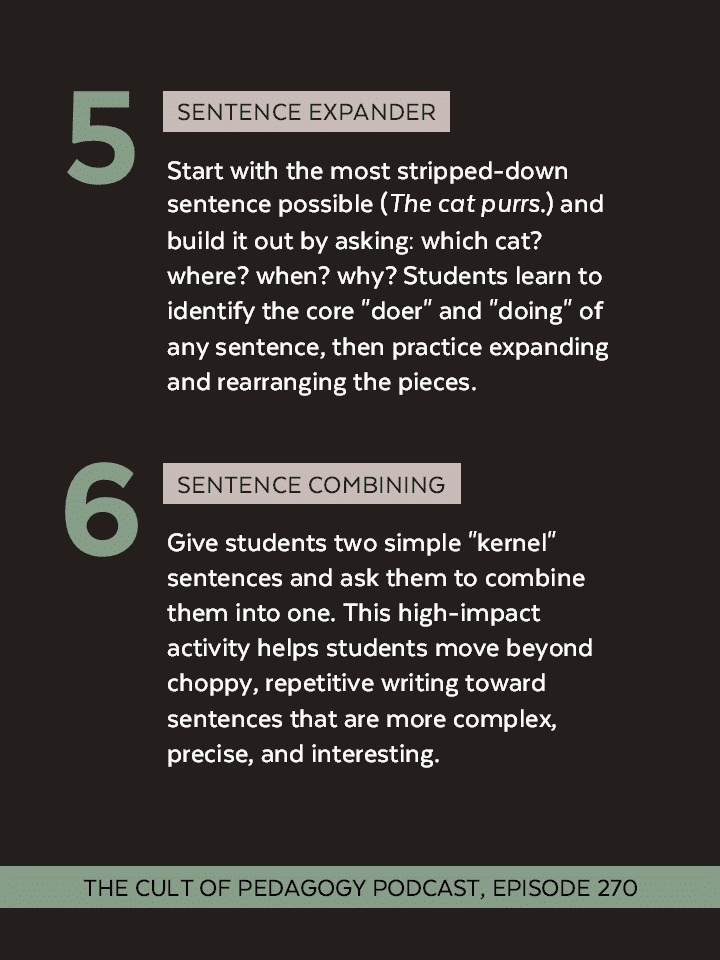
Beginning with a minimalist "kernel sentence" (e.g., The cat purrs), students systematically expand the idea by answering targeted questions: Which cat? What color? Where? When? Why? Meehan advocates using concrete terms like "doer" and "doing" instead of abstract grammatical labels like "subject" and "predicate." Once the sentence is fully expanded—such as The orange cat is sleeping on the couch in the afternoon because he is tired—students experiment with rearranging elements to discover how syntax impacts rhythm and meaning.
6. Sentence Combining
Hailed by Roberts as a high-impact, rapid intervention, sentence combining bridges the gap between choppy drafting and sophisticated prose. Students take two bare-bones sentences (My cat is orange and My cat is big) and merge them into a single, cohesive unit (My big orange cat…). As confidence grows, students integrate conjunctions (because, and, but) to weave complex thoughts together, a habit that transfers naturally to independent narrative and expository writing.
Executive Functioning and Cognitive Flexibility
The pinnacle of writing instruction involves executive functioning—specifically, cognitive flexibility and perspective-taking. Writers must constantly evaluate alternatives, shift viewpoints, and adapt their phrasing for maximum impact.
7. "What’s Another Way?"
This minute move targets cognitive flexibility directly at the sentence level. Students take a completed sentence and rewrite it under varying constraints: What if you started with the dependent clause? What if you replaced the noun with a pronoun? What if you made it exceptionally brief? Meehan emphasizes that writing maturity is not solely about length; the true craft lies in the deliberate juxtaposition of long, complex clauses with punchy, impactful short sentences. Explicitly naming this practice as "cognitive flexibility" empowers students, transforming how they view their own intellectual capabilities.
8. New Angle
Zooming out from the sentence to the macro-level of narrative structure, this strategy asks students to retell a familiar scene from a completely different character’s perspective. Whether analyzing a classroom event or dissecting a narrative through digital media—such as Pixar’s short film Snack Attack—students must hold competing viewpoints in active working memory. This intervention transcends the language arts classroom, reinforcing civic empathy, democracy, and a deep understanding of human perspective.
Supporting Context & Metrics
The release of Foundational Skills for Writing arrives at a critical juncture in American education. Over the past decade, sweeping literacy initiatives have heavily prioritized the "Science of Reading," resulting in measurable shifts in how early reading is taught nationwide. However, corresponding frameworks for writing instruction have largely stagnated.
Educational researchers note that writing places a far heavier cognitive load on young brains than reading. While reading involves decoding existing visual stimuli into spoken language, writing requires simultaneous generation of content, transcription, motor control, spelling retrieval, syntactic structuring, and self-regulation. When schools fail to systematically scaffold these foundational skills through short, targeted interventions, students frequently experience cognitive overload, leading to widespread writing avoidance and academic frustration. The adoption of micro-interventions like "Minute Moves" offers a scalable, low-overhead solution that integrates effortlessly into existing instructional blocks without requiring extensive curriculum overhauls.
Official Statements and Expert Insights
Reflecting on the motivations behind their work, co-authors Melanie Meehan and Maggie Roberts emphasize the urgent need to demystify the writing process for educators and students alike.
"The more that you can get kids curious and thinking words are cool, the better," notes Melanie Meehan, highlighting the importance of morphological play in spelling instruction. Addressing the broader implications of cognitive flexibility and perspective-taking, Meehan adds: "It’s not just about writing and it’s not just about watching this show, but it’s also about democracy and thinking about how other people think and what their perspectives are."
Echoing the necessity for high-impact syntactic tools, Maggie Roberts points out the transformative nature of structured sentence work:
"Sentence combining is a really high-impact, quick way for kids to graduate from writing a series of simple sentences to ones that are more syntactically complex, interesting, and precise."
By shifting the educational paradigm away from tedious, unguided writing assignments toward deliberate, brain-based micro-drills, Meehan and Roberts provide a clear roadmap for instructional renewal.
Future Outlook
As school districts nationwide continue to refine their literacy frameworks, the integration of explicit writing foundations will undoubtedly move to the forefront of pedagogical discussion. The success of Foundational Skills for Writing signals a growing appetite among educators for actionable, neuroscience-backed strategies that respect instructional time constraints while delivering profound cognitive results.
Looking forward, the widespread adoption of "Minute Moves" and similar micro-interventions promises to reshape classrooms into environments where writing is no longer viewed as an insurmountable chore. By systematically building transcription fluency, morphological curiosity, syntactic variety, and cognitive flexibility, educators can equip the next generation of students with the powerful tools needed to articulate their thoughts clearly, critically, and creatively in an increasingly complex world.