
Executive Overview
In the ever-evolving landscape of English as a Second Language (ESL) education, educators and curriculum developers continuously face the formidable challenge of moving learners beyond intermediate proficiency and into true fluency. While foundational grammar and basic conversational skills can be acquired through immersive practice and standard textbooks, the subtle intricacies of the English language—specifically homophones, deceptive adjectives, dynamic verbs, and easily confused words—often present persistent roadblocks.
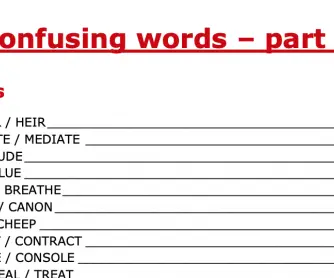
A newly released pedagogical resource, Confusing Words – Part 18, authored by educator Kristine44 on the widely utilized BusyTeacher platform, offers an expansive, highly structured approach to mastering these linguistic pitfalls. Spanning an impressive nine pages, this comprehensive instructional packet features 40 distinct exercises comprising more than 160 contextualized sentences. Designed primarily for intermediate to upper-intermediate and advanced (B2-C1) learners, the resource systematically deconstructs lexical ambiguities that frequently confound even advanced users of the English language.
This investigative report examines the structural design, pedagogical rationale, and broader educational implications of this resource. By analyzing the mechanics of vocabulary acquisition, the challenges of distinguishing between similarly sounding or morphologically related terms, and the structural methodology employed in Part 18, we provide a holistic view of modern ESL material development. Furthermore, we explore how crowdsourced educational ecosystems are transforming instructional design, allowing educators to collaboratively refine and distribute high-impact teaching tools globally.
Detailed Chronology: The Evolution and Implementation of Lexical Practice Materials
To understand the significance of Confusing Words – Part 18, one must trace the historical trajectory of vocabulary instruction within ESL methodologies. For decades, traditional language instruction relied heavily on rote memorization and isolated vocabulary lists. Students were expected to memorize definitions without fully grasping the contextual, pragmatic, or syntactical constraints of the words they studied. Over time, second-language acquisition (SLA) research revealed the limitations of this approach, demonstrating that vocabulary is best acquired through deliberate, varied, and context-rich exposure.
The Genesis of Targeted Lexical Resources
As digital platforms democratized the creation and sharing of educational materials, educators began developing specialized resources targeted at specific language friction points. BusyTeacher, operating as a repository for teacher-generated content, became a focal point for this movement. Within this ecosystem, serial resource collections—such as multi-part guides on confusing words—evolved organically to address recurring classroom challenges.
- Early Phases (Parts 1–5): Initial installments in similar vocabulary series typically focused on high-frequency errors, such as basic homophones (there/their/they’re) and simple spelling traps. These foundational worksheets relied on brief matching exercises and fill-in-the-blank formats.
- Middle Development (Parts 6–12): As the series matured, authors introduced more sophisticated syntactic contrasts, including transitive versus intransitive verbs, tricky noun-verb shifts, and nuanced prepositional usage. The scale of the worksheets expanded from single-page handouts to multi-page thematic packets.
- Advanced Maturation (Parts 13–18): The release of Part 18 represents the apex of this developmental curve. Incorporating 9 pages and 40 structured exercises, it reflects a shift toward comprehensive, modular self-study or classroom-ready toolkits. Alphabetically organized and accompanied by a complete answer key, this iteration bridges the gap between informal classroom handouts and rigorous academic workbooks.
Deployment in Modern Classrooms
The implementation of Part 18 follows a deliberate pedagogical sequence. Teachers typically introduce the material following a diagnostic assessment that highlights persistent student errors in writing or speech. Rather than presenting all 160 sentences simultaneously, instructors deploy the exercises modularly, aligning them with specific lesson themes:
- Diagnostic Phase: Students complete a targeted subset of exercises (e.g., distinguishing reluctant from reticent) to expose preconceptions and errors.
- Analytical Phase: Class discussion unpacks the etymological and syntactical differences between the target words.
- Contextual Reinforcement: Learners work through the remaining sentences, applying the words to newly generated written contexts.
- Self-Correction and Review: Utilizing the included answer key, students engage in autonomous error analysis, fostering metacognitive awareness.
Supporting Context & Metrics: Analyzing the Linguistic Challenges of English
English is famously a linguistic mosaic, borrowing heavily from Germanic, Romance, and classical roots. This historical evolution has resulted in a lexicon rife with irregularities, overlapping semantic fields, and deceptive morphological structures. Understanding the metrics and linguistic categories addressed in Part 18 reveals the depth of the challenges faced by advanced learners.
Categorical Breakdown of Lexical Confusions
The worksheet meticulously categorizes common linguistic traps into distinct structural buckets. A quantitative review of the curriculum highlights several primary areas of focus:
- Homophones and Near-Homophones: Words that sound identical or nearly identical but possess divergent spellings and meanings (e.g., air/err/hear). These challenge both listening comprehension and spelling accuracy.
- Lexical Pairs with Subtle Semantic Shifts: Words that share a root or general domain but carry different stylistic, emotional, or grammatical weights (e.g., reluctant versus reticent). While a student might understand that both imply hesitation, failing to distinguish between unwillingness to act and unwillingness to speak leads to unnatural phrasing.
- Morphological Derivations: Distinguishing between base words and their derived forms (e.g., magic as a noun/adjective versus magical). Misapplying these forms disrupts the rhythm and grammatical integrity of complex sentences.
- Confusable Verb Pairs and Phrasal Verbs: Navigating the dense web of verb valency, auxiliary requirements, and idiomatic particles.
Quantitative Overview of the Resource
- Total Pages: 9
- Total Exercises: 40 modular activities
- Sentence Count: 160+ contextualized sentences
- Target Proficiency Levels: Intermediate (B2) to Upper-Intermediate/Advanced (C1-C2)
- Digital Metrics: Over 37,820 platform views, demonstrating high demand for targeted lexical interventions.
+-----------------------------------------------------------------+
|               LEXICAL FOCUS AREAS IN PART 18                    |
+--------------------------+--------------------------------------+
| Category                 | Example Pairs / Triads               |
+--------------------------+--------------------------------------+
| Homophones               | AIR / ERR / HEAR                     |
| Semantic Nuance          | RELUCTANT / RETICENT                 |
| Morphological Forms      | CANNON / CANON, MAGIC / MAGICAL      |
| Syntactic Shifts         | Nouns vs. Verbs, Verbs vs. Adjectives|
+--------------------------+--------------------------------------+
The Cognitive Load of Advanced Vocabulary Acquisition
According to contemporary cognitive linguistics, acquiring advanced vocabulary requires moving beyond declarative knowledge (knowing what a word means) to procedural mastery (deploying it accurately and automatically in real-time discourse).
When learners encounter deceptive word pairs like reluctant and reticent, they experience high cognitive load. If instructional materials fail to provide sufficient contextual contrast, learners often resort to lexical fossilization—a state where incorrect or clumsy usage becomes deeply entrenched. The structure of Part 18 specifically combats fossilization by forcing learners to evaluate target words side-by-side within diverse sentence environments.
Official Statements and Pedagogical Perspectives
The release and reception of instructional packets such as Confusing Words – Part 18 have sparked discussions among language instructors, curriculum designers, and educational technologists regarding the future of ESL resource development.
Insights from Curriculum Developers
Kristine44, the creator of the worksheet series, emphasizes the practical necessity of systematic vocabulary review in advanced classrooms. In professional teaching circles, creators of such resources frequently highlight the gap between standardized grammar curricula and authentic language use.
"Standard textbooks often treat vocabulary as an afterthought, presenting lists of words without exploring the friction points where learners naturally stumble," notes an experienced ESL curriculum consultant. "Resources that focus explicitly on homophones and deceptive word pairs fill a crucial void. They acknowledge that advanced learners do not just need more words; they need greater precision with the words they already half-know."
Pedagogical Endorsements and Peer Review
The open, collaborative nature of platforms like BusyTeacher allows for immediate peer evaluation. With a top-tier rating from evaluating educators and thousands of community interactions, the resource has earned praise for its meticulous organization.
- Alphabetical Ordering: Instructors have praised the decision to organize entries alphabetically, noting that it transforms the multi-page document into a functional mini-dictionary that students can easily reference during writing workshops.
- Inclusion of Answer Keys: Educational psychologists consistently stress the importance of immediate feedback in error correction. The incorporation of a verified answer key enables asynchronous, independent study, making the worksheet equally valuable for flipped classrooms and distance learning environments.
- Crowdsourced Error Correction: The platform’s built-in revision mechanism—which invites educators to report and correct typographical or pedagogical errors—ensures that living resources like Part 18 undergo continuous refinement.
Future Outlook: The Direction of Lexical Instruction in ESL
As artificial intelligence, adaptive learning platforms, and globalized classrooms reshape education, the role of static worksheets is undergoing a profound transformation. However, comprehensive print and digital text resources like Confusing Words – Part 18 remain foundational pillars of effective pedagogy.
Integration with Digital and AI Tools
Looking ahead, the next generation of lexical training materials is poised to merge traditional worksheet structures with intelligent tutoring systems.
- Adaptive Sentences: Future iterations of confusing word exercises will likely utilize AI algorithms to generate infinite variations of sentences tailored to a student’s specific error patterns.
- Corpus-Driven Content: Curriculum developers are increasingly turning to massive language corpora (such as the Corpus of Contemporary American English) to ensure that the sentence examples provided in worksheets reflect authentic, contemporary usage rather than artificial textbook constructions.
The Enduring Value of Structured Teacher-Authored Resources
Despite technological advancements, teacher-authored resources retain a unique advantage: they are forged in the crucible of actual classrooms. The specific word pairs addressed in Part 18—such as the subtle distinction between cannon and canon or the functional differences in verbal and adjectival forms—stem directly from years of observing where learners stumble.
As educational institutions worldwide place a renewed emphasis on literacy, precise communication, and advanced critical thinking, comprehensive lexical guides will continue to serve as indispensable tools. By bridging the gap between passive recognition and active mastery, resources like Confusing Words – Part 18 ensure that learners are equipped to navigate the profound complexities of the English language with confidence and accuracy.

