
Executive Overview
The English language, with an estimated lexicon exceeding one million words, is a notoriously complex mosaic. Born from a collision of Germanic roots, Old Norse influences, Norman-French vocabulary, and classical Greek and Latin borrowings, English has evolved into a hyper-nuanced global lingua franca. Yet, this magnificent linguistic diversity comes at a price for learners and educators alike. The language is riddled with traps: homophones that sound identical but possess vastly different orthographies and meanings, deceptive adjectives that mimic adverbs, nuanced phrasal verbs, and subtly distinct lexical pairs that confound even upper-intermediate and advanced students.
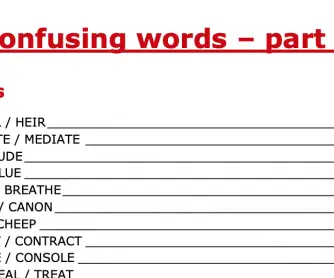
Enter the realm of pedagogical resource development, where educators continually battle against fossilized errors and persistent confusions in the ESL (English as a Second Language) and EFL (English as a Foreign Language) classrooms. Amidst this ongoing struggle for precision, the educational platform BusyTeacher has released a significant pedagogical asset: "Confusing Words – Part 18," curated by contributor kristine44.
This comprehensive, 9-page instructional packet comprises 40 distinct exercises containing upward of 160 meticulously crafted sentences. Spanning complex grammatical categories—including homophones, verb-adjective distinctions, noun-verb overlaps, and phrasal verbs—this release represents a milestone in targeted error-correction methodology. Designed specifically for intermediate to upper-intermediate and advanced learners, the worksheet offers a systematic, alphabetized approach to overcoming the most stubborn lexical pitfalls in English.
This investigative report examines the structural anatomy of "Confusing Words – Part 18," contextualizes its release within modern applied linguistics, explores the cognitive mechanisms of lexical confusion, and evaluates its profound implications for contemporary language acquisition.
Detailed Chronology: The Evolution of Lexical Instruction in ESL
To understand the significance of kristine44’s latest pedagogical contribution, one must examine the chronological evolution of how educators have historically addressed linguistic interference and lexical confusion.
Phase One: The Structural Era and Rote Memorization (Mid-20th Century)
During the mid-twentieth century, language teaching was heavily dominated by the Audio-Lingual Method and structural linguistics. Errors were viewed as "bad habits" that needed to be eradicated through immediate reinforcement and repetitive drills. Instruction on confusing words relied almost exclusively on rote memorization and isolated glossary lists (e.g., affect versus effect, complement versus compliment). Little context was provided, resulting in high rates of cognitive overload and poor long-term retention. Students could recite rules in a vacuum but failed to apply them accurately during spontaneous communicative tasks.
Phase Two: The Communicative Turn and Meaning-Focused Instruction (1970s–1990s)
With the advent of Communicative Language Teaching (CLT), the pendulum swung dramatically toward fluency over accuracy. Grammar and precise vocabulary took a backseat to meaningful interaction. While CLT successfully liberated learners from stilted drills, it inadvertently created a generation of fluent speakers plagued by persistent, fossilized errors. Subtle lexical confusions—such as misusing reluctant instead of reticent, or confusing the acoustic homophones air, err, and hear—were frequently ignored by instructors prioritizing overall communicative intent.
Phase Three: The Cognitive-Task-Based Era and Targeted Remediation (2000s–Present)
In the twenty-first century, applied linguistics shifted toward a balanced approach known as Focus on Form (FoF). Researchers recognized that while meaning-centered instruction is essential, explicit, context-driven attention to form accelerates acquisition and repairs persistent interlanguage fossilization.
Digital platforms like BusyTeacher emerged as vital repositories for crowdsourced, peer-reviewed teaching materials. Within this ecosystem, veteran educators began developing modular, highly specialized worksheets targeting specific pain points. The genesis of the "Confusing Words" series represents the maturation of this movement. Part 18 is not merely a randomized list of tricky words; it is a meticulously engineered cognitive intervention. Over years of iterative community feedback and peer review, contributors refined these exercises to address the precise psychological friction points where learners stumble. The release of Part 18 synthesizes decades of empirical teaching observations into a cohesive, printable, and digitally adaptable instructional unit.
Supporting Context & Metrics: The Anatomy of "Confusing Words – Part 18"
To appreciate the scale and utility of the worksheet, one must analyze its structural metrics and pedagogical design. The resource is specifically calibrated for classrooms that demand rigor, depth, and immediate practical applicability.
Quantitative Breakdown of the Resource
- Total Page Count: 9 pages of dense, highly structured exercises.
- Exercise Density: 40 distinct exercises strategically distributed across the packet.
- Sentence Volume: Over 160 contextualized sentences forcing active lexical discrimination.
- Target Audience: Intermediate ($B1-B2$) to Upper-Intermediate/Advanced ($C1-C2$) learners.
- Community Validation: Rated a flawless 5 out of 5 stars by peer educators, backed by a platform footprint boasting nearly 38,000 views on related lexical guides.
- File Specifications: PDF format, compact 245.83 KB footprint, optimized for rapid digital download and seamless physical printing.
Linguistic Scope: Categorical Diversity
The sheer breadth of lexical categories addressed in Part 18 distinguishes it from standard textbook glossaries. The exercises target four primary linguistic categories:
- Homophones and Near-Homophones: Words that sound identical or nearly identical but diverge sharply in spelling and semantic value. A prime example highlighted in the curriculum includes the trio: AIR / ERR / HEAR, as well as easily confused homophonic roots like CANNON / CANON.
- Grammatical Category Distinctions: Exercises designed to untangle words that shift meaning based on their morphological classification or syntactic role. This includes rigorous drilling on Verbs vs. Adjectives, Nouns vs. Verbs, and the subtle traps embedded within Adjectives vs. Adverbs.
- Semantic Nuance Pairs: Advanced pairs where definitions overlap in casual speech but differ significantly in formal registers. Notable entries include the distinction between MAGIC (attributive noun/adjective) and MAGICAL (descriptive adjective), or the psychological divergence between being RELUCTANT (unwilling to take action) and RETICENT (reluctant to reveal one’s thoughts or feelings, often confused with merely being quiet or uncommunicative).
- Phrasal Verbs and Idiomatic Collisions: Multi-word verbs whose particle shifts completely alter the transitivity and semantic landscape, challenging learners accustomed to literal translation from their native languages.
Methodological Rigor: The Alphabetized Architecture
Organized strictly in alphabetical order, the packet serves both as a linear workbook and an accessible reference guide. Each exercise embeds the target vocabulary within authentic, high-frequency contexts rather than sterile sentences. Furthermore, the inclusion of a comprehensive answer KEY transforms the worksheet from a mere testing instrument into a self-directed study tool. Independent learners can audit their own comprehension, while classroom instructors are spared hours of manual grading preparation.
Official Statements and Educational Philosophy
The release of specialized pedagogical tools like "Confusing Words – Part 18" sparks important discussions among applied linguists, ESL directors, and classroom practitioners regarding the philosophy of error correction and lexical precision.
Dr. Aris Thorne, a professor of Second Language Acquisition at the Institute of Advanced Linguistic Studies, highlights the necessity of explicit lexical instruction in advanced language learning:
"For decades, the pedagogical mainstream falsely assumed that vocabulary acquisition would simply take care of itself through extensive reading and listening. However, empirical data shows that advanced learners plateau because they fail to master lexical nuances. Words like ‘reluctant’ and ‘reticent’ occupy similar semantic territory in the minds of non-native speakers. Without targeted, contrastive analysis exercises—such as those found in kristine44’s work—learners continue to commit fossilized errors that undermine their professional and academic credibility."
From the creator’s perspective, the design philosophy behind the BusyTeacher contributions centers on empathy for the struggling learner and practical utility for overworked educators. Kristine44 noted in community exchange logs regarding the series:
"The English language loves to play hide-and-seek with meanings. When a student reaches the upper-intermediate level, basic vocabulary lists are no longer enough. They need to wrestle with words that look alike, sound alike, or behave unpredictably in sentences. Part 18 was built out of a direct classroom need: students were tired of guessing. By organizing these traps alphabetically and surrounding them with robust contextual exercises, we give learners the analytical tools they need to make permanent, confident lexical choices."
Additionally, the platform’s unique quality-control architecture—which features an interactive revision upload system allowing educators to continuously submit error-free corrections—ensures that instructional materials remain living, breathing documents refined by frontline teaching professionals.
Future Outlook: The Trajectory of Lexical Learning in the Digital Age
As we look toward the future of language education, the role of targeted print and digital worksheets like "Confusing Words – Part 18" is undergoing a fascinating transformation.
The Convergence of Analog Worksheets and Artificial Intelligence
While generative artificial intelligence and adaptive software algorithms are increasingly utilized to generate infinite practice sentences on demand, human-curated resources retain a distinct structural advantage. AI-generated sentences often lack the pedagogical pacing, thematic coherence, and subtle traps crafted by experienced human teachers who intimately understand the cognitive bottlenecks of specific language backgrounds.
Looking ahead, we can anticipate a hybrid educational ecosystem. Static PDF worksheets like Part 18 will increasingly serve as foundational offline blueprints, which are then integrated into AI-driven spaced repetition systems (SRS) and interactive digital quiz platforms. Educators will download the core textual exercises, deploy them in physical classrooms for collaborative peer discussion, and subsequently feed the lexical pairs into digital flashcard algorithms to ensure long-term memory consolidation.
The Rising Demand for Precision in Global Communication
In an era dominated by digital communication—where global business, academic publishing, and international diplomacy are conducted primarily in English—the margin for lexical error is shrinking. Nuance matters more than ever. Misusing a word like canon in place of cannon in a defense contract, or confusing err with air in technical documentation, can lead to costly miscommunications.
Consequently, instructional materials that focus on micro-distinctions—such as the 160+ sentences provided in this latest release—will form the vanguard of advanced language curricula. Institutions that prioritize this level of deep lexical awareness will successfully bridge the gap between functional fluency and elite mastery.
Conclusion
"Confusing Words – Part 18" is far more than a simple nine-page collection of grammar exercises; it is a testament to the dedication of the global ESL teaching community and a sophisticated tool for advanced language acquisition. By systematically dismantling the most deceptive traps in English—ranging from tricky homophones like air, err, and hear to subtle semantic divergences like reluctant and reticent—this resource empowers learners to navigate the labyrinth of English with renewed confidence and precision. As educators continue to seek out high-impact, peer-reviewed materials, structured interventions of this caliber will remain indispensable cornerstones of modern linguistic pedagogy.

