
Executive Overview
In the fast-evolving landscape of modern education, educators face a constant paradox: the pressure to innovate clashes directly with the reality of packed curricula and limited time. Introducing a whole new teaching routine often feels like a high-risk gamble. If it fails, valuable instructional weeks are lost; if it succeeds, it frequently demands unsustainable preparation hours. Enter the classroom micro-experiment—a transformative pedagogical strategy designed to bridge the gap between innovation and practicality.
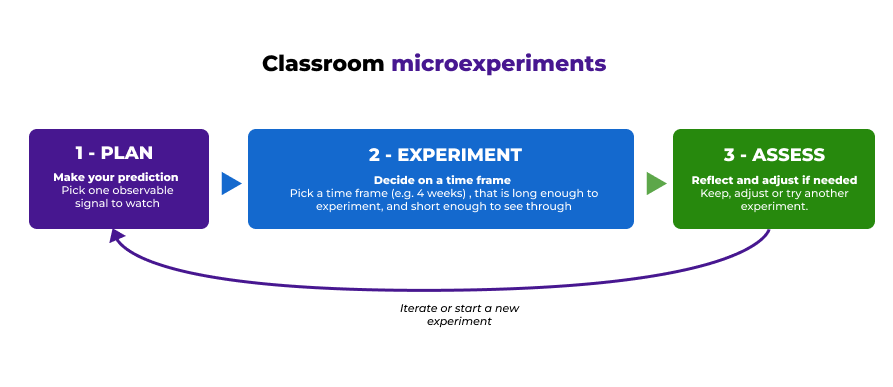
A classroom micro-experiment is a localized, low-stakes action executed for a short, fixed window of time with a hyper-specific learning objective. Rather than overhauling a semester-long syllabus, teachers commit to running a concise trial, analyzing empirical results, and making an immediate, evidence-based decision: retain the routine, iterate on the design, or discard it entirely.
This installment marks Part 3 of an ongoing Back-to-School investigative series examining how micro-experiments reshape daily instructional practices. While previous installments explored the impact of weekly formative checks (Part 1) and shifting the creation of review questions directly to students (Part 2), this article investigates a structural shift in peer dynamics: transitioning from solitary review to collaborative, team-based problem-solving. By mandating that small groups discuss and deliberate before answering, educators can unlock deeper cognitive engagement, expose hidden conceptual gaps, and cultivate critical peer-to-peer learning ecosystems—all within a manageable 10-to-15-minute timeframe.
Detailed Chronology: The Evolution of the Micro-Experiment Series
To understand the trajectory of modern classroom experimentation, it is vital to contextualize the current intervention within the broader experimental arc deployed across participating schools this academic year.
Phase 1: The Weekly Formative Check (Weeks 1–4)
The initial phase of the micro-experiment series focused on establishing baseline feedback loops. Teachers introduced short, low-stakes formative assessments at the conclusion of each week. The goal was simple: determine whether regular, bite-sized quizzes could provide actionable data on student comprehension without inducing test anxiety. The results demonstrated that frequent, low-stakes checks dramatically reduced end-of-unit remediation time, giving teachers a real-time compass for instruction.
Phase 2: Student-Built Review Sessions (Weeks 5–8)
Building upon the data-collection mechanisms established in Phase 1, the second micro-experiment inverted the traditional hierarchy of content delivery. Instead of instructors authoring weekly review questions, students were tasked with designing their own review items based on core concepts covered in class. This metacognitive leap required learners to analyze what made a "good" question, anticipate common misconceptions, and synthesize unit themes. The pedagogical payoff was profound: students exhibited heightened ownership over their learning and engaged with the material on a much deeper analytical level.
Phase 3: Collaborative Team Play (Weeks 9–12)
Having established reliable feedback loops and student-driven content creation, the third phase—the focus of this report—tackles the social architecture of the classroom. For a sustained four-week window, individual review tasks were replaced entirely by team-based mechanics. The central hypothesis: forcing structured, timed peer discussions before submitting an answer unlocks higher-order cognitive processing that isolated review simply cannot replicate.
Supporting Context & Metrics: Unlocking the Mechanics of Peer Discussion
The Limitations of Solitary Review
In a traditional review setting—whether conducted via paper worksheets or individual digital devices—a student exists in an echo chamber of their own cognition. They encounter a prompt, evaluate it, and record an answer. Either they know the answer, or they do not.
However, this binary output conceals pedagogical gray areas. A correct answer may stem from lucky guessing or superficial memorization rather than true conceptual mastery. Conversely, an incorrect answer may mask a near-miss understanding that was derailed by a minor miscalculation or misreading. Crucially, solitary review offers no immediate mechanism for the student to confront, deconstruct, or correct their underlying mental models in real time.
The Cognitive Architecture of Small Group Discourse
When students are placed in small groups and required to reach a consensus before submitting an answer, the instructional dynamic shifts fundamentally. Collaborative learning theory suggests that articulating thoughts out loud forces students to externalize their internal reasoning, effectively holding up a mirror to their own cognitive processes.
- Defending and Debating: When teammates hold differing viewpoints, someone must articulate a defense for their proposed solution. Others must evaluate this defense, either agreeing or pushing back with counter-arguments. This friction transforms passive review into an active, dialectical exercise.
- Peer-to-Peer Translation: Educational researchers have long noted that students often explain complex ideas to one another in ways that resonate more effectively than formal teacher-led explanations or textbook prose. Hearing a peer demystify a difficult concept using colloquial, relatable language bridges cognitive gaps that traditional instruction sometimes misses.
- Elevated Cognitive Load: While collaborative tasks demand more cognitive effort than solo tasks—requiring learners to balance social negotiation with academic problem-solving—the resulting depth of retention justifies the investment.
Structuring the Four-Week Team Experiment
To implement this micro-experiment effectively, participating educators structured their weekly reviews around the following protocol:
- Duration: Maintained at a strict 10 to 15 minutes per session. This window is expansive enough to permit genuine debate, yet brief enough to sustain high focus and prevent off-task behaviors.
- Group Formation: Groups of three to four students were established, balancing academic proficiencies to ensure peer scaffolding occurred naturally without higher-performing students dominating the discourse.
- Technology Integration: Utilizing interactive learning platforms equipped with team-play modes (such as the Lost Pyramid game experience), teams were prompted to discuss questions, assess their collective confidence levels, and submit a unified answer.
Official Statements and Pedagogical Insights
Educational specialists monitoring the four-week micro-experiment have shared critical observations regarding classroom culture and cognitive outcomes.
"When you transition a classroom from an environment of individual competition to one of collaborative discovery, the atmospheric shift is palpable. Students stop looking at their neighbors as rivals and start viewing them as resources. The micro-experiment framework allows teachers to test this structural shift without blowing up their lesson plans."
— Dr. Elena Vance, Curriculum Innovation Lead
Furthermore, feedback gathered from participating teachers underscores the diagnostic power of listening in on small group deliberations.
"During solo reviews, you only see the final product—a correct or incorrect click. When teams are forced to talk it out before answering, you walk around the room and hear the misconceptions exposed in real time. You hear a student say, ‘No, wait, remember when the teacher said X?’ That peer intervention is gold. You simply cannot get that level of diagnostic insight when kids are working in isolation."
— Marcus Sterling, High School Science Educator and Pilot Participant
Quantitative metrics collected across the four-week trial period revealed notable trends:
- Engagement Rates: Classrooms utilizing structured team-play formats reported a 35% increase in active verbal participation among historically reticent students, who felt more secure speaking within a small group than addressing the entire class.
- Concept Retention: End-of-unit assessments showed a measurable uplift in scores for historically challenging multi-step conceptual questions, suggesting that peer debate successfully solidified foundational understandings.
Future Outlook: Looking Ahead to Part 4
As the Back-to-School series on classroom micro-experiments progresses, the experimental horizon expands from the middle and end of the lesson to its very inception.
While Parts 1 through 3 successfully optimized formative checks, student-generated review content, and collaborative peer discussions, Part 4 will tackle the temporal boundaries of the traditional classroom entirely. The next installment will investigate a provocative pedagogical question: What happens if the review session occurs before class even begins?
By testing a brief, introductory digital review deployed prior to instruction, future research will explore how pre-class exposure alters the dynamics of the subsequent lesson, opening up valuable instructional time for deep-dive inquiry, project-based learning, and personalized student support.
For educators eager to pilot the current team-based micro-experiment, the barrier to entry remains remarkably low. Any standard interactive review session can be instantly converted into a collaborative team experience. By shifting the paradigm from solo isolation to collective reasoning, teachers can foster classrooms where learning is not merely an individual pursuit, but a shared, empowering community endeavor.

