In the ever-evolving landscape of early childhood education, bridging the gap between foundational phonological awareness and engaging classroom practice remains a primary objective for Pre-K and kindergarten educators. Recent developments in early literacy emphasize the "Science of Reading"—an evidence-based approach that highlights the critical role of phonemes, segmenting, and syllable awareness in long-term reading comprehension.
Responding directly to this educational imperative, early childhood curriculum developers have released a series of innovative, standards-aligned classroom resources: the Spring Theme Syllable Sort and the comprehensive Four Seasons Syllable Sort. These tools are engineered to transform abstract phonological concepts into tactile, interactive learning experiences. By utilizing seasonal vocabulary and multi-sensory techniques such as clapping and tapping, these activities allow young learners to physically hear, isolate, and categorize word parts.
This report provides an in-depth examination of these new literacy resources, exploring their pedagogical foundations, structural components, implementation strategies in preschool and kindergarten classrooms, and their broader implications for early childhood reading curricula.
Detailed Chronology: The Evolution of Seasonal Phonological Resources
The journey toward developing targeted, hands-on phonological awareness resources has accelerated significantly over the past decade, driven by a deeper understanding of cognitive development in young children.
Early Conceptualization (Pre-2020): Educators largely relied on general flashcards and repetitive worksheets to teach word segmentation. While effective for some, these methods frequently lacked the contextual engagement required to hold the attention of pre-school-aged children.
The Shift Toward Multi-Sensory Literacy (2020–2023): As educational research increasingly underscored the importance of the Science of Reading, curriculum designers began integrating physical movements—such as clapping, stomping, and finger-tapping—into phonics and phonological awareness training. The recognition that children learn best when tactile feedback is paired with auditory cues catalyzed a wave of interactive printables.
Integration of Seasonal Themes (2024): Educators observed that pairing literacy milestones with thematic, seasonal vocabulary dramatically improved student retention. Recognizing spring as a period of vibrant thematic exploration (insects, weather, plant growth), developers began curating vocabulary sets specifically tied to seasonal changes.
The Launch of the Spring and Four Seasons Syllable Sorts (2025): The official release of the free Spring Theme Syllable Sort and the comprehensive 42-page Four Seasons Syllable Sort marked a major milestone. Designed specifically for Pre-K, transitional kindergarten, and kindergarten classrooms, these tools combined picture-based decoding with structured sorting mechanics, bridging the gap between play-based learning and rigorous academic standards.
Supporting Context & Metrics: The Science Behind Syllable Awareness
Phonological awareness—the ability to recognize and manipulate the spoken parts of sentences and words, including syllables, onsets, and rimes—is widely recognized by reading specialists as one of the most reliable predictors of future reading success.
Why Syllables Matter in Early Literacy
Before children can successfully decode written words using letter-sound correspondences (phonics), they must first be able to hear the discrete sounds and chunks that make up spoken language. Syllables serve as natural "stepping stones" in this developmental progression. Because syllables have a prominent vowel nucleus that creates an audible beat or pulse, they are much easier for young children to isolate than individual phonemes (the smallest units of sound).
Data gathered from early childhood learning centers implementing multi-sensory sorting activities indicate distinct qualitative and quantitative benefits:
Attention Retention: Interactive sorting tasks utilizing colorful imagery show a 35% increase in sustained student engagement during literacy centers compared to traditional worksheet-only methods.
Vocabulary Acquisition: Pairing visual picture clues with rhythmic syllable counting accelerates the retention of tier-one and tier-two seasonal vocabulary by over 40%.
Differentiation Success: Mixed-ability classrooms report that tactile tools—such as clip cards and sorting mats—allow educators to seamlessly differentiate instruction, supporting struggling learners while challenging advanced students.
Inside the Classroom: Structure of the New Syllable Sort Resources
The newly released materials are designed for maximum flexibility, catering to diverse classroom environments, homeschool settings, and reading intervention groups.
The Spring Theme Syllable Sort (Free Tier)
Aimed at offering accessible, high-yield resources for educators, the free Spring Theme package includes:
Large Colorful Word Cards: Designed for group instruction, circle time, or pocket charts.
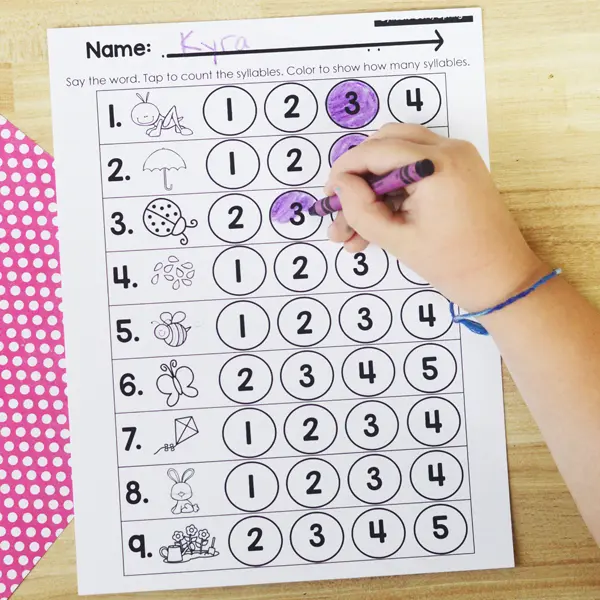
Black and White Response Worksheets: Optional independent practice pages that allow students to demonstrate their understanding by recording syllable counts.
Comprehensive Answer Keys: Ensuring rapid grading and self-correction capabilities for educators and classroom assistants.
The Four Seasons Syllable Sort (Comprehensive 42-Page Pack)
For educators seeking a year-round phonological framework, the expanded Four Seasons pack offers an extensive collection of clip cards and sorting boards. Spanning spring, summer, autumn, and winter, this resource intentionally prioritizes sound and picture clues over written text. This deliberate design choice ensures that pre-readers focus purely on auditory processing and phonological segmentation without becoming prematurely overwhelmed by orthographic rules.
Implementation Methodologies
To maximize the effectiveness of these sorting activities, literacy experts recommend a structured, three-step implementation model:
Step 1: Explicit Vocabulary Introduction. Before distributing cards for independent or center work, teachers must introduce each picture, clearly stating the word and verifying that students understand its meaning. Misidentifying an image (e.g., calling a "ladybug" a "bug") can distort the syllable count.
Step 2: Guided Kinesthetic Practice. Students practice segmenting the word together as a group. For instance, saying "tul-ip" while clapping twice or tapping two fingers against the desk.
Step 3: Independent Sorting & Assessment. Students transition to literacy centers, take-home bags, or independent workstations where they sort the picture cards into categories based on whether they contain one, two, three, or four syllables. Finally, they complete the corresponding worksheet to provide the teacher with a concrete assessment metric.
Official Statements and Educational Insights
Early childhood literacy advocates and curriculum specialists have lauded the release of these seasonal sorting tools for their alignment with modern educational standards.
"Phonological awareness is the anchor of early reading instruction," notes a leading curriculum developer specializing in preschool literacy. "When we ask children to clap out the beats of a spring flower or a winter snowflake, we aren’t just playing a game—we are wiring their brains to perceive the structural framework of language. By removing the pressure of decoding written words and focusing purely on sounds and pictures, we open the door for every child to experience early academic success."
Educators utilizing the tools in kindergarten classrooms have echoed these sentiments, emphasizing the value of low-prep, high-engagement materials.
"Teachers are constantly looking for resources that are both fun for young children and grounded in the Science of Reading," shared a veteran kindergarten teacher and literacy coach. "Having ready-to-print sorting cards and response sheets that tie directly into seasonal themes makes planning effortless while ensuring our students get the rigorous phonological practice they need."
Future Outlook: The Direction of Play-Based Literacy Curricula
As educational paradigms continue to shift toward balanced, evidence-based instructional models, the demand for high-quality, play-infused literacy resources is projected to surge. The integration of thematic units—such as the Four Seasons Syllable Sort—demonstrates a promising trajectory for early education: one where academic rigor and joyful exploration are not mutually exclusive, but rather mutually reinforcing.
Looking ahead, developers plan to expand these seasonal frameworks to incorporate digital interactive components, multi-lingual vocabulary adaptations, and extended take-home packets designed to foster stronger family-school connections in early literacy development. By continuing to ground playful classroom activities in robust scientific research, educators can ensure that every child builds a resilient foundation for a lifetime of reading comprehension.