
Executive Overview
In an era defined by geopolitical polarization, cultural friction, and an increasing reliance on digital screens, parents face an unprecedented challenge: raising children who are empathetic, globally minded, and resilient. While endless parenting philosophies exist to address this developmental imperative, journalist, educator, and mother of four Meg St. Esprit argues for a time-tested yet increasingly sidelined antidote: travel.
Recent sociological data underscores this perspective. According to a landmark study by the Pew Research Center, roughly 23 percent of Americans have never left the United States. However, those who do venture internationally consistently demonstrate heightened knowledge of foreign affairs, deeper geopolitical interest, and a demonstrably greater capacity for empathy toward unfamiliar cultures. Travel, it appears, is not merely a leisure activity; it is a catalyst for cognitive and emotional development.
Yet, for many modern families, the physical and financial hurdles of international travel can feel insurmountable. Between bureaucratic bottlenecks, passport backlogs, and the rising cost of living, global exploration often takes a backseat to domestic stability. However, St. Esprit’s personal and professional thesis challenges this status quo. Drawing from her family’s recent expedition to Panama—alongside years of navigating the logistical mazes of passport applications and tight travel budgets—she posits that the psychological dividends of experiencing new cultures far outweigh the financial sacrifices.
For families unable to cross oceans, the philosophy of "microdosing the world" offers a practical alternative. By leveraging local cultural touchstones, exploring U.S. territories, or taking advantage of simplified cross-border travel rules, parents can systematically expand their children’s worldviews without breaking the bank or boarding a long-haul flight.
Detailed Chronology: A Case Study in Global Exposure
The philosophical shift toward experiential parenting is best illustrated through lived experience. For St. Esprit and her family—consisting of a high schooler, twin middle schoolers, and an eight-year-old—the journey to international awareness has been years in the making, culminating in a transformative spring expedition to Panama.
Navigating the Bureaucratic Threshold
The genesis of the Panamanian adventure began long before boarding a plane. Rooted in complex adoption-related procedures, securing official documentation for a family of six required years of persistence and substantial financial investment. For many families, the administrative and monetary toll of obtaining six blue passport books serves as an immediate deterrent.
However, St. Esprit frames the acquisition of these documents not as a bureaucratic hurdle, but as a rite of passage into global citizenship. "I’d rather go into debt over my kids’ first sunset over the Pacific than over anything that makes our house more Pinterest-worthy," she notes, acknowledging the inherent privilege in making such a choice while emphasizing the profound sense of liberation that accompanied the weight of the passports in hand.
Arrival and Immersion: Altos de Campana and Beyond
Upon touching down in Panama to visit family, the family’s itinerary quickly transcended a standard vacation. At Altos de Campana National Park, St. Esprit observed her 14-year-old son quietly documenting sweeping vistas and Pacific views before pausing simply to absorb the landscape. It was a moment that crystallized the entire logistical ordeal.
As the days progressed, the family’s immersion deepened. Cruising down the Chagres River in traditional dugout canoes provided a masterclass in cross-cultural engagement. Seated at the rear of the vessel, St. Esprit watched her children absorb the wisdom of indigenous hosts while taking in unfamiliar sights, sounds, and culinary traditions. Notably, even a child typically resistant to unconventional foods found themselves willingly tasting fresh tilapia plucked from the river and cooked over an open flame.
Cultivating Independence in Casco Viejo
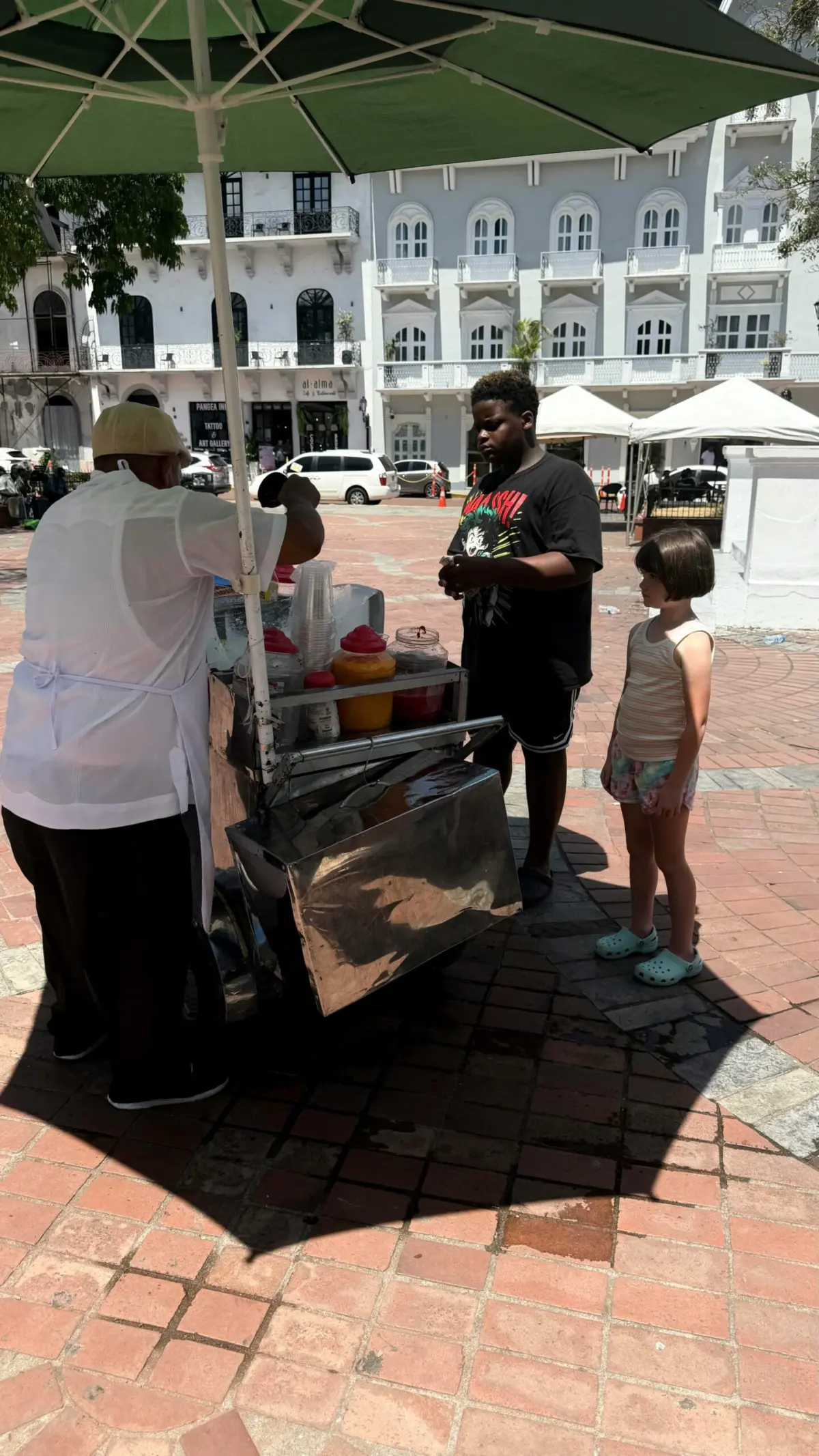
The apex of the trip’s developmental milestones manifested in moments of linguistic and cultural risk-taking. Amidst the historical stones of Plaza de la Independencia in Panama City—constructed in 1673—the children demonstrated newfound confidence.
By the end of the week, one of her 12-year-old twins stepped forward to guide his younger sister to a local street vendor. Counting out a handful of Panamanian balboas, he utilized his fledgling Spanish vocabulary to successfully order frozen fruit desserts. While the journey was not without its trials—including emergency morale-boosting runs to international McDonald’s outlets and moments of parental exhaustion—the cumulative effect was a generation of children better equipped to navigate an interconnected planet.
Supporting Context & Metrics: The Science of Global Mobility
To understand the urgency of youth travel, one must examine the intersection of sociology, psychology, and national demographics. The insular nature of many American upbringing environments has tangible consequences for global literacy.
The American Travel Deficit
Statistical insights from the Pew Research Center reveal a stark demographic reality:
- The 23 Percent Margin: Nearly a quarter of the U.S. population has never crossed national borders.
- Barriers to Entry: Primary deterrents include prohibitive costs, passport acquisition anxieties, and a general lack of geographic proximity to international neighbors.
- The Empathy Dividend: Conversely, citizens with international travel experience consistently score higher on cross-cultural comprehension metrics, demonstrating reduced xenophobia and a greater appreciation for systemic global interdependencies.
"Microdosing the World" on a Domestic Scale
Recognizing that international voyages are financially unfeasible for many households, experts emphasize that global exposure can be achieved through localized immersion. The concept of "microdosing the world" relies on the deliberate seeking out of diverse cultural experiences within one’s own backyard or immediate region.
For families operating on strict budgets or tight schedules, several strategic avenues exist:
- Simplified Regional Travel: Minors aged 16 and under can travel to Canada and Mexico by land or sea, or embark on closed-loop Caribbean cruises, utilizing only a birth certificate.
- U.S. Territories: Destinations such as Puerto Rico and the U.S. Virgin Islands offer rich, distinct cultural tapestries, bilingual environments, and historical depth without the requirement of a passport.
- Urban Cultural Ecosystems: Cities like Pittsburgh serve as micro-cosms of global diversity. Weekly bilingual community storytimes, free-to-tour nationality rooms, international food festivals, and localized cultural celebrations (such as Eid festivals or dragon boat launches) provide immersive learning environments without requiring long-distance travel.
Official Statements and Expert Perspectives
Child development specialists and educators increasingly validate the integration of experiential learning into formative years. While formal institutional policies often emphasize standardized testing and in-classroom curriculum, developmental psychologists argue that emotional intelligence and global competency are best forged through environmental disruption and cultural adaptation.
"It’s not weird, it’s just different."
— A foundational family mantra utilized by educators and global travelers to reframe unfamiliar cultural practices away from judgment and toward curiosity.
According to behavioral analysts, framing differences through this lens prevents children from internalizing ethnocentric biases. When children witness alternative ways of life—whether through navigating indigenous communities in Central America or participating in multicultural urban festivals—they develop cognitive flexibility.
Furthermore, educational sociologists point out that modern youth are subjected to digital echo chambers that frequently sensationalize geopolitical conflict. Introducing physical travel, or structured cross-cultural encounters domestically, serves as a vital corrective mechanism. It grounds abstract global events in tangible human interactions, fostering an innate desire for peacebuilding and cross-border collaboration.
Future Outlook: Raising a Generation of Global Citizens
As the global community looks toward the coming decades, the imperative to cultivate empathetic leadership among the younger generation has never been more pressing. The traditional metrics of childhood success—academic achievement and extracurricular accumulation—must be balanced with emotional and cultural resilience.
The Path Forward for Parents
The modern parenting landscape requires intentionality in combating insularity. Whether families choose to save for monumental international expeditions, explore the diverse cultural enclaves of domestic urban centers, or utilize simplified travel pathways to neighboring nations, the core objective remains unchanged: proving to children that the world is fundamentally cooperative rather than adversarial.
The financial and logistical sacrifices associated with obtaining passports, navigating language barriers, and stepping outside comfort zones yield compounding returns. As children learn to order food in a foreign tongue, taste unfamiliar cuisines, and walk among centuries-old ruins, they shed the fear of the unknown.
Ultimately, the argument for travel is an argument for hope. By intentionally exposing children to the vast, multifaceted tapestry of humanity, parents offer them the most vital tool for the future: the realization that what unites people across the globe vastly outweighs what divides them.

