
Executive Overview
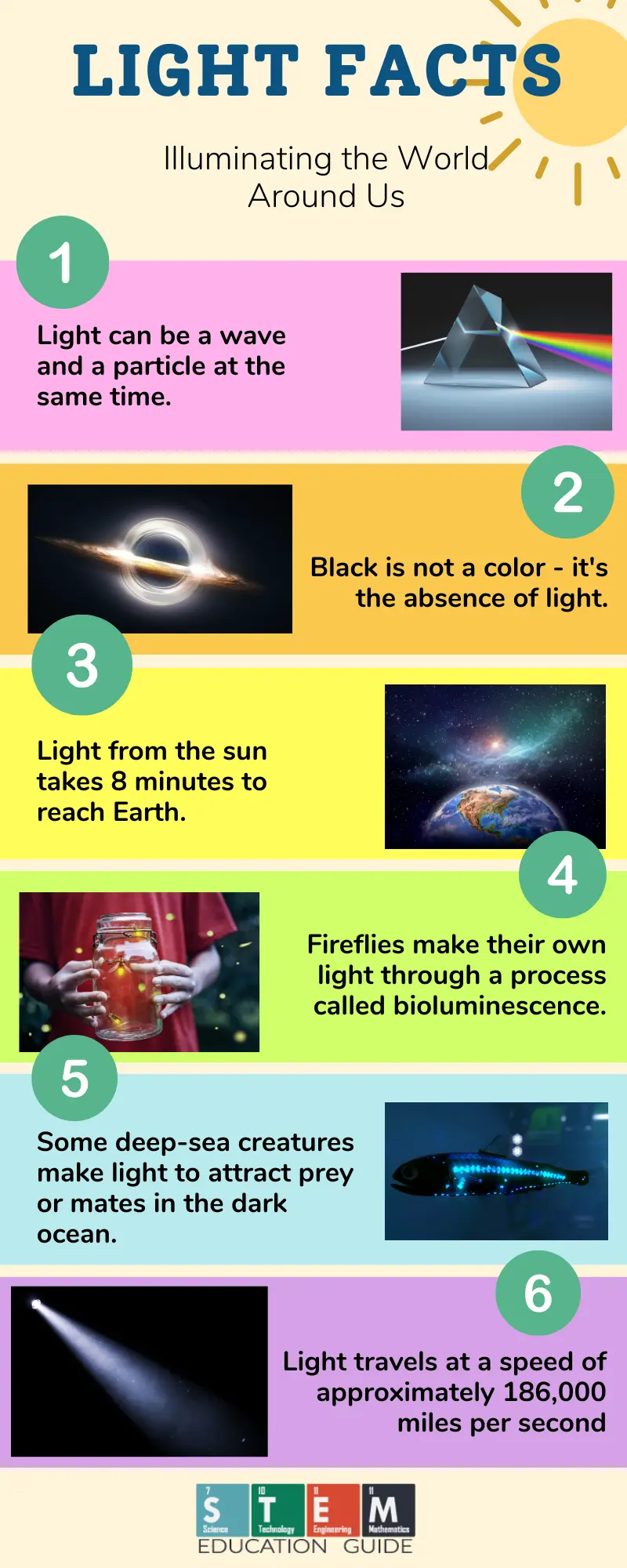
Light is the fundamental thread that weaves together the visual tapestry of our universe. From powering biological processes on Earth to carrying data across global fiber-optic networks at blistering speeds, light is simultaneously an everyday convenience and an extraordinary physical phenomenon. Defined fundamentally as a form of energy that behaves both as a wave and a particle, light enables human vision, paints the natural world in breathtaking spectrums, and serves as the backbone of modern technological infrastructure.
While everyday perception treats light as a simple instantaneous switch—flipping a light bulb on or watching sunlight flood a room—the reality governed by physics is far more complex. Light is electromagnetic radiation traveling at a cosmic speed limit of roughly 186,000 miles per second (approximately 300,000 kilometers per second). It originates from a multitude of natural and artificial sources, interacts with physical matter through reflection, refraction, and absorption, and spans a vast spectrum far beyond the narrow band of colors visible to the human eye.
This comprehensive analysis explores the nature of light, its core scientific principles, its dramatic manifestations in nature, historical milestones in optics, hands-on educational applications, and cutting-edge future technologies poised to revolutionize how humanity harnesses illumination.
Detailed Chronology: Milestones in the Scientific Understanding of Light
The human quest to understand light spans millennia, evolving from philosophical musings into rigorous mathematical and experimental physics. The chronology of optics and light science reveals a gradual unmasking of one of nature’s most elusive forces.
Antiquity to the Scientific Revolution
- c. 300 BCE: Euclid formulates early geometric principles of optics, suggesting that light travels in straight lines (rays) and establishing the law of reflection.
- 11th Century: Arab mathematician and physicist Ibn al-Haytham (Alhazen) revolutionizes the field in his Book of Optics. He proves that vision occurs when light reflects off an object and enters the eye, debunking the ancient Greek "emission" theory of vision.
The Enlightenment and Wave-Particle Debates
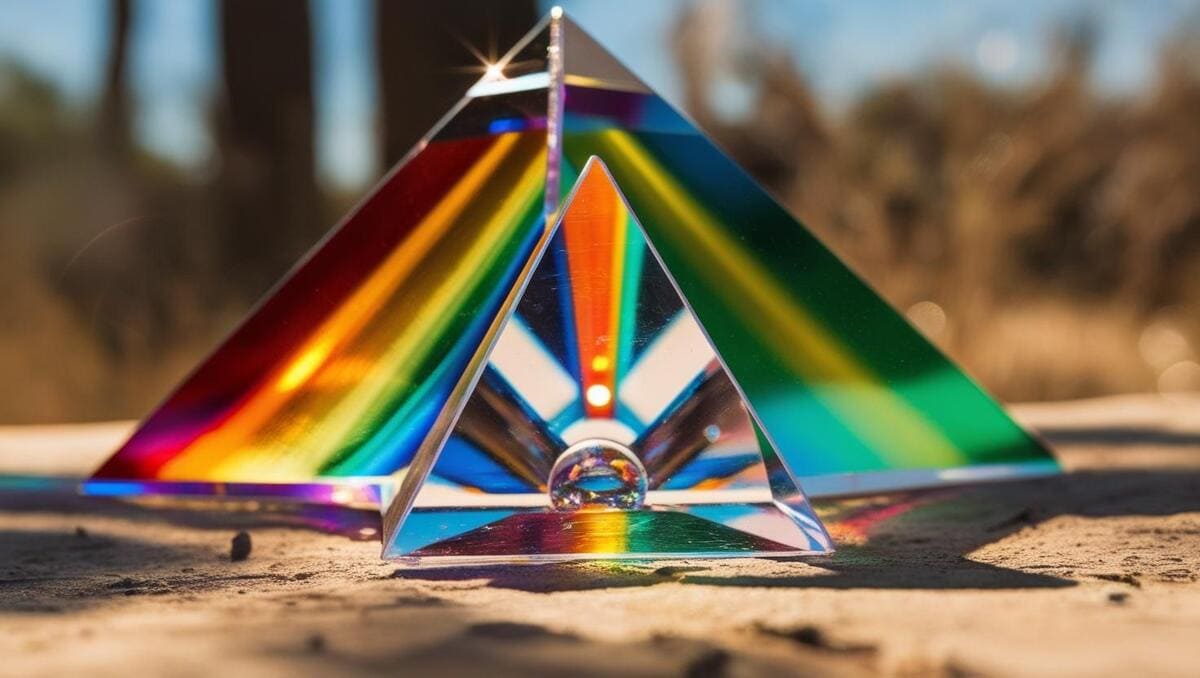
- 1665–1672: Sir Isaac Newton conducts landmark prism experiments, proving that white light is not simple or homogeneous, but rather a heterogeneous mixture of distinct colored rays that separate when refracted. He subsequently publishes Opticks in 1704.
- 1678: Dutch physicist Christiaan Huygens proposes the wave theory of light, arguing that light propagates through a hypothetical medium called the "luminiferous ether" via wavefronts.
- 1801: Thomas Young performs the famous double-slit experiment, demonstrating the interference of light waves and providing definitive evidence for the wave theory of light over Newton’s corpuscular (particle) theory.
Electromagnetism and Modern Physics
- 1865: James Clerk Maxwell formulates his famous electromagnetic field equations, proving mathematically that light is an electromagnetic wave traveling at a constant velocity.
- 1905: Albert Einstein publishes his paper on the photoelectric effect, proposing that light exists as discrete packets of energy called "photons." This breakthrough births quantum mechanics, establishing that light exhibits a dual wave-particle nature.
- 1960: Theodore Maiman constructs the first operational laser (Light Amplification by Stimulated Emission of Radiation), ushering in an era of coherent light technology that underpins modern telecommunications, medicine, and industrial manufacturing.
Supporting Context & Metrics: The Physics and Properties of Light
Understanding light requires examining its dual identity: it is simultaneously an electromagnetic wave and a stream of massless packets called photons.
The Electromagnetic Spectrum and Visible Light
Visible light constitutes only a minuscule fraction of the vast electromagnetic spectrum. Human eyes have evolved photoreceptor cells (rods and cones) optimized to detect wavelengths roughly between 380 and 750 nanometers.
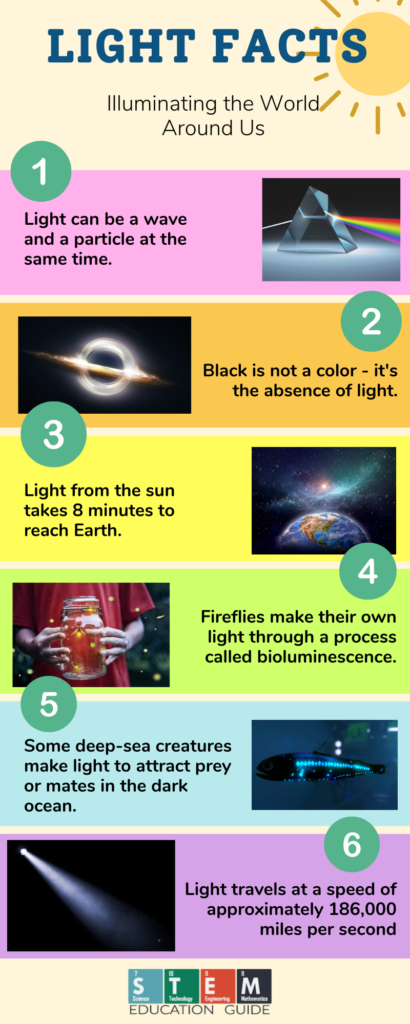
- Red Light: Features the longest wavelengths in the visible spectrum (620–750 nm) and the lowest frequency, allowing it to penetrate dust and atmosphere more effectively (which is why sunsets appear red).
- Violet Light: Features the shortest wavelengths in the visible spectrum (380–450 nm) and the highest frequency.
- Invisible Radiation: Beyond the visible spectrum lie infrared radiation (sensed as heat), ultraviolet (UV) radiation (capable of causing sunburns), X-rays, and gamma rays.
Core Metrics of Light Behavior
- Speed in a Vacuum: Exactly 299,792,458 meters per second (~186,000 miles per second). Sunlight traverses the 93 million miles from the Sun to Earth in approximately 8 minutes and 20 seconds.
- Refractive Index: A measure of how much the speed of light is reduced inside a given medium compared to a vacuum. For instance, water has a refractive index of about 1.33, meaning light travels slower in water than in air.
- Intensity and Wavelength: Intensity governs the brightness or dimness of a light beam, while wavelength and frequency dictate its color properties.
Natural vs. Artificial Sources
Light generation occurs via thermal excitation, chemical reactions, or quantum transitions.
- Natural Sources: The Sun and distant stars generate light through nuclear fusion. Meanwhile, biological organisms such as fireflies, deep-sea fish, and certain jellyfish produce cold light via bioluminescence—a chemical reaction involving luciferin and luciferase.
- Artificial Sources: Incandescent bulbs, fluorescent tubes, light-emitting diodes (LEDs), and lasers represent engineered methods of converting electrical energy into radiant light energy.
Official Statements and Expert Perspectives
The profound impact of light science extends far into industrial applications, telecommunications, and theoretical physics. Leading scientific bodies and institutions emphasize light’s critical role in global development.
The United Nations designated 2015 as the International Year of Light and Light-based Technologies (IYL 2015), highlighting how optical technologies promote sustainable development and provide solutions to global challenges in energy, education, agriculture, and health.

"Light-based technologies touch our daily lives in myriad ways and are central to future developments in science, medicine, and communications. Photonics—the science and technology of generating, controlling, and detecting photons—is driving the 21st-century economy just as electronics drove the 20th century."
— Consensus Statement from the International Commission for Optics (ICO)
Furthermore, educational researchers in STEM fields stress the importance of early hands-on interaction with optics. By exploring fundamental principles such as reflection and refraction through classroom experiments, students develop critical analytical skills that pave the way for future careers in engineering, astrophysics, and material science.
Future Outlook: The Next Frontier in Light Technology
As optical engineering matures, light is moving beyond illumination and communication to become a primary driver of next-generation computing, medicine, and defense.

1. Quantum Dots and Ultra-High-Definition Displays
Researchers are actively refining microscopic semiconductor particles known as quantum dots. These particles can emit precise frequencies of light when exposed to UV excitation, paving the way for hyper-vivid, energy-efficient display technologies that could soon replace traditional LED and OLED screens.
2. Optical Computing and High-Speed Data Transmission
Current computer processors rely on electrons moving through silicon microchips, generating heat and encountering physical speed limits. Photonics aims to replace electrons with photons. Optical computing promises processing speeds orders of magnitude faster than silicon counterparts, with virtually zero thermal resistance. Meanwhile, fiber-optic networks continue to expand, utilizing dense wavelength-division multiplexing to send petabytes of internet traffic across continents through hair-thin glass filaments.
3. Invisibility Cloaking and Metamaterials
One of the most fascinating frontiers in modern optics is the development of metamaterials—engineered structures designed to bend light entirely around an object. By manipulating the refractive index at a sub-wavelength scale, scientists are bringing theoretical concepts of optical cloaking closer to reality, with potential applications ranging from aerospace engineering to advanced medical imaging.

Conclusion
Light remains one of the most astonishing phenomena in the natural world. From the solar radiation that sustains life on Earth to the engineered lasers shaping microscopic surgeries and global telecommunications, our mastery of light defines the pinnacle of human achievement. By continuing to investigate its properties—through historical milestones, modern experimentation, and future-forward technological innovations—humanity unlocks deeper secrets of the cosmos and secures a brighter, more connected future.

