
By the Active Minds Editorial Desk
Published: September 14, 2026
Executive Overview
In an era defined by hyper-connectivity and profound isolation, human relationships are frequently mediated by glowing glass screens, rapid-fire notifications, and an unyielding societal demand for economic efficiency. Modern colloquialisms urge us to accept that "to be loved is to be known," yet the relentless pace of urban existence rarely affords us the quiet moments necessary to truly know one another—or ourselves. We race endlessly toward the next professional milestone or digital distraction, operating on a perpetual loop of exhaustion and recovery.
However, deep cultural shifts do not always arrive through grand institutional declarations or sweeping legislative reforms. Sometimes, they arrive in the dark of night, hidden behind the curtains of a localized thunderstorm.
In September 2026, a sharp, torrential storm swept through Washington, D.C. To the sleeping populace, the tempest was a minor inconvenience—an overnight disturbance that caused fleeting power outages and scattered localized debris. By morning, the storm had passed, leaving behind a city eager to resume its hurried daily rhythm. But the tempest had quietly claimed a silent, enduring pillar of the community: a majestic, 55-year-old oak tree that had stood as a stoic fixture in the northern end of Dupont Circle for over half a century.
What began as a mundane urban forestry incident transformed into a profound socio-cultural phenomenon. The remaining 15-foot stump became an impromptu canvas for collective grief, shared memory, and radical human connection. This article explores the anatomy of that transformation, examining how a simple act of nature disrupted the urban grind, revitalized neighborhood bonds, and served as a poignant reminder of our collective psychological need for grounded community.
Detailed Chronology: The Storm, the Loss, and the Awakening
The Tempest of September 2026
The meteorological event itself was unremarkable by East Coast standards. Situated on the periphery of volatile Atlantic weather patterns, Washington, D.C. is no stranger to sudden summer thunderstorms. The September storm hit hard and fast, unleashing heavy downpours and fierce gusts of wind that shook windowpanes across the District. While emergency services and municipal departments noted localized damage—including downed power lines that briefly forced the closure of several area schools—the city at large slept through the worst of it.
When morning broke, the city’s inhabitants stepped out onto slick sidewalks, adjusting their umbrellas, checking their smartphones, and stepping briskly toward their morning commutes. On the surface, D.C. had weathered the storm completely unscathed.
The Discovery at Dupont Circle
For the thousands of residents, commuters, and students who routinely traversed the northern end of Dupont Circle, the landscape was permanently altered. The venerable oak tree—a towering canopy of emerald green that had watched generations of Washingtonians grow, fall in love, protest, celebrate, and commute—was gone.

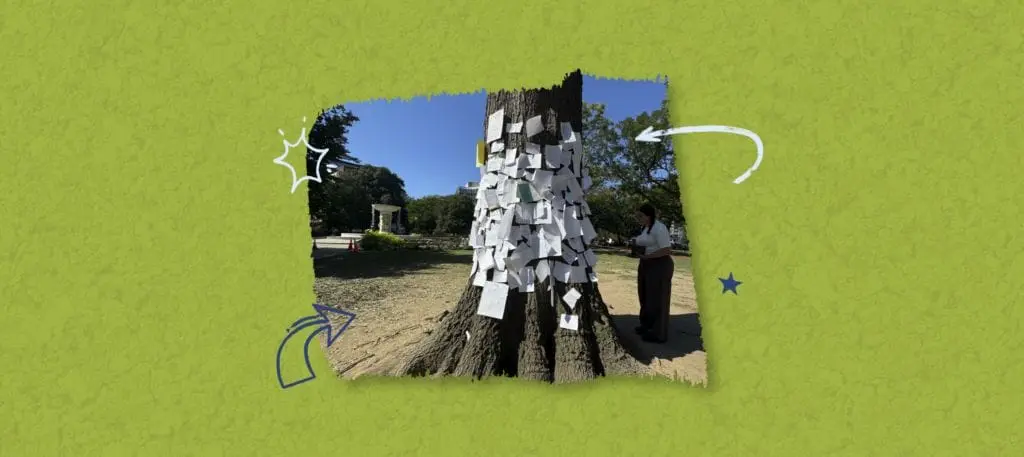
In its place lay a jagged, 15-foot-tall wooden stump. Its root system, exposed and convulsed, protruded from the soil in thick, muscular grooves that risked tripping the careless pedestrian. To a municipal crew, it was simply work order #4829—a downed tree requiring removal and replacement. But to the neighborhood, it was the abrupt erasure of an old friend.
For over fifty-five years, this oak had functioned as an ecological and social anchor. It was the natural compass point for morning joggers, the shaded canopy for afternoon readers, and the familiar landmark for late-night strollers returning home. Its sudden absence created an eerie vacuum in the urban landscape—a visual and emotional void that demanded acknowledgment.
The First Note and the Birth of a Community Conversation
Within hours of the storm, a solitary passerby stopped before the splintered trunk. Moved by a sudden impulse of unexpected grief, they affixed a handwritten note to the raw wood. The message read:
"When you’re falling in Dupont and there’s nobody around, did you ever even crash or even make a sound?"
That single note acted as a psychological catalyst. By midday, additional notes began to appear. Commuters stopped in their tracks; men in tailored business suits paused alongside teenagers with skateboards and parents pushing strollers. Over the next forty-eight hours, the stump was blanketed in a mosaic of sticky notes, index cards, and handwritten letters.
The messaging evolved from expressions of mourning for the tree into a profound dialogue among strangers. Neighborhood residents shared memories of sitting under its boughs during historic snowstorms and stifling summer heatwaves. Children pinned delicate, crayon-drawn sketches of the tree to its bark. Elders recounted decades of neighborhood changes watched over by those exact branches.
The northern end of Dupont Circle transformed from a transit corridor into an open-air community parlor. For the first time in recent memory, the frantic pace of the nation’s capital ground to a halt, replaced by the slow, deliberate art of human conversation.
Supporting Context & Metrics: The Human-Nature Bond and Urban Psychology
The Evolutionary Roots of Our Connection to Trees
The profound emotional reaction elicited by the fallen Dupont Circle oak is far from accidental. Anthropological and psychological research consistently demonstrates that human beings share an ancient, deeply embedded evolutionary bond with the natural world—particularly with long-lived canopy trees like oaks.

A landmark study published in the peer-reviewed literature (Human Ecology, PMC7166128) notes that "the shared history of humans and oaks also generated cultural and emotional relationships that translated into symbols or were incorporated into religious beliefs and mythology." For millennia, oaks have symbolized strength, longevity, endurance, and shelter. When an urban tree of this magnitude is destroyed, it triggers a genuine psychological bereavement process within the local population, who subconsciously view the tree not merely as landscaping, but as a silent, steadfast member of the community ecosystem.
The Epidemic of Urban Loneliness and the Need for "Third Places"
The spontaneous gathering at Dupont Circle also highlights a critical modern sociological crisis: the severe deficit of functional "third places." Coined by sociologist Ray Oldenburg, the term "third place" refers to social environments separate from the two usual environments of home ("first place") and the workplace ("second place"). Places like cafes, community centers, and neighborhood parks are essential for civil society, civic engagement, and mental health.
In contemporary American cities, third places are rapidly disappearing, swallowed by commercialization, gentrification, and an overarching cultural architecture that prioritizes rapid transit over lingering. Consequently, urban residents experience unprecedented rates of loneliness and alienation.
When the Dupont Circle oak fell, its absence inadvertently created a temporary, egalitarian third place. It forced individuals out of their self-imposed psychological bubbles. For a few brief days, socio-economic divides, political affiliations, and generational gaps dissolved in the shared shadow of a broken stump.
Expert Perspectives and Psychological Insights
Mental health advocates and urban planners alike have pointed to the Dupont Circle event as a masterclass in organic community resilience and emotional grounding.
Dr. Elena Vance, an environmental psychologist specializing in urban spaces, notes that modern city design frequently alienates the human psyche. "We build environments designed for maximum logistical throughput," Dr. Vance explains. "We optimize for cars, for foot-traffic velocity, and for digital connectivity. But in doing so, we starve the human brain of micro-moments of awe and grounded contemplation. When an urban landmark falls, and people gather to mourn it, they are actually mourning their own isolation. The notes on that tree weren’t just about the oak; they were an SOS flare for connection."
This sentiment resonates deeply with frameworks established by mental health organizations like Active Minds, which continually emphasize that emotional well-being is intrinsically tied to community support and intentional pauses in our daily routines. When individuals allow their routines to be interrupted by the mundane beauty of shared human experience, the nervous system regulates, cortisol levels drop, and the hyper-vigilance of the modern grind momentarily recedes.
Furthermore, the phenomenon ties directly into modern discussions surrounding student and youth mental health. As explored in parallel wellness literature regarding high-stress environments—such as navigating academic finals or managing the burnout of the modern gig economy—the antidote to overwhelm is almost invariably found in small, tactile interventions: a structured breath, a shared story, or a deliberate pause to acknowledge one’s immediate surroundings.

Future Outlook: Rebuilding More Than Infrastructure
As municipal arborists in Washington, D.C. evaluate the eventual removal of the remaining stump and the planting of a sapling in its stead, the legacy of the Dupont Circle oak offers a vital blueprint for the future of urban living.
Cities are frequently evaluated through cold economic metrics: GDP output, real estate valuation, transit efficiency, and crime statistics. Yet, the intangible health of a city is measured by its capacity for empathy, its willingness to grieve collectively, and its ability to turn tragedy into fellowship.
The spontaneous memorial on the northern end of Dupont Circle serves as a timeless challenge to urban planners, civic leaders, and everyday citizens alike. It asks a fundamental question: Must we wait for a storm to bring us together?
The answer lies in our daily choices. We can choose to let our routines be interrupted. We can choose to look up from our screens, to acknowledge the strangers walking beside us, and to treat our neighborhoods not merely as backdrops for our busy lives, but as living, breathing ecosystems of shared humanity.
As the notes weathered and eventually faded from the oak’s rough bark, the message left behind remains indelible. In the words inspired by one of childhood’s most enduring literary reflections on arboreal sacrifice and unconditional love: And the tree was happy. May our communities be equally resilient, deeply rooted, and profoundly connected.

