
Executive Overview
In the fast-paced, high-stakes environment of modern urban life, the boundary between a bustling metropolis and an isolated individual can feel razor-thin. Washington, D.C., a city synonymous with political ambition, relentless operational schedules, and the perpetual hum of institutional pressure, is rarely characterized as a place of quiet reflection. Yet, in September 2026, an unexpected ecological event on the north end of Dupont Circle pierced the city’s collective armor, transforming grief over a fallen landmark into a powerful meditation on community, mental health, and the urgent necessity of human connection.
A torrential overnight storm—brief enough to pass unnoticed by many sleeping residents—uprooted a majestic, 55-year-old oak tree that had long served as a silent anchor for the neighborhood. When dawn broke, the community was greeted not by the lush canopy that had shaded generations of commuters, dog-walkers, and daydreamers, but by a jagged 15-foot stump and a web of trip-hazard roots gripping the earth.
What followed was an extraordinary spontaneous display of urban sociology. What began as a solitary, poignant handwritten note tacked to the wounded bark snowballed into a communal mosaic of grief, gratitude, and storytelling. Neighbors who had spent years passing one another as anonymous shadows suddenly stopped, conversed, and confronted the shared vulnerability of living in a hyper-efficient society. This article explores the anatomy of that singular event, the psychological frameworks that link urban nature to mental wellness, and the broader lessons the Dupont Circle oak offers a society starved of intentional presence.
Detailed Chronology: The Fall and Rise of the Dupont Circle Oak
The Night of the Tempest
The atmospheric disturbance that swept through the District of Columbia in mid-September 2026 was swift and unforgiving. While localized thunderstorms are a standard feature of the mid-Atlantic late summer, this particular front carried gale-force winds capable of testing the structural integrity of D.C.’s historic urban forest. Across the city, school districts delayed openings, power lines snapped under the weight of downed timber, and emergency services responded to a flurry of calls regarding blocked thoroughfares.
However, the storm’s most profound casualty was not infrastructural, but cultural. In the northern quadrant of Dupont Circle—a vibrant nexus where historic residential neighborhoods bleed into commercial corridors—the 55-year-old oak tree succumbed to the elements. Stripped of its crown, the once-towering giant was reduced to a raw, splintered 15-foot-tall stump.
The First Note: Catalyzing the Silence
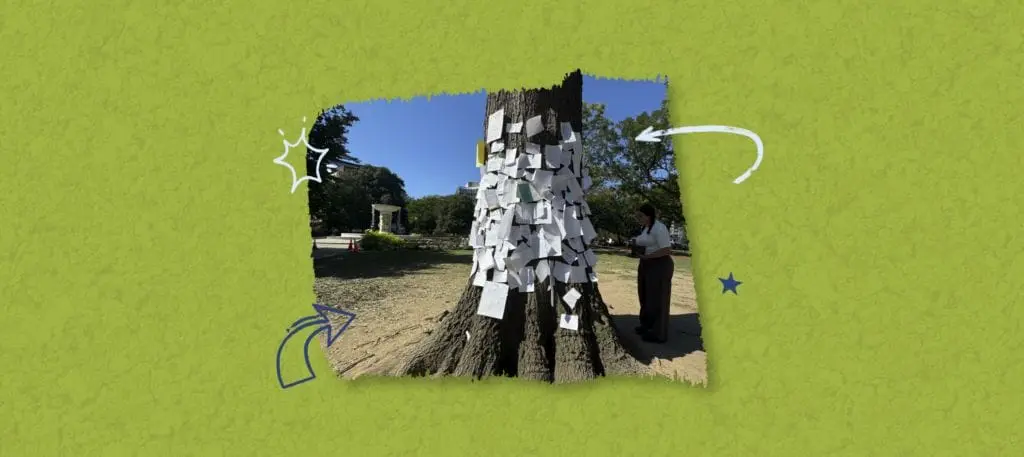
By the morning of September 14, 2026, pedestrians navigating the square began to register the loss. The spatial void left by the canopy was jarring. It was then that an anonymous resident paused, pinned a piece of paper to the weathered wood, and penned a question that would soon capture the zeitgeist of the neighborhood:

“When you’re falling in Dupont and there’s nobody around, did you ever even crash or even make a sound?”
This existential inquiry struck a chord. In a city driven by performance, metrics, and relentless output, the metaphor of the unseen fall resonated deeply with the psychological undercurrents of urban isolation. Within hours, the solitary note multiplied.
The Spontaneous Archival of Grief
Over the subsequent days, the stump transformed into a living bulletin board—a dynamic, open-source monument to civic attachment. Passersby began affixing sticky notes, index cards, sketches, and poems. The dialogue expanded rapidly:
- Expressions of Gratitude: Neighbors thanked the tree for decades of morning shade, afternoon refuge, and evening orientation points.
- Collective Mourning: Participants articulated a genuine sense of bereavement, treating the loss of the tree akin to the passing of a long-time neighborhood resident.
- Philosophical Interchanges: Complete strangers debated the nature of permanence, community resilience, and the relentless march of time in a major capital city.
The base of the oak became a pedestrian bottleneck—not out of frustration, but out of a shared, voluntary impulse to slow down. Men in tailored suits, university students, toddlers in strollers, and elderly residents walking high-strung terriers converged on the same physical point. They stopped scrolling on their smartphones, looked up, and engaged in real-time, analog conversation.
Supporting Context & Metrics: The Science of Urban Trees and Mental Health
The phenomenon observed in Dupont Circle is far from an isolated emotional anomaly; it is supported by a robust body of environmental psychology and neurobiological research regarding humanity’s deep-seated relationship with the natural world.
The Biophilia Hypothesis and Cultural Ecology
Human beings have maintained a symbiotic, symbolic relationship with trees—particularly oaks—for millennia. Anthropological and ecological studies highlight that oaks have historically served as focal points for mythology, religious ceremonies, and community gatherings. They represent longevity, stability, and endurance against the elements.

According to research published in leading ecological journals regarding human-oak dynamics, the loss of legacy trees in urban ecosystems triggers a legitimate psychological stress response among residents. Trees act as "anchors of place," providing cognitive mapping cues and emotional grounding in densely populated environments where architectural uniformity often induces sensory fatigue.
The Antidote to the Dopamine Treadmill
Modern society is engineered for efficiency, speed, and continuous digital connectivity. As noted in contemporary mental health discourse, individuals frequently cycle between pushing professional boundaries and attempting to recover, with leisure time routinely hijacked by the impulse to seek digital dopamine hits.
This hyper-efficient lifestyle correlates directly with rising rates of urban loneliness and anxiety. When a physical landmark like the Dupont Circle oak is abruptly removed, it forces a disruption of routine. Psychologists note that such interruptions are vital; they break the autopilot state of daily commuting, compelling the human brain to re-engage with its immediate physical and social surroundings.
By forcing pedestrians to literally trip over the exposed roots and stop in their tracks, the tree’s demise achieved what wellness apps and public awareness campaigns often struggle to do: it mandated a pause and fostered spontaneous, cross-generational interaction.
Official Statements and Community Perspectives
The community response to the Dupont Circle incident drew commentary from local civic leaders, urban planners, and mental health advocates who view the impromptu memorial as a case study in grassroots resilience.
Civic Leadership and Neighborhood Voices
Local business owners near the circle reported an immediate shift in neighborhood dynamics following the storm. "You usually see people marching down these sidewalks with their eyes glued to their devices, wrapped in their own bubbles," said a local cafe proprietor who watched the memorial grow. "For a solid week after the storm, those notes changed the air. People were laughing, pointing at sketches, and introducing themselves to neighbors they’d lived next to for five years without exchanging a word."

Urban planners emphasized that cities are frequently designed as mechanical systems—transit grids, zoning laws, and real estate assets—when they are, in reality, complex living ecosystems. The Dupont Circle oak reminded the public that a city’s health is measured not solely by its economic output or structural integrity, but by the strength of the social fabric binding its inhabitants together.
Mental Health Advocates Weigh In
Organizations focused on mental health and community well-being highlighted the event as a masterclass in organic connection. In an era where clinical isolation is recognized as a public health crisis, spontaneous public rituals that encourage shared vulnerability play an essential role in emotional stabilization.
"We spend an immense amount of energy trying to engineer wellness through digital interventions," noted a local community mental health advocate. "Yet, sometimes the most profound healing comes from stepping off the treadmill, acknowledging a shared loss, and realizing that your neighbors are feeling the exact same weight. The tree didn’t just fall; it created a permission structure for people to care out loud."
Future Outlook: Translating the Dupont Circle Phenomenon into Daily Life
As municipal crews eventually clear away the remaining stump and replant new saplings in the soil of Dupont Circle, the true legacy of the September 2026 storm will not be measured in board-feet of timber lost, but in the cultural shift it catalyzed.
The episode serves as a powerful reminder of several core truths for urban dwellers:
- The Value of Intentional Disruption: We must actively cultivate moments of pause in our routines. Waiting for a crisis or a fallen landmark to force our attention is a fragile strategy for maintaining community health.
- Ecosystems Over Environments: Cities are not merely backdrops against which we perform our lives; they are interconnected ecosystems where every individual, structure, and living organism impacts the collective emotional climate.
- The Cure for Loneliness is Proximity and Presence: Strangers remain strangers only as long as we refuse to see them. Simple acts—a handwritten note, a shared observation, a momentary hesitation on a crowded sidewalk—can bridge vast demographic divides.
Ultimately, the notes pinned to the Dupont Circle oak faded in the autumn rain, but the conversations they sparked left an indelible mark on Washington, D.C. To borrow the spirit of the neighborhood’s impromptu literature: when we fall, and when our routines are upended by life’s inevitable storms, we make a sound only if we allow ourselves to be heard—and only if we take the time to listen to those standing right beside us.

