
Executive Overview
The rapid, unscripted arrival of generative artificial intelligence in K-12 classrooms has fundamentally disrupted the traditional landscape of education. Tools like OpenAI’s ChatGPT, Claude, and specialized educational software have transformed from sci-fi novelty into everyday classroom fixtures almost overnight. For an overburdened teaching workforce navigating chronic resource shortages, oversized classes, and administrative bloat, these technologies offer an enticing promise: automated lesson planning, instant differentiation for struggling learners, and the reclamation of evenings previously lost to mountains of grading.
Yet, this technological leap forward has arrived without an operational manual. Educators find themselves thrust onto the front lines of an unprecedented socio-technological shift, forced to balance the productivity-enhancing capabilities of AI with deeply troubling pedagogical hurdles. Plagiarism has evolved from slyly copying a classmate’s paper to deploying sophisticated language models to generate five-paragraph essays in seconds. Furthermore, the inherent vulnerabilities of large language models—ranging from fabricated citations and outdated facts to algorithmic bias—pose severe risks to academic integrity and student development.
Rather than adopting a utopian stance of unconditional embrace or a dystopian posture of outright prohibition, educational experts increasingly advocate for a nuanced approach. Artificial intelligence must be treated as a sophisticated teaching assistant, never a replacement for human pedagogical judgment. By establishing rigorous boundaries, integrating mandatory fact-checking habits into daily curricula, and shifting focus toward critical literacy, schools can prepare students for a future where AI fluency is no longer optional. This report investigates how AI is actively reshaping the modern classroom, where it falls critically short, and how educators can harness its power without sacrificing the irreplaceable human element of teaching.
Detailed Chronology: The Evolution of AI in Modern Education
The integration of artificial intelligence into school systems did not happen in a vacuum; it represents the latest wave in a decades-long trajectory of educational technology adoption. To understand where the classroom stands today, it is essential to trace how generative AI moved from Silicon Valley research labs to suburban and urban school districts.
Phase One: The Pre-Generative Era and Early Adaptive Software
Long before the public launch of ChatGPT in late 2022, machine learning algorithms were quietly embedded in educational software. Platforms like DreamBox, Khan Academy’s early adaptive tools, and various reading comprehension programs used algorithmic logic to adjust the difficulty of math problems or reading prompts based on student performance. These systems operated within closed loops—they did not create novel content from scratch; rather, they curated existing pathways to support differentiated learning. Educators generally viewed these tools as helpful, albeit limited, supplements to traditional instruction.
Phase Two: The Shockwave of Generative AI (Late 2022 – 2023)
The release of ChatGPT in November 2022 caught educational institutions entirely off-guard. Unlike closed-loop adaptive software, generative AI possessed the capacity to synthesize human-like text, solve complex mathematical proofs, write computer code, and generate creative compositions on demand.

Initial reactions across school districts were reactive and frequently punitive. Fearing an epidemic of cheating, numerous major urban school districts—most notably Los Angeles and New York City—enacted immediate blanket bans on AI tools across their networks. Teachers scrambled to identify AI-generated text, leaning on rudimentary detection software that frequently produced false positives, erroneously flagging neurodivergent students or non-native English speakers whose writing styles matched algorithmic patterns.
Phase Three: The Pivot Toward Integration and Policy Development (2024 – Present)
By late 2023 and into 2024, educational bodies realized that blanket bans were both unenforceable and counterproductive. Students routinely accessed generative tools on personal devices outside school firewalls, rendering network-level blocks largely symbolic.
Pioneered by guidance from federal entities such as the U.S. Department of Education’s Office of Educational Technology, the conversation shifted from prohibition to guidance. Policymakers and administrators began drafting frameworks aimed at digital literacy, data privacy, and ethical usage. Industry leaders, including OpenAI executives, drew historical parallels to the introduction of the handheld calculator or the widespread adoption of the internet: rather than banning the tool, educational assessment models had to evolve to test higher-order critical thinking rather than rote memorization.
Supporting Context & Metrics: Data and Real-World Impact
Navigating the AI transition requires an empirical understanding of how teachers, students, and the broader public view these technologies. A comprehensive landscape emerges when examining public opinion surveys, demographic data, and labor market forecasts.
Public Opinion and Student Preparedness
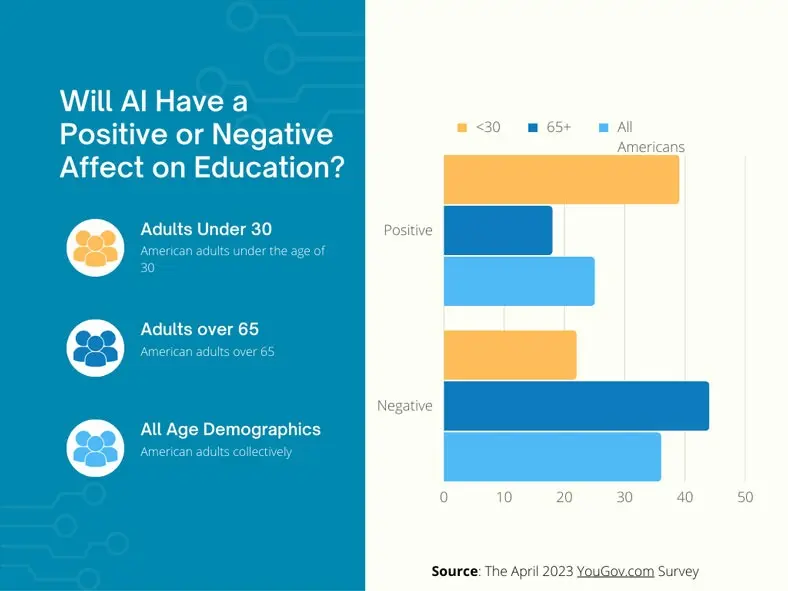
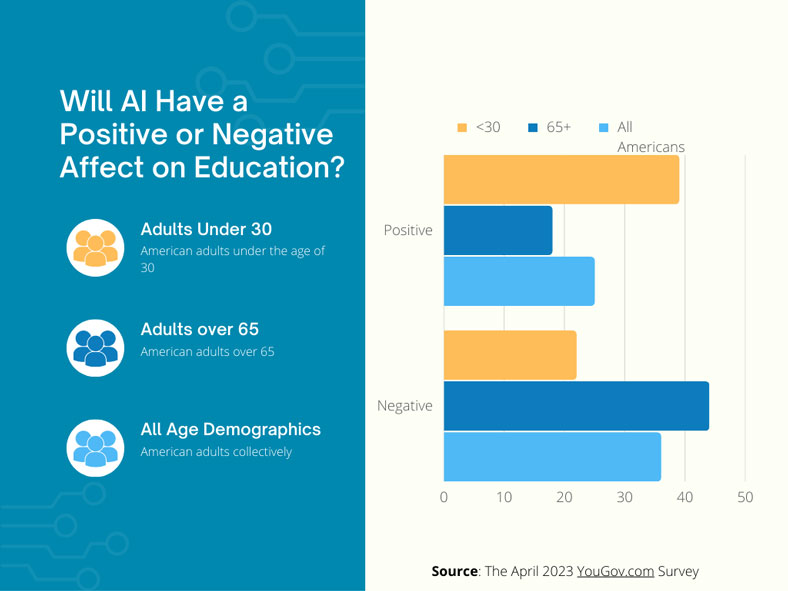
According to a landmark 2023 YouGov survey tracking attitudes toward artificial intelligence in K-12 schools, public sentiment heavily favors adaptation over prohibition:
- 52% of U.S. adults believe schools should actively focus on teaching students how to use artificial intelligence appropriately and ethically.
- 24% favored a restrictive approach centered primarily on preventing student access and use.
- 61% considered AI-related competencies and digital literacy to be "at least somewhat necessary" for students’ future career success in an evolving economy.
These statistics underscore a widening gap between public expectations and institutional policies. While parents and community stakeholders recognize the inevitability of AI in the modern workforce, many school districts remain trapped in a reactive posture, struggling to establish cohesive guidelines.
The Educator Landscape: Workload and Compensation
To fully comprehend why teachers are turning to generative AI, one must examine the grueling operational realities of the profession. According to data from the U.S. Bureau of Labor Statistics (BLS) and industry projections, educators operate under immense time constraints while managing complex emotional and academic landscapes.
National median annual salaries for educators reflect the immense responsibilities borne by the workforce:
- Elementary School Teachers: $63,820
- Middle School Teachers: $64,370
- High School Teachers: $72,040
Note: Actual compensation varies significantly by state, local district funding formulas, and individual years of experience. These national baselines illustrate broader economic trends rather than localized offers.
Simultaneously, long-term labor projections from resources like Projections Central (spanning 2024 through 2034) indicate that employment trends for core K-12 teaching roles will experience modest shifts. While overall student population dynamics fluctuate, substantial annual job openings persist. However, these openings are driven heavily by attrition—educators transferring to other professions or departing the workforce through retirement—rather than technological displacement. AI is not replacing teachers; rather, the administrative burden of the profession is driving burnout, making efficiency tools increasingly vital for retention.
Official Statements and Institutional Perspectives
Major educational bodies, federal agencies, and technology developers have weighed heavily on the ethical deployment of artificial intelligence in learning environments.
The U.S. Department of Education’s Office of Educational Technology
Federal guidance emphasizes that artificial intelligence must be centered around human agency and equity. In foundational policy briefs, the Office of Educational Technology has stressed that AI tools should be deployed to augment human decision-making, not automate away the essential interpersonal bonds that define effective teaching. Federal frameworks urge districts to evaluate AI platforms rigorously for data privacy compliance, algorithmic bias, and equitable access across socioeconomic divides.

The Technology Sector: Parallels to Past Innovations
Industry leaders have frequently pushed back against apocalyptic narratives regarding education. Echoing sentiments shared by OpenAI CEO Sam Altman during technology forums, advocates for educational AI argue that human societies have repeatedly weathered technological disruptions—from the printing press to the pocket calculator and the internet. In each instance, education did not collapse; instead, curricula evolved. When calculators entered mathematics classrooms, schools stopped grading students solely on manual arithmetic computation and pivoted toward testing algebraic reasoning and complex problem-solving. Proponents argue that generative AI demands an analogous pedagogical evolution: a shift away from assessing basic information retrieval toward evaluating synthesis, source critique, and ethical reasoning.
Where AI Excels: The Virtual Teaching Assistant
When integrated thoughtfully, generative AI functions as a tireless co-teacher capable of absorbing the crushing administrative and preparatory weight that contributes heavily to educator burnout.
1. Rapid Lesson Planning and Resource Generation
Drafting daily lesson plans, designing rubrics, and formatting multi-week units consumes hours of uncompensated educator time. Teachers can prompt models like ChatGPT to generate foundational frameworks for complex topics—such as outlining a week-long unit on the American Civil Rights Movement—complete with state standard alignments, vocabulary lists, and formative assessment ideas. While the raw output rarely goes straight to the printer, it provides a robust first draft that an experienced educator can refine in minutes rather than hours.
2. Radical Differentiation for Diverse Learners
One of the most profound challenges in modern education is managing mixed-ability classrooms. An English teacher might have students reading at a third-grade level sitting alongside peers operating at a high school sophomore level. AI allows educators to instantly rewrite informational texts or discussion prompts into multiple Lexile levels, ensuring every student accesses the core academic content. Similarly, struggling readers can ask AI models to rephrase dense textbook explanations using analogies tailored to their personal hobbies, bridging comprehension gaps before checking their understanding against core classroom materials.
3. Brainstorming and Prompt Engineering
Creativity fatigue is a silent adversary for educators. Teachers use generative tools to brainstorm engaging hook activities, alternative project-based learning prompts, or cross-curricular connections that link scientific principles to historical events.
Where AI Falls Short: The Pitfalls and Vulnerabilities
Despite its dazzling capabilities, generative artificial intelligence possesses inherent flaws that make unmonitored use dangerous for both teachers and students.
1. Hallucinations and Factual Inaccuracies
Large language models do not "know" facts in the human sense; they predict statistical probabilities of word sequences. Consequently, they frequently generate "hallucinations"—confidently presenting fabricated historical dates, nonexistent scientific citations, or completely false mathematical proofs as absolute truth. Educators and students must maintain a rigorous fact-checking habit. Accepting an AI output at face value without cross-referencing authoritative sources degrades academic rigor.
2. The Plagiarism and Academic Integrity Crisis
Generative AI has introduced unprecedented complications regarding cheating. Students can prompt a chatbot to write complete analytical essays, book reports, or scientific summaries in seconds.
Detecting AI-generated text remains an imperfect science. While commercial detection tools—such as Winston AI and Turnitin’s AI writing indicator—exist, developers explicitly caution that these platforms can produce false positives and false negatives. Turnitin’s own documentation notes that their detector can misidentify human-written text as algorithmic output, warning schools that algorithmic flags should never serve as the sole basis for disciplinary action or academic penalties. Relying on automated detectors risks unfairly penalizing students, particularly non-native speakers whose structured writing styles mimic algorithmic patterns.
Practical Application: The Classroom Activity Framework
Rather than engaging in an unwinnable arms race of prohibition and surveillance, forward-thinking educators are turning AI’s flaws into teachable moments. Below is a structured high school classroom activity designed to demystify generative AI and teach critical source evaluation.
+-------------------------------------------------------------------------+
|                  CLASSROOM ACTIVITY: THE AI AUDIT                       |
|                                                                         |
| Objective: Teach students to critically evaluate AI-generated writing   |
|            and master independent fact-checking and revision skills.    |
+-------------------------------------------------------------------------+
| Step 1: Prompt Generation                                               |
|         Students ask an AI tool to write an argumentative essay on a    |
|         complex historical or literary topic assigned by the teacher.   |
+-------------------------------------------------------------------------+
| Step 2: The Audit (Fact-Checking)                                       |
|         Working in pairs, students examine every statistic, historical  |
|         date, and quotation produced by the AI, verifying them against  |
|         peer-reviewed journals, textbooks, or verified primary sources. |
+-------------------------------------------------------------------------+
| Step 3: Bias & Gap Analysis                                             |
|         Students identify logical fallacies, emotional manipulation, or |
|         oversimplifications present in the AI's structural narrative.   |
+-------------------------------------------------------------------------+
| Step 4: Human Enhancement                                               |
|         Students rewrite the essay, replacing flawed AI arguments with  |
|         original insights, deep analysis, and verified evidence.        |
+-------------------------------------------------------------------------+
This pedagogical framework transforms a cheating tool into an instrument of critical media literacy, teaching students that AI output is merely a rough, unverified draft that requires rigorous human oversight.
Future Outlook: The Horizon of Educational Technology
As artificial intelligence continues to evolve through the remainder of the decade, its footprint within educational institutions will inevitably deepen. However, the trajectory of this evolution depends entirely on the intentionality of policy decisions made at the district, state, and federal levels.

1. From Generic Chatbots to Specialized Pedagogical Agents
The future of educational AI lies not in generic consumer chatbots, but in tightly controlled, privacy-compliant pedagogical agents embedded directly into Learning Management Systems (LMS) like Canvas or Google Classroom. These specialized tools will operate under strict guardrails, designed specifically to scaffold student learning through Socratic questioning rather than handing out direct answers. Instead of writing a student’s essay, a future AI tutor will prompt the student with guiding questions to help them formulate their own thesis statement.
2. The Unbreakable Necessity of the Human Educator
As artificial intelligence assumes greater responsibility for administrative workflows, lesson drafting, and baseline differentiation, the core identity of the human teacher will experience a renaissance. No algorithm can observe a student’s micro-expressions, sense emotional distress during a morning check-in, or build the deep, empathetic trust required to pull a struggling adolescent through a personal crisis.
Projections Central employment data confirms that while technology will continue to reshape workflows, the fundamental demand for human educators remains rock-solid. Artificial intelligence cannot replace a teacher’s localized judgment, ethical reasoning, and capacity for mentorship.
3. Toward a Culture of Critical Digital Citizenship
Ultimately, the integration of AI into K-12 education forces a re-examination of the ultimate purpose of schooling. If information retrieval is now instantaneous and automated, schools must prioritize teaching students how to think rather than what to memorize. By establishing clear boundaries, embracing transparency, and teaching rigorous fact-checking, educators can successfully guide the next generation through the algorithmic era—ensuring that technology remains a powerful tool that serves human potential, rather than superseding it.

