In the sprawling landscape of modern educational reform, literacy remains a permanent fixture at the center of public discourse. However, the national conversation around literacy is deeply imbalanced. Debates regularly rage across school boards, legislative floors, and academic journals regarding phonics instruction, reading fluency, and comprehension assessments. Meanwhile, writing instruction—the indispensable, deeply intertwined counterpart to reading—is frequently relegated to the background.
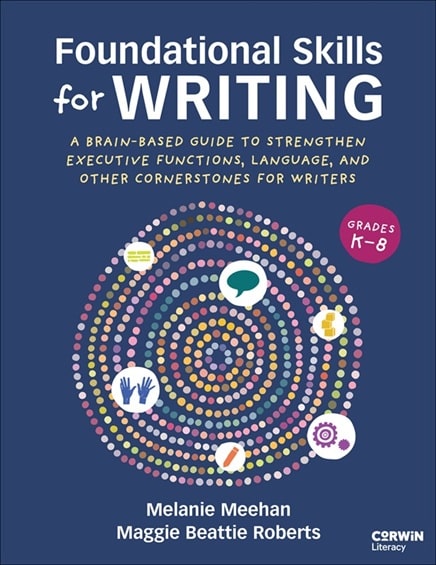
This glaring omission has long frustrated educators who recognize that reading and writing are two sides of the same neurological coin. To bridge this critical gap, literacy experts and veteran educators Melanie Meehan and Maggie Roberts have released a groundbreaking new text: Foundational Skills for Writing: A Brain-Based Guide to Strengthen Executive Functions, Language, and Other Cornerstones for Writers.
Drawing on extensive classroom experience and cognitive science, Meehan and Roberts argue that writing is one of the most cognitively demanding tasks we ask students to perform. When foundational skills—such as transcription, oral language, and executive functioning—are underdeveloped, they consume the cognitive energy students desperately need for the higher-level work of composition. To combat this, the authors have introduced a series of high-impact, low-barrier classroom strategies known as “Minute Moves.” Designed to take just a couple of minutes, these flexible exercises can be integrated seamlessly into classroom transitions, academic warm-ups, or daily routines, fundamentally reshaping how students acquire the mechanical and cognitive prerequisites of exceptional writing.
Detailed Chronology: The Journey to Brain-Based Writing Instruction
The path toward Foundational Skills for Writing spans decades of combined classroom experience, pedagogical evolution, and curriculum development.
The Classroom Foundation: Maggie Roberts spent nearly twenty years embedded in classrooms, primarily as a middle school teacher and literacy consultant, observing firsthand where student writers stalled out. Concurrently, Melanie Meehan served as a school curriculum coordinator before establishing an in-person writing center, granting her a unique vantage point on individualized student writing blocks.
Identifying the Disconnect: Over the last several years, as the "Science of Reading" movement gained unprecedented momentum, Meehan and Roberts noticed a recurring systemic oversight: reading instruction was receiving a massive overhaul, yet writing instruction remained chained to outdated, hit-or-miss methodologies.
The Cognitive Turn: Recognizing that writing requires immense coordination across multiple brain networks, the authors turned their attention to cognitive science. They sought to map out precisely what the human brain must accomplish during the act of writing—from managing working memory and cognitive flexibility to executing fine-motor transcription.
The Publication: Earlier this month, Meehan and Roberts officially published Foundational Skills for Writing: A Brain-Based Guide to Strengthen Executive Functions, Language, and Other Cornerstones for Writers. The release coincided with an in-depth interview on Episode 270 of the popular education podcast Cult of Pedagogy, where the co-authors pulled back the curtain on their core instructional philosophy and shared actionable, bite-sized strategies for busy teachers.
Supporting Context & Metrics: The Architecture of Written Expression
To understand why traditional writing instruction often overwhelms students, educators must first examine the cognitive architecture underlying written composition. Meehan and Roberts categorize the core components of writing into three distinct domains:
Transcription Skills: Encompassing handwriting, keyboarding, spelling, and both gross and fine motor development. When physical transcription is labored and slow, it acts as a bottleneck, draining working memory before a student can even articulate a complete thought.
Oral Language: The foundational speaking and listening skills that serve as the precursor to written syntax, including sentence construction and vocabulary acquisition.
Executive Functioning: The managerial system of the brain, featuring working memory, cognitive flexibility, and inhibitory control.
When these components are shaky, the act of writing feels akin to cognitive overload. To make these skills automatic, Meehan and Roberts designed their "Minute Moves"—short, targeted exercises divided into spelling, sentence construction, and executive functioning.
Spelling Minute Moves: Building Neural Pathways
Traditional spelling instruction has long relied on rote memorization and Friday tests—methods that often fail to stick. Meehan and Roberts advocate for a shift toward morphological curiosity.
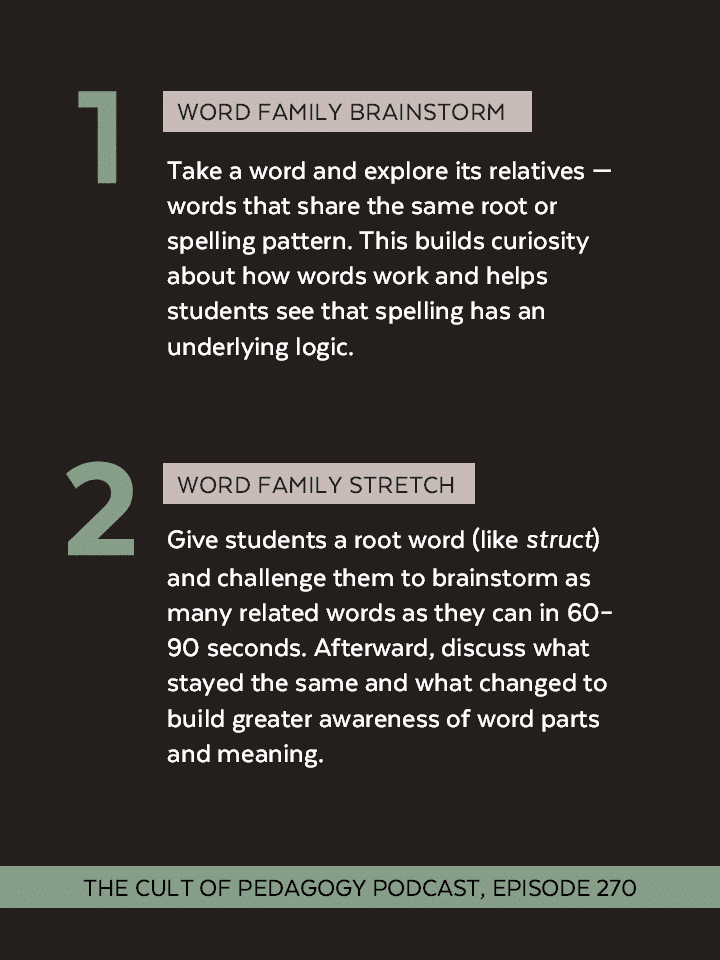
Word Family Brainstorm: Championed by spelling researcher Rebecca Treiman, this exercise encourages students to view words as interconnected webs rather than isolated silos. For example, instead of treating the homophones two, to, and too as arbitrary memory tasks, educators can connect two to morphological relatives like twin, twine, and twenty, anchoring the "tw" spelling to the concept of twoness. Similarly, unlocking a difficult word like decision through roots linked to decide, concise, and scissors reveals a shared Latin heritage meaning "to cut."
Word Family Stretch: Utilizing a 60-to-90-second timer, students are challenged to brainstorm words sharing a common root, such as the bound root struct (to build) or the free root form. A rigorous debrief follows: What stayed the same? How did the prefix alter the meaning? This exercise builds deep awareness of how academic vocabulary functions.
Prefix Swap: Building directly on morphological roots, students manipulate base words by swapping prefixes (e.g., transforming form into reform, transform, inform, or deform). This proves especially transformative for multilingual learners, who frequently recognize Latinate or Greek roots (like bene or mal) from their native languages, accelerating English vocabulary acquisition.
Sentence Construction Minute Moves: From Choppy to Complex
Students often struggle to transition from writing a series of short, choppy sentences to crafting sophisticated prose. Sentence-level Minute Moves bridge this gap through active manipulation.
Sentence Scramble: Dissecting a model sentence word-by-word onto physical index cards allows students to physically rearrange, debate, and analyze syntax. By removing punctuation or introducing distractor words, teachers prompt deeper metacognitive discussions about why certain words must remain bound together.
Sentence Expander: Starting with a basic kernel sentence (e.g., The cat purrs), students systematically expand the idea by answering guiding questions (Which cat? What color? Where? When? Why?). Meehan advocates using accessible terminology like "doer" and "doing" in place of abstract grammatical labels like subject and predicate, helping students visualize how modifiers change sentence pacing.
Sentence Combining: Described by Roberts as a high-impact, rapid intervention, students take two or three bare-bones sentences and merge them using conjunctions and punctuation. This directly translates into authentic writing, helping students naturally eliminate choppy sentence structures in favor of fluid, precise prose.
Writing is fundamentally an exercise in problem-solving and perspective-taking. Executive functioning moves explicitly target these higher-order cognitive capacities.
What’s Another Way?: This exercise cultivates cognitive flexibility—the ability to shift approaches and consider alternatives. Students take an existing sentence and rewrite it under different constraints: starting with a dependent clause, substituting pronouns, or intentionally shortening it for rhetorical impact. Meehan emphasizes that teaching students the actual phrase "cognitive flexibility" empowers them, reframing writing mechanics as sophisticated brain training.
New Angle: Zooming out to the macro-level of narrative structure, students retell a familiar story, text, or short film from an entirely different character’s perspective. Utilizing rich visual resources like Pixar’s Snack Attack, students practice holding dual perspectives simultaneously. As Meehan notes, this practice extends far beyond the English language arts classroom, reinforcing the empathy and perspective-taking essential for democratic civic life.
Official Statements & Expert Insights
The release of Foundational Skills for Writing has sparked vital conversations across the educational community regarding how writing is taught, remediated, and conceptualized.
Reflecting on the emotional and cognitive barriers many students face, Melanie Meehan emphasizes the power of shifting student perception toward language:
"The more that you can get kids curious and thinking words are cool, the better… When you start naming that as cognitive flexibility for kids, that’s exciting to them. There’s something genuinely empowering about being told you’re practicing a sophisticated cognitive skill—especially for students who have struggled to see themselves as capable writers."
Highlighting the structural benefits of targeted syntactic practice, Maggie Roberts points to the immediate transferability of explicit sentence work:
"Sentence combining is a really high-impact, quick way for kids to graduate from writing a series of simple sentences to ones that are more syntactically complex, interesting, and precise."
Furthermore, the authors stress that writing instruction must move beyond isolated technical drills to foster genuine civic and interpersonal awareness. Speaking on the "New Angle" strategy, Meehan encapsulates the broader societal stakes of writing pedagogy:
"It’s not just about writing and it’s not just about watching this show, but it’s also about democracy and thinking about how other people think and what their perspectives are."
Future Outlook: Reclaiming Writing in the Literacy Era
As school districts nationwide continue to refine their literacy action plans in the wake of post-pandemic learning shifts, the publication of Foundational Skills for Writing arrives at a pivotal moment. The educational community is increasingly recognizing that reading recovery efforts will remain incomplete until writing instruction receives an equivalent, evidence-based renaissance.
Looking ahead, the integration of brain-based, low-friction interventions like "Minute Moves" points toward a sustainable future for writing pedagogy. By embedding transcription automaticity, morphological awareness, and executive function training directly into the daily rhythms of the classroom—without overwhelming already overburdened instructional schedules—educators can demystify the writing process.
Ultimately, Meehan and Roberts offer a compelling blueprint for classrooms where writing is no longer viewed as an intimidating chore or an afterthought of reading instruction, but as an empowering, joyful, and deeply cognitive act of creation. Through deliberate practice and structural support, every student can unlock the foundational skills required to find their voice on the page.