In modern classrooms, educators face a growing challenge: helping students navigate complex academic demands while fostering the cognitive processes required for lifelong self-regulation. Enter executive functioning (EF)—the essential suite of mental processes encompassing planning, working memory, attention, self-control, mental flexibility, and task initiation. Long viewed as innate traits, these neurological skills are increasingly recognized as plastic capacities that can be systematically taught, practiced, and refined.
A burgeoning pedagogical movement is turning to a deceptively simple yet powerful tool to build these foundational competencies: inspirational and reflective quotations. By pairing carefully selected quotes with targeted discussion protocols, educators are transforming traditional bell-ringer routines into dynamic exercises in critical thinking and self-awareness. This article investigates the cognitive science behind executive functioning, explores how classroom quotes bridge the gap between abstract psychological concepts and student lived experiences, and provides actionable frameworks for implementing this strategy in K-12 education.
Detailed Chronology: The Evolution of Executive Functioning in Education
To understand why quotations have emerged as an effective intervention for executive functioning, it is helpful to trace how these cognitive skills moved from clinical psychology laboratories into everyday classrooms.
Late 20th Century (The Neuropsychological Foundation): For decades, executive functioning was primarily studied within clinical settings, heavily associated with the prefrontal cortex. Researchers identified these processes as the brain’s "air traffic control system," yet pedagogical frameworks rarely integrated EF training directly into standard curricula, leaving struggling students underserved.
Early 2000s (The Shift Toward Metacognition): As neuroscience advanced, educators began recognizing that academic failure was frequently not a deficit of intelligence, but a shortfall in executive skills—specifically organization, time management, and emotional regulation. Schools started searching for scalable ways to teach metacognition (thinking about thinking) without overwhelming overburdened instructional schedules.
2010s (The Rise of Social-Emotional Learning): The integration of Social-Emotional Learning (SEL) opened doors for holistic educational strategies. Teachers experimented with mindfulness, growth mindset mantras, and reflective writing prompts to help students regulate behavior and approach complex tasks.
The Present Era (Strategic Quotation Integration): Recognizing that students respond strongly to narrative and succinct wisdom, modern instructional designers have formalized the use of daily quotations. Rather than relying solely on abstract lectures about time management or self-control, teachers are utilizing curated quotes to spark deep classroom dialogue, transforming passive listening into active executive skill-building.
Supporting Context & Metrics: The Science of EF and the Power of Reflection
Executive functioning is not a single skill, but a coordinated network of top-down mental processes managed largely by the prefrontal cortex. These skills dictate how children and adolescents manage distractions, prioritize tasks, regulate emotional responses, and adapt to unexpected changes.
The Core Components of Executive Functioning
Planning & Organization: The ability to map out multi-step processes and keep materials structured.
Task Initiation: The capacity to take action without excessive procrastination, even when unmotivated.
Self-Control & Inhibition: Pausing to evaluate consequences before acting, thus protecting future outcomes.
Attention & Working Memory: Maintaining focus amidst environmental stimuli and holding information in mind while manipulating it.
Perseverance (Grit): Sustaining effort through obstacles and academic fatigue.
Cognitive Flexibility: Adjusting strategies when initial attempts fail and viewing problems from multiple perspectives.
Why Quotations Work as a Cognitive Catalyst
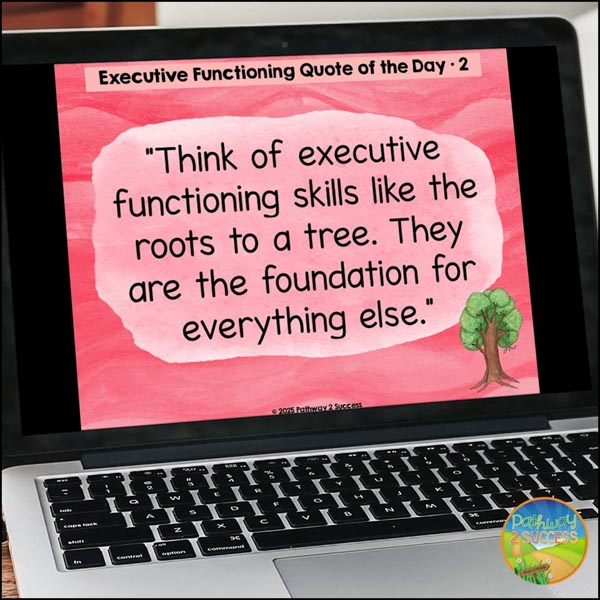
Cognitive psychology indicates that young minds thrive on contextualization. When students encounter a well-crafted quote, it functions as a cognitive puzzle. Decoding metaphoric language ("Think of executive functioning skills like the roots to a tree") requires working memory, analogical reasoning, and cognitive flexibility.
Furthermore, utilizing quotes as "bell-ringers"—short activities at the beginning of a class period—establishes a predictable routine. Predictability lowers anxiety, preparing the prefrontal cortex for higher-order processing and setting a calm tone for the academic day ahead.
Official Statements and Pedagogical Frameworks
Educators, school psychologists, and curriculum developers have increasingly championed methods that seamlessly blend academic learning with mental health and cognitive development.
"Executive functioning skills are the foundational roots of a student’s entire educational and personal ecosystem," notes a leading curriculum specialist in adolescent development. "When we ask students to analyze a quote about perseverance or self-control, we aren’t just teaching literature or rhetoric. We are giving them a mirror to examine their own internal wiring, helping them understand that their challenges with focus or task initiation are manageable processes rather than fixed character flaws."
To implement this effectively, educational frameworks suggest a structured, three-part pedagogical approach:
Read & Reflect: Present the quote visibly at the start of class, allowing students time to read and digest the literal text.
Deconstruct & Connect: Guide learners through targeted inquiry. What does the author mean? How does this apply to real-world scenarios in and out of the classroom?
Actionable Takeaway: Translate the quote’s underlying executive skill into a concrete strategy that students can apply immediately during the school day.
Case Study: Applying Quotes to Specific Executive Functioning Domains
To illustrate how this looks in practice, educators utilize targeted quotations paired with guided reflection questions across various domains of executive functioning.
1. Executive Functioning Foundations
The Quote:"Think of executive functioning skills like the roots to a tree. They are the foundation for everything else."
The Meaning: EF skills govern our ability to plan, organize, initiate tasks, and manage challenges. They operate invisibly beneath the surface of every daily action, much like tree roots nourish the visible branches and leaves.
Guided Discussion Questions:
What are some extracurricular or academic activities you genuinely enjoy doing?
In what ways do focus, organization, and problem-solving support you in those activities?
Why is building an awareness of these internal mental processes vital for personal growth?
2. Self-Control and Inhibition
The Quote:"Using self-control is showing kindness to your future self."
The Meaning: Self-control is often misconstrued as a restriction or punishment. By reframing it as an act of future-oriented kindness—such as organizing a backpack or studying ahead of an exam—students realize that regulation benefits their future well-being.
Guided Discussion Questions:
How does practicing restraint or organization today alleviate stress tomorrow?
In what specific ways can you demonstrate self-kindness during this school week?
3. Task Initiation
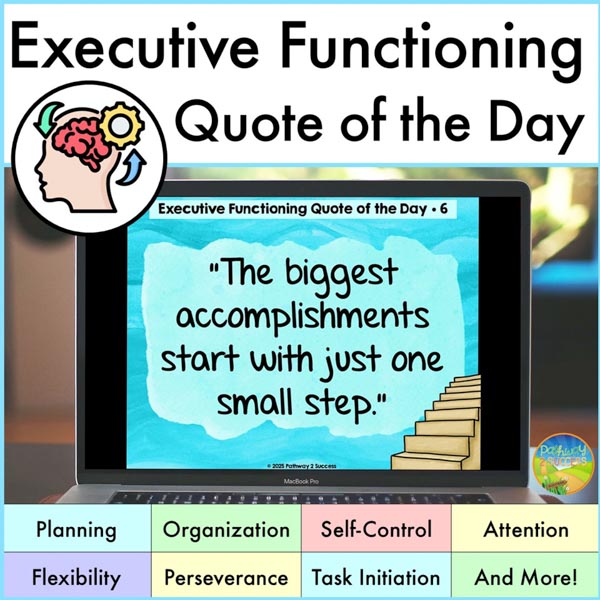
The Quote:"The most important part of reaching any goal is the beginning. Just start."
The Meaning: Inertia is often the greatest barrier to productivity. Task initiation requires overriding the friction of starting, trusting that momentum will build once the first step is taken.
Guided Discussion Questions:
Why does beginning a difficult assignment often feel so intimidating?
What micro-steps can you use to break past the hesitation barrier?
4. Attention and Working Memory
The Quote:"A calm mind is a more focused mind."
The Meaning: Emotional regulation and cognitive focus are deeply intertwined. When anxiety or overwhelm hijacks the nervous system, working memory diminishes. Calming strategies directly enhance attentional capacity.
Guided Discussion Questions:
How does an elevated emotional state impact your ability to concentrate on a test or reading passage?
What personal relaxation techniques help clear mental clutter?
5. Perseverance
The Quote:"Perseverance isn’t always easy, but it’s simple. Just keep going."
The Meaning: Grit does not require perfection; it requires endurance. Simplifying complex challenges down to persistent effort keeps students from becoming paralyzed by the magnitude of long-term goals.
Guided Discussion Questions:
Can you share an instance where pushing past an obstacle yielded a rewarding result?
What internal dialogue helps you maintain momentum when you want to quit?
6. Cognitive Flexibility
The Quote:"Every problem has a solution. Most have many."
The Meaning: Rigid thinking traps individuals in dead-end frustrations. Flexibility empowers students to shift perspectives, brainstorm alternative strategies, and view setbacks as creative design problems rather than permanent failures.
Guided Discussion Questions:
Think of a recent conflict or roadblock. What were alternative ways you could have approached it?
Why is embracing multiple solutions essential for healthy problem-solving?
Future Outlook: Integrating Metacognition into Tomorrow’s Classrooms
As schools continue to prioritize holistic student development, the integration of executive functioning strategies into daily academic life will become increasingly vital. Programs that utilize structured tools—such as yearlong quote-of-the-day sets complete with educator guides, targeted discussion prompts, and reflection journals—are paving the way for sustainable, low-friction interventions.
Looking ahead, the fusion of literature, philosophy, and cognitive science offers a promising roadmap. By routinely engaging children and teens in meaningful dialogues about self-regulation, educators do more than prepare students for standardized assessments; they equip them with the lifelong psychological infrastructure necessary to navigate an unpredictable world with resilience, clarity, and purpose.