
EXECUTIVE OVERVIEW
In the modern landscape of early childhood education, bridging the gap between foundational literacy skills and engaging, play-based instruction remains one of the most persistent challenges for preschool and kindergarten educators. Phonological awareness—the ability to recognize, think about, and manipulate the individual sounds and structural components of spoken language—is widely acknowledged by reading researchers as a critical precursor to successful decoding and reading comprehension. Yet, traditional approaches to teaching phonological awareness often rely on rote memorization or repetitive drills that can disengage young learners.
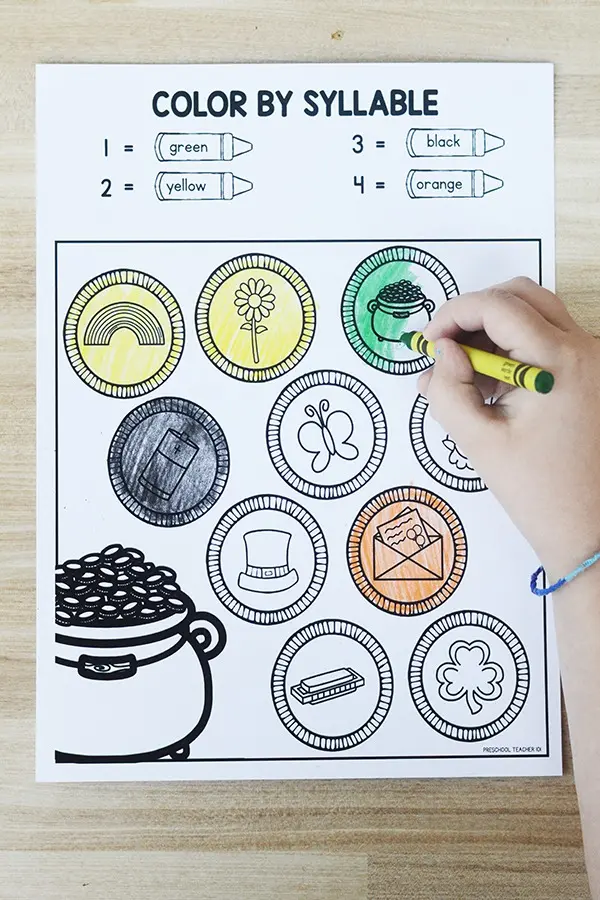
Enter the "Color by Syllable" pedagogical framework. Designed specifically for pre-school and kindergarten classrooms, this innovative, no-prep literacy tool merges the classic, beloved format of color-by-code worksheets with rigorous phonological awareness training. By breaking spoken words down into individual syllables and challenging students to match these counts to specific color keys, educators can seamlessly weave foundational pre-reading instruction into holiday- and seasonal-themed activities.
This report provides an in-depth examination of the newly released St. Patrick’s Day Color by Syllable activity set, exploring its foundational methodology, practical classroom applications, broader implications for early childhood literacy development, and the expansion of a comprehensive year-long curriculum that is transforming how young children learn to hear the rhythms of language.

The Science of Sound: Why Syllable Segmentation Matters in Early Childhood
Long before children learn to match letters to sounds (phonics), they must tune their ears to the sounds of spoken language. Phonological awareness encompasses a continuum of skills, starting from broad auditory discrimination down to phoneme manipulation. Among these milestones, syllable segmentation—the ability to break a word into its natural rhythmic beats—serves as an essential stepping stone.
The Cognitive Foundation of Syllable Awareness
When children clap, tap, or count syllables, they are actively engaging their working memory and auditory processing systems. Words like cat (one syllable) sound fundamentally different from shamrock (two syllables) or leprechaun (three syllables). Recognizing these distinct acoustic units helps children understand that words are composed of smaller parts.
Educational specialists note that early childhood classrooms often struggle to find resources that isolate these skills without overwhelming young minds. Standard worksheets can feel sterile, while pure play can sometimes lack targeted instructional focus. The St. Patrick’s Day Color by Syllable initiative strikes a delicate balance. By transforming a cognitive task—counting syllables—into a visual and artistic reward (coloring an image), the activity leverages gamification to maintain student engagement and reduce cognitive fatigue.
Inside the St. Patrick’s Day Color by Syllable Toolkit
Developed as part of a popular seasonal color-by-code literacy series, the St. Patrick’s Day edition is engineered for immediate classroom deployment. Recognizing that educators face severe time constraints and large class sizes, the resource requires zero preparation beyond printing.

Core Components and Flexibility
The printable set is specifically tailored for preschool and kindergarten environments, offering versatile implementation options that adapt to varied pedagogical needs:
- Literacy Centers: Can be placed in independent workstation rotations, allowing students to practice phonological awareness skills autonomously.
- Take-Home Practice: Extends learning beyond the classroom walls, empowering parents to participate in their child’s pre-reading development.
- Fast-Finisher Activities: Provides a productive, educationally rich task for students who complete core assignments ahead of schedule.
Differentiated Learning Objectives
To accommodate the diverse developmental stages present in any early childhood classroom, the printable set features multiple tiered options. While some children are just beginning to distinguish between single-syllable words and multi-syllable terms, others are ready to tackle complex groupings. The worksheets guide students through recognizing syllable counts ranging generally from one to five, utilizing thematic vocabulary such as gold, rainbow, clover, and horseshoe.
"Color-by-syllable activities are excellent no-prep tools that help break down words into their individual syllables, allowing children to hear the sounds within a word and master segmentation naturally."
Integrating Thematic Literacy Into Modern Curricula
The success of holiday-themed educational resources lies in their ability to capitalize on children’s natural excitement surrounding seasonal events. St. Patrick’s Day offers a vibrant, highly visual theme—complete with leprechauns, pots of gold, and emerald-hued landscapes—that naturally captures the imagination of young learners.

Best Practices for Educators
Early childhood experts emphasize that introducing a worksheet like Color by Syllable should never be done in a vacuum. Effective integration requires a multi-step instructional sequence:
- Vocabulary Introduction: Before assigning independent work, educators must explicitly introduce and define the vocabulary words featured on the worksheet. Children cannot reliably segment a word if they do not understand its meaning or pronunciation.
- Auditory Modeling: Teachers should guide the class in choral sounding exercises, clapping out the syllables of target words together (e.g., sham-rock = two claps).
- Independent Application: Once the auditory pattern is established, students transition to the worksheet, using their newly acquired segmentation skills to decode the color-coding key and reveal the hidden image.
For educators seeking a fully rounded curriculum, these standalone printables complement broader frameworks, such as comprehensive preschool lesson plans centered entirely around thematic units like St. Patrick’s Day.
Expanding the Framework: The Year-Long Color by Syllable Ecosystem
While holiday-specific printables provide timely engagement, sustained literacy development requires consistent, year-round practice. To address this need, curriculum developers have expanded the single-event model into a comprehensive 33-page, year-long Color by Syllable resource pack.
A Continuum of Seasonal Learning
Designed to span the entire academic calendar, this expansive set ensures that children receive continuous, progressive exposure to phonological awareness exercises. The collection features themed pages tailored to major holidays and seasonal shifts, including:

- Back-to-School and Fall Harvest themes
- Winter and Holiday celebrations (including the referenced winter-themed integration components)
- Spring milestones and summer transitions
By maintaining a consistent format across different seasons, the activity minimizes instructional friction. Students do not need to waste valuable time learning new rules or mechanics each month; instead, the familiar color-by-code structure allows them to focus entirely on the linguistic challenge of the new vocabulary words.
Official Perspectives and Industry Reception
The release of targeted phonological awareness printables has drawn significant attention from educational publishers and early childhood practitioners alike. As standardized benchmarks for kindergarten readiness continue to rise, tools that combine fine motor skill development (coloring) with auditory processing (syllable counting) are viewed as highly efficient investments of instructional time.
The Rise of Digital and Print Hybrids
Platforms such as Teachers Pay Teachers and specialized early learning networks report a surge in demand for resources that offer both print and digital adaptability. Teachers increasingly look for materials that can be printed for hands-on fine-motor practice with crayons and colored pencils, or integrated into digital learning hubs where applicable.
Industry analysts note that no-prep worksheets do not replace direct, small-group teacher instruction; rather, they serve as vital reinforcement tools. By offering differentiated sheets within a single pack, developers allow teachers to address the widening achievement gaps typical in modern pre-K and kindergarten classrooms without spending hours designing custom materials.

Future Outlook: The Evolution of Play-Based Literacy
Looking ahead, the trajectory of early childhood education points toward an increased integration of cross-curricular play and foundational skills. As neuroscience continues to validate the connection between artistic expression, kinesthetic movement (such as clapping syllables), and cognitive retention, tools like the Color by Syllable series are expected to evolve further.
What Lies Ahead for Pre-K Literacy Tools
- Enhanced Multisensory Integration: Future iterations may incorporate interactive audio components or augmented reality elements, bridging physical printables with digital pronunciation guides.
- Data-Driven Customization: Publishers are exploring ways to provide educators with modular worksheet generation tools, allowing them to input specific vocabulary words relevant to their local curriculums into standard seasonal templates.
- Parent-Teacher Partnership Expansion: With take-home literacy packets gaining permanent traction post-pandemic, resources designed for home-school synergy will continue to prioritize accessibility, requiring minimal household supplies (just crayons and a printed page).
In conclusion, the St. Patrick’s Day Color by Syllable activity—and its broader year-long ecosystem—demonstrates how creative instructional design can elevate foundational skill-building. By transforming phonological awareness into an engaging artistic pursuit, educators can ensure that young learners step into the world of reading with confidence, curiosity, and a deep appreciation for the rhythm of language.

