
EXECUTIVE OVERVIEW
In the landscape of early childhood education, mastering phonological awareness remains one of the most critical developmental milestones for pre-kindergarten and kindergarten students. The ability to recognize, isolate, and manipulate the structural parts of spoken language serves as the bedrock upon which all future reading and writing proficiencies are built.
Amid an ongoing educational shift toward evidence-based reading practices—frequently championed by the Science of Reading movement—educators are continually searching for hands-on, engaging tools that bridge auditory processing with cognitive development. Enter the newly released Spring Syllable Sort and its comprehensive companion, the Four Seasons Syllable Sort bundle.
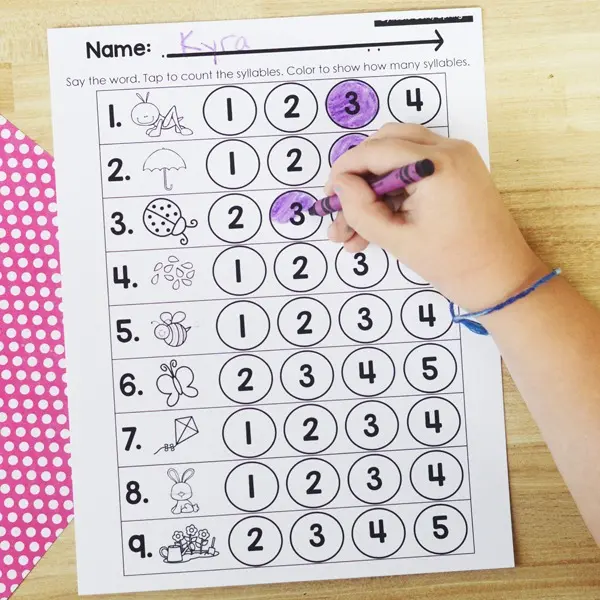
Developed as a dynamic, play-based literacy intervention, these printable resources leverage seasonal vocabulary to teach young learners how to segment words through physical movement, such as clapping and tapping. By decoupling phonological awareness from traditional, text-heavy decoding burdens, these tools allow children to focus strictly on sound structures using vibrant picture clues. This special report examines the pedagogical framework behind the Spring Syllable Sort, evaluates its integration into modern classrooms, and explores the broader implications of seasonal thematic units in early childhood literacy instruction.

1. Executive Overview: The Science of Reading and Phonological Foundations
At its core, phonological awareness is an auditory skill that does not initially require written text. Long before children learn to map letters to sounds (phonics), they must understand that spoken language is composed of words, syllables, and smaller sound units (phonemes). Syllables, in particular, provide an accessible entry point for young minds because they represent natural, rhythmic beats within words.
The Science of Reading emphasizes explicit, systematic instruction in foundational skills. Traditional rote memorization has increasingly given way to multisensory pedagogical approaches. The Spring Syllable Sort aligns directly with this philosophy by incorporating kinesthetic learning—clapping and tapping—into the cognitive act of word segmentation.
When children physically clap out the beats of spring-themed vocabulary words like "tulip," "butterfly," or "raincoat," they engage multiple neural pathways. This multisensory integration accelerates cognitive processing, making abstract linguistic concepts tangible for pre-K and kindergarten learners. Educators utilizing these tools report heightened student engagement and a more intuitive grasp of how words are constructed.
2. Detailed Chronology: The Evolution of Seasonal Literacy Centers
The journey from traditional flashcard-based vocabulary drills to immersive, theme-based phonological sorting activities marks a significant evolution in early childhood curriculum design.

Phase I: The Need for Contextualized Learning (Early Development)
Historically, early literacy instruction often relied on isolated worksheets that divorced vocabulary acquisition from phonological practice. Children were asked to identify syllables in abstract lists of words that held little relevance to their immediate environment or lived experiences. Teachers frequently noted a disconnect: students could perform mechanical tasks in isolation but struggled to transfer those skills to authentic reading and writing contexts.
Phase II: The Integration of Thematic Units
To combat this disconnect, educators began organizing curricula around thematic units—most notably the changing of the seasons. Spring, autumn, winter, and summer offer rich, sensory-laden vocabularies that naturally captivate young learners. The introduction of seasonal themes allowed educators to anchor literacy concepts in real-world observations, such as blooming flowers, falling leaves, or melting snow.
Phase III: The Launch of the Spring Syllable Sort
Building on the success of thematic teaching, educational developers introduced the Spring Syllable Sort as a targeted pre-K and kindergarten literacy center activity. Designed to be accessible and low-prep, the tool combined visual sorting cards with interactive segmenting exercises.
Rather than focusing on written text—which can overwhelm children who have not yet developed advanced graphophonemic knowledge—the activity relies entirely on high-quality picture cards representing iconic spring vocabulary. This ensures that children focus purely on auditory processing and phonological segmentation.

Phase IV: Expansion into the Four Seasons Curriculum
Recognizing the efficacy of the spring module, curriculum designers expanded the framework into a comprehensive Four Seasons Syllable Sort 42-page pack. This broader offering allowed educators to maintain a consistent instructional routine throughout the entire school year, scaling up the complexity of seasonal vocabulary while reinforcing the foundational habit of syllable clapping, tapping, and sorting.
3. Supporting Context & Metrics: How the Program Works
To understand the practical impact of the Spring Syllable Sort, one must examine its mechanics and the components included in the instructional package. The system is meticulously engineered to minimize preparation time for educators while maximizing independent or small-group learning time for students.
Core Components of the Free Spring Syllable Sort
The foundational spring-themed kit includes several essential assets designed for seamless classroom integration:
- Syllable Counting Cards: Visual prompts featuring spring imagery paired with tactile counting guides.
- Large Colorful Word Cards: Bright, engaging illustrations of seasonal objects, animals, and weather patterns.
- Black and White Response Worksheets: Printable pages allowing students to independently record and reinforce their sorting categories.
- Comprehensive Answer Keys: Designed for quick teacher assessment or peer-led checking during literacy centers.
The Pedagogical Process: From Auditory Input to Mastery
The implementation of the sorting activity follows a structured, three-step methodology:

- Vocabulary Introduction: Experts strongly advise educators to explicitly introduce and review the vocabulary depicted on the picture cards before expecting independent work. If a child does not recognize an image as a "caterpillar" or a "watering can," the syllable-counting exercise becomes compromised.
- Segmenting via Movement: Students select a picture card, say the word aloud, and physically segment it by clapping or tapping out each rhythmic beat.
- Categorized Sorting: Children place the picture card into designated sorting bins or mats based on whether the word contains one, two, three, or more syllables. Following this hands-on sorting phase, students can complete an optional reinforcement worksheet to solidify their understanding.
Expanding Horizons: The 42-Page Four Seasons Pack
For classrooms seeking year-round continuity, the extended 42-page Four Seasons pack scales these mechanics across spring, summer, autumn, and winter. Featuring specialized clip cards and differentiated sorting matrices, the expanded suite ensures that phonological awareness remains a vibrant, recurring touchpoint in early childhood classrooms.
4. Official Statements and Expert Perspectives
Educational specialists and curriculum developers have praised the shift toward multisensory, phonology-first approaches in early reading instruction.
"When we ask young children to sit passively and memorize sight words or decode text before they have developed a firm grasp of phonological awareness, we set many of them up for frustration," notes an early childhood literacy consultant. "Tools like the Spring Syllable Sort transform abstract linguistic theory into a game. Children are not just ‘doing work’; they are discovering the musical rhythm of language through clapping, sorting, and visual discovery."
Furthermore, educators emphasize the importance of picture-based phonological activities for diverse learners, including English Language Learners (ELLs). Because the primary mechanism relies on images and spoken segments rather than complex written sentences, ELL students can participate fully alongside their native-speaking peers, simultaneously building oral vocabulary and phonological competence.

Primary teachers utilizing the resource have highlighted its versatility across multiple learning environments:
- Literacy Centers: Serving as an independent or small-group station rotation.
- Take-Home Practice: Bridging the gap between the classroom and home by providing parents with accessible, game-like literacy activities.
- Special Education Interventions: Offering tactile and visual scaffolds for students requiring targeted phonological support.
5. Future Outlook: The Direction of Early Childhood Literacy
As educational institutions continue to refine their reading curricula in alignment with modern research, the demand for practical, low-prep, high-engagement resources is projected to grow. The success of thematic tools like the Spring Syllable Sort points toward a broader trend in educational publishing: the integration of multisensory design with real-world thematic content.
Looking ahead, developers are exploring digital adaptations of tactile sorting games, blending physical manipulation with interactive software to create hybrid learning environments. However, educators and child development experts agree that the core tactile elements—such as clapping hands, tapping fingers, and physically placing picture cards into sorting categories—will remain irreplaceable in the early childhood classroom.
By transforming foundational phonological practice into an engaging seasonal exploration, resources like the Spring Syllable Sort and the Four Seasons bundle ensure that young learners build both the technical skills and the emotional enthusiasm necessary for a lifelong journey of reading success. Educators interested in implementing these strategies can access the free spring printables directly through early education platforms or explore the comprehensive Four Seasons packs available via dedicated teacher resource networks like Teachers Pay Teachers.

