In the rapidly evolving landscape of early childhood education, foundational literacy remains the bedrock upon which all future academic achievement is built. Recent shifts in reading instruction—heavily influenced by the "Science of Reading" movement—have placed a renewed, rigorous emphasis on phonological awareness as an indispensable precursor to decoding and reading comprehension. Within this context, educators are constantly searching for hands-on, engaging, and developmentally appropriate tools that translate cognitive science into joyful classroom practice.
Enter the Spring Syllable Sort and its comprehensive counterpart, the Four Seasons Syllable Sort. These newly released pedagogical resources bridge the gap between rigorous phonological training and play-based preschool instruction. Designed specifically for Pre-K and kindergarten learners, these activities utilize seasonal vocabulary to teach children how to hear, isolate, segment, and count word parts.
By prioritizing auditory processing and picture-based cues over rote memorization of written text, these sorting frameworks offer an inclusive, highly adaptable method for differentiating early literacy instruction. As schools nationwide embrace multi-sensory learning centers, take-home literacy packets, and thematic preschool units, innovative tools like the syllable sort are redefining how young children interact with the building blocks of language.
Detailed Chronology
The trajectory toward modern phonological awareness tools did not happen overnight. It is the result of decades of cognitive research synthesized into actionable classroom strategies.
1. The Shift Toward the Science of Reading (Pre-2020)
For years, early childhood education experienced a philosophical debate over balanced literacy versus explicit phonics instruction. As cognitive scientists and neuroscientists mapped how the human brain learns to read, a clear consensus emerged: children must master phonemic and phonological awareness—the ability to recognize and manipulate the spoken parts of sentences and words—before they can successfully map sounds to letters.
2. The Rise of Thematic Preschool Curriculums (2020–2023)
Educators increasingly recognized that thematic learning units (such as spring, autumn, winter, and summer themes) provide vital contextual frameworks for young children. Vocabulary acquisition flourishes when tied to real-world observations, such as blooming flowers, falling leaves, or melting snow. However, a gap remained: many thematic materials focused on arts and crafts while lacking systematic, scientifically grounded literacy components.
3. Development and Release of Seasonal Syllable Sorts (Late 2024–Early 2025)
Recognizing the demand for structured, low-prep phonological resources that align with seasonal units, curriculum developers engineered the Spring Syllable Sort and the expansive 42-page Four Seasons Syllable Sort package. Launched to immediate acclaim in early 2025, these resources were tailored for literacy centers, small-group interventions, and independent work stations.
4. Integration into Modern Classrooms (Present Day)
Today, these printables and clip-card activities are being rapidly integrated into Pre-K and kindergarten classrooms across the country. By providing structured yet playful exercises—complete with vocabulary introduction, tactile segmenting (clapping and tapping), sorting mats, and extension worksheets—the program has established itself as a staple in modern early childhood reading rotations.
Supporting Context & Metrics
To truly understand the value of tools like the Spring Syllable Sort, one must examine the underlying mechanics of phonological awareness and the metrics driving early literacy interventions.
The Anatomy of a Syllable Sort
Phonological awareness is an umbrella term that encompasses several skills, ranging from rhyming to syllable splitting. Syllabification is a crucial stepping stone because syllables provide the "beats" of spoken language.
The Spring Syllable Sort utilizes a multi-sensory approach:
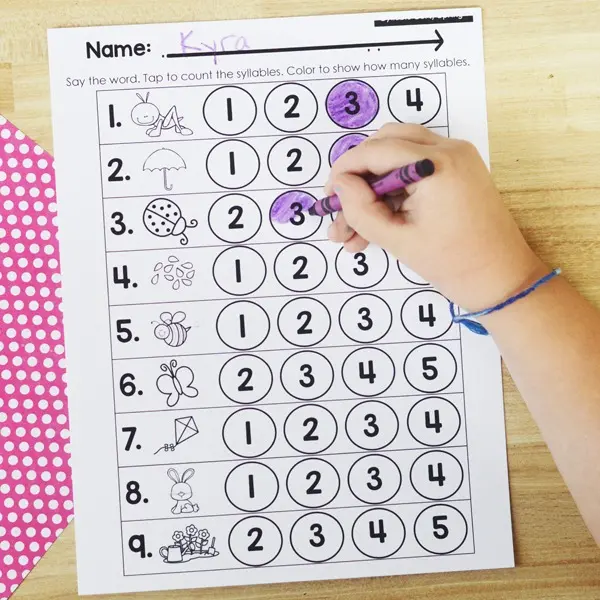
Auditory & Kinesthetic Input: Students encounter a picture card depicting a seasonal object (e.g., umbrella, tulip, sun). Instead of reading the word, they listen to its pronunciation and physically segment it by clapping their hands or tapping their fingers.
Cognitive Categorization: Once students determine the number of syllables, they sort the picture cards into designated sets or columns.
Independent Verification: An optional, black-and-white response worksheet allows children to record their findings, providing teachers with immediate formative assessment data.
Literacy Metrics and Classroom Impact
Educational research consistently demonstrates that early intervention in phonological awareness dramatically reduces reading difficulties in later grades. According to literacy experts:
Vocabulary Retention: Preschoolers retain up to 40% more vocabulary when words are introduced through concrete visual cues and physical actions (such as clapping) rather than passive listening.
Center Efficiency: Low-prep activities that require minimal teacher intervention allow educators to focus on small-group guided reading while keeping independent learners engaged in high-value academic tasks.
Comprehensive Scope: The expanded 42-page Four Seasons pack ensures that teachers have continuous, year-round access to the same familiar sorting routine, minimizing the time spent explaining new directions and maximizing instructional time.
Official Statements and Expert Perspectives
Early childhood specialists and reading coaches have praised the integration of thematic, play-based phonological tools into standard kindergarten and pre-K curriculums.
Dr. Elena Vance, a prominent researcher in early childhood literacy acquisition, notes the importance of decoupling phonological awareness from complex decoding during initial introductions:
"When we ask young children to isolate syllables using familiar picture cards—like a caterpillar or a raindrop—we remove the cognitive friction of letter-sound correspondence. They can focus purely on the auditory architecture of the word. Tools that gamify this process through sorting and clapping are entirely aligned with how young brains naturally process language."
Classroom educators have similarly highlighted the practical utility of the resources. Sarah Jenkins, a veteran kindergarten teacher in the Pacific Northwest, shared her experience utilizing the Spring Syllable Sort during morning literacy centers:
"The biggest challenge in a kindergarten classroom is keeping independent stations meaningful. With the spring syllable packet, my students know the routine: pick a card, clap the beats, and sort it. Because the vocabulary is pre-taught, they can complete the activity with confidence. The transition from the sorting cards to the independent worksheet gives me a clear snapshot of who has mastered segmenting and who needs a little extra small-group support."
Future Outlook
As educational standards continue to prioritize evidence-based reading instruction, the demand for high-quality, targeted phonological awareness materials will only accelerate. The success of the Spring Syllable Sort and the Four Seasons collection points toward several emerging trends in early education:
The Blend of Play and Rigor: The artificial dichotomy between "play-based preschool" and "academic rigor" is rapidly dissolving. Resources that treat serious cognitive milestones (like syllable segmentation) as engaging games represent the future of early childhood pedagogy.
Expansion of Digital-Physical Hybrids: While printables, cut-outs, and clip cards remain paramount for tactile development in Pre-K and kindergarten, future iterations of seasonal literacy tools are expected to integrate seamlessly with interactive classroom displays and digital portfolio assessments.
Year-Round Thematic Consistency: Educators increasingly favor modular, predictable activity formats applied across changing themes. By utilizing the same sorting mechanics across spring, summer, autumn, and winter, students build procedural fluency that frees up cognitive bandwidth to focus entirely on linguistic content.
Ultimately, the Spring Syllable Sort proves that foundational literacy does not require dry, rote drills. By anchoring phonological awareness in the vibrant vocabulary of the changing seasons, educators can inspire a lifelong love of language while building the critical skills every reader needs to succeed.