
Executive Overview
The traditional timeline for career and academic planning is undergoing a radical transformation. For decades, the conventional wisdom in American public education dictated that serious career exploration, pathway selection, and goal setting should be deferred until high school—frequently materializing around the junior or senior year, just as students began preparing for higher education or immediate workforce entry. However, a growing body of educational research and a mounting sense of urgency among educational leaders suggest that this model is not only outdated, but fundamentally flawed.
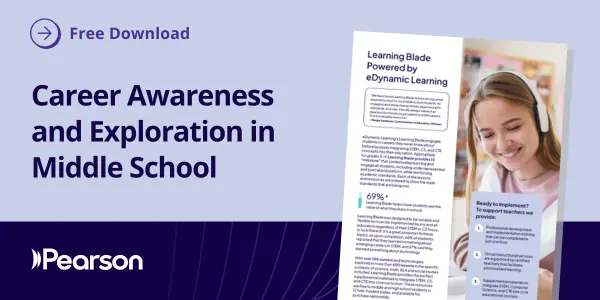
According to new insights and strategic frameworks released in a comprehensive educational guide published by Pearson, career exploration must begin much earlier than most school districts currently realize. The new research highlights middle school—typically spanning grades six through eight—as a pivotal, high-impact window of opportunity. During these formative adolescent years, students undergo profound cognitive, social, and emotional shifts. They begin to form an abstract sense of identity, ask deeper questions about their place in the world, and look for tangible connections between their daily classroom experiences and their long-term futures.
When districts wait until high school to introduce career awareness, they risk losing students to disengagement, academic burnout, and poorly informed course selections that can lead to credit friction, extended graduation timelines, or a lack of preparedness for the modern economy. Conversely, proactively integrating career exploration into middle school empowers students to connect their personal interests, strengths, and curiosities with viable professional pathways. By introducing age-appropriate career awareness before students are forced to make high-stakes academic decisions—such as tracking into advanced placement courses, career and technical education (CTE) programs, or specialized endorsements—educators can foster a deep sense of purpose, boost self-efficacy, and build lasting academic confidence.
This comprehensive report examines the paradigm shift toward early career awareness, tracing the evolution of middle school counseling, analyzing the metrics and psychological factors driving this movement, reviewing insights from leading educational publishers and policymakers, and exploring the future outlook for K-12 career readiness initiatives nationwide.
Detailed Chronology: The Evolution of Career Readiness in K-12 Education
To understand why middle school has emerged as the critical frontier for career exploration, it is necessary to examine how vocational and career guidance has evolved within the American educational system over the past century.
The Industrial Model and Late-Stage Tracking
For much of the 20th century, career preparation in secondary schools was largely bifurcated. High schools traditionally maintained two distinct tracks: an academic track designed for students bound for four-year universities, and a vocational track designed for students entering the trades or manufacturing sectors immediately after graduation. Guidance counseling during this era was predominantly reactive. Counselors reviewed transcripts, assessed standardized test scores late in high school, and helped students select courses that aligned with these predetermined tracks.
Middle schools, meanwhile, functioned almost entirely as transitional holding environments—a bridge designed to acclimate pre-teens to departmentalized instruction, changing classrooms, and larger peer groups before the perceived "real work" of high school began. Little intentional connection was made between a 7th grader’s fascination with science fiction, video game design, or animal biology and the actual economic ecosystems waiting for them in the adult world.
The Shift Toward Comprehensive College and Career Readiness (CCCR)
As the global economy shifted from an industrial base to a knowledge- and technology-driven marketplace at the turn of the 21st century, policymakers realized that the rigid bifurcation of the past was obsolete. Modern careers demanded a blend of technical know-how, critical thinking, adaptability, and lifelong learning. This realization birthed the modern "College and Career Readiness" (CCCR) movement.
Initially, CCCR initiatives focused heavily on high school reform. Federal legislation, notably the Carl D. Perkins Career and Technical Education Improvement Act and subsequent reauthorizations, poured funding into high school CTE programs, academies, and dual-enrollment opportunities. States began redesigning high school graduation requirements to ensure that all students—regardless of whether they pursued a university degree or an immediate career path—graduated with foundational workplace competencies.
The Middle School Blind Spot
Despite these sweeping reforms, educators and researchers soon identified a critical systemic flaw: by the time students reached high school, many had already formed rigid self-perceptions about their academic and professional capabilities. A student who struggled with algebra in the 8th grade might internalize the belief that they are "not a math person," inadvertently closing off future pathways in engineering, finance, architecture, and technology before they even set foot in a high school building.
Furthermore, high school course scheduling is notoriously inflexible. In many districts, students must declare a pathway or endorsement by the end of their freshman year. Without prior exposure to the breadth of modern industries—many of which did not exist a decade ago—these choices are frequently made in an informational vacuum. They are often driven by parental expectations, peer pressure, or superficial media representations rather than genuine self-discovery.
Recognizing this systemic bottleneck, educational researchers, curriculum developers, and forward-thinking district administrators began advocating for a "shift-left" strategy—moving career awareness further down the timeline into the middle grades. This evolution has transformed middle schools from passive transitional spaces into active incubators of purpose, where career exploration is woven seamlessly into core academic subjects, advisory periods, and extracurricular programs.
Supporting Context & Metrics: The Science of Adolescent Development
The push for early career exploration is not merely a trendy educational philosophy; it is deeply rooted in developmental psychology, cognitive science, and labor market analytics.
The Psychology of Identity Formation in Early Adolescence
Psychologist Erik Erikson identified adolescence as the critical life stage for identity versus role confusion. During middle school (roughly ages 11 through 14), children experience rapid neurological development, particularly in the prefrontal cortex—the area of the brain responsible for executive function, impulse control, and long-term planning. At the same time, their capacity for abstract thought expands dramatically.
Pre-teens begin to ask existential and self-reflective questions: Who am I? What am I good at? What do I want my future to look like?
When schools fail to provide structured outlets for these questions, students may experience anxiety, disengagement, or apathy. Integrating career exploration into this specific developmental window provides a constructive framework for self-discovery. By exposing students to diverse career possibilities, educators help them channel their natural curiosity into purposeful exploration, directly addressing the risk of adolescent role confusion.
The Cost of Disengagement: Statistical Insights
The urgency of early intervention is underscored by troubling metrics regarding student engagement in the middle grades:
- The Middle School Slump: According to data from the Gallup Student Poll, student engagement plummets steadily as children progress through school. While roughly 74% of elementary students report high levels of engagement, that figure drops to roughly 50% by middle school, bottoming out in high school.
- Relevance as an Antidote: Research consistently shows that students are more engaged when they can answer the age-old question: "When am I ever going to use this?" Career exploration provides the missing bridge between abstract academic concepts (such as algebraic formulas, scientific method, or historical context) and real-world application.
- The Danger of Late Planning: Studies from organizations tracking post-secondary retention indicate that students who enter high school with a clear, personally meaningful academic and career plan exhibit higher attendance rates, better grade point averages, and significantly higher rates of high school completion and post-secondary enrollment compared to their peers who lack such direction.
Economic Realities and the Modern Labor Market
Beyond psychological and academic benefits, macroeconomic realities demand an early introduction to career pathways. The modern workforce is dynamic, highly specialized, and rapidly evolving due to automation, artificial intelligence, and global interconnectedness.
According to labor economists, the traditional linear career ladder has been replaced by a fluid career web. Professionals frequently pivot between industries, requiring a versatile core skill set combined with specialized technical knowledge. Introducing students to this complexity in middle school demystifies the economy. It exposes them to emerging fields—such as renewable energy, cybersecurity, data analytics, biotechnology, and advanced manufacturing—that they might never encounter through traditional academic curricula alone.
Crucially, early exposure also helps dismantle persistent socioeconomic and demographic equity gaps. In many communities, children’s career aspirations are bounded by their immediate geographic and familial exposure. A child who grows up in a community without tech enterprises or professional medical facilities may never envision themselves as a software engineer or a biomedical researcher. Age-appropriate career awareness programs expand students’ horizons, leveling the playing field and ensuring that all students, regardless of background, can envision a future of upward economic mobility.
Official Perspectives and Industry Insights
Educational publishers, policymakers, and district leaders are actively responding to these imperatives by developing practical tools and curriculum frameworks designed to make career exploration accessible, engaging, and developmentally appropriate for middle schoolers.
The Pearson Framework: Bridging Purpose and Pathway
Pearson’s recent educational guide on career exploration addresses the logistical challenges districts face when attempting to implement early career awareness. According to educational experts contributing to the initiative, the primary barrier is often not a lack of willingness among teachers, but rather a lack of structured, age-appropriate resources that do not add to educators’ already overburdened workloads.
The guidance emphasizes that career exploration in middle school should not resemble heavy, intimidating high-profile job training programs. Instead, it should focus on career awareness and identity mapping. Students should be given the space to explore:
- Self-Awareness: Identifying personal strengths, interests, working styles, and core values.
- Industry Awareness: Discovering the vast array of career clusters and understanding that single jobs often sit within broad, interconnected industries.
- Pathways Exploration: Learning about the various educational and experiential routes—including certifications, apprenticeships, military service, and two- or four-year degrees—that lead to different professions.
By embedding these components into standard middle school subjects—such as having English classes analyze literature through the lens of different professions, or math classes calculate budgets for real-world entrepreneurial projects—districts can normalize career conversations without sacrificing instructional time for core academic standards.
Administrative Challenges and District Solutions
Conversations with school superintendents and curriculum directors reveal a shared consensus: while the philosophical case for early career exploration is ironclad, execution requires careful planning.
Common administrative challenges include:
- Teacher Capacity and Professional Development: Middle school teachers are typically certified in specific content areas (e.g., general science or middle grades literature) and may feel ill-equipped to speak authoritatively about modern labor markets. Districts are addressing this by providing modular professional development and partnering with external curriculum providers that offer turnkey resources.
- Curricular Crowding: With intense pressure to raise standardized test scores in reading and math, teachers often feel they have no room for "extras." The most successful districts are those that integrate career exploration into existing core curricula rather than treating it as a separate subject.
- Community and Industry Partnerships: Effective middle school career exploration relies heavily on community connectivity—virtual guest speakers from local businesses, interactive video tours of manufacturing facilities, and mentorship programs. Forward-thinking districts are leveraging digital platforms to scale these experiences, ensuring equitable access across urban, suburban, and rural school systems.
Future Outlook: The Next Decade of K-12 Career Readiness
As we look toward the future of American education, the integration of career exploration into the middle grades is poised to move from an innovative best practice to an expected standard of comprehensive school operations. Several key trends will shape this evolution over the next decade:
1. Technology-Enabled Immersive Experiences
The integration of emerging educational technologies will revolutionize how middle schoolers experience the world of work. Virtual Reality (VR) and Augmented Reality (AR) will allow students to take virtual field trips inside a robotic surgical suite, an architectural design studio, or an offshore wind turbine control room from the comfort of their homeroom. These immersive technologies democratize exposure, making real-world career exploration possible for every student regardless of geographic location or district funding levels.
2. Personalized Learning Portfolios and Digital Badges
The concept of the traditional paper transcript is evolving. States and districts are increasingly adopting comprehensive learner profiles—digital portfolios that track a student’s academic progress alongside their developing skills, interests, leadership experiences, and career exploration milestones. By starting this documentation in middle school, students build a rich, multi-year narrative of their growth, providing them with invaluable self-awareness as they transition into high school and beyond.
3. Policy and Funding Alignment
Federal and state policymakers are recognizing the ROI of early intervention. Increasingly, state education agencies are revising funding formulas and accountability metrics to reward districts that demonstrate robust college and career readiness indicators starting as early as grade six. This policy shift will likely unlock dedicated grant funding, making it easier for under-resourced districts to acquire high-quality curriculum guides, digital exploration tools, and professional development programs.
4. Deepened Corporate-Educational Partnerships
The boundaries between K-12 education and private industry will continue to blur. Chambers of commerce, regional workforce development boards, and private corporations have a vested interest in the long-term health of the talent pipeline. Over the next ten years, we can expect to see more structured, scalable partnerships where industry leaders collaborate directly with educational publishers and district leaders to design curriculum modules that accurately reflect the needs of tomorrow’s economy.
Conclusion
The realization that career exploration must begin in middle school marks a watershed moment for American education. By shifting the timeline of career awareness "left," educational leaders are acknowledging a fundamental truth: students cannot aspire to paths they do not know exist, nor can they build meaningful academic goals without understanding the "why" behind their studies.
Resources such as Pearson’s new guidance guide districts through this vital transition, offering actionable, age-appropriate strategies that transform middle schools from passive transitional zones into active incubators of student purpose and confidence. When districts invest in early career exploration, they are doing far more than preparing students for future employment; they are equipping an entire generation with the self-awareness, resilience, and clarity needed to navigate a complex world and shape a purposeful future.
To learn more about implementing practical, age-appropriate career exploration strategies in your district, download the complete guide and discover how early awareness can build a stronger foundation for student success.

