
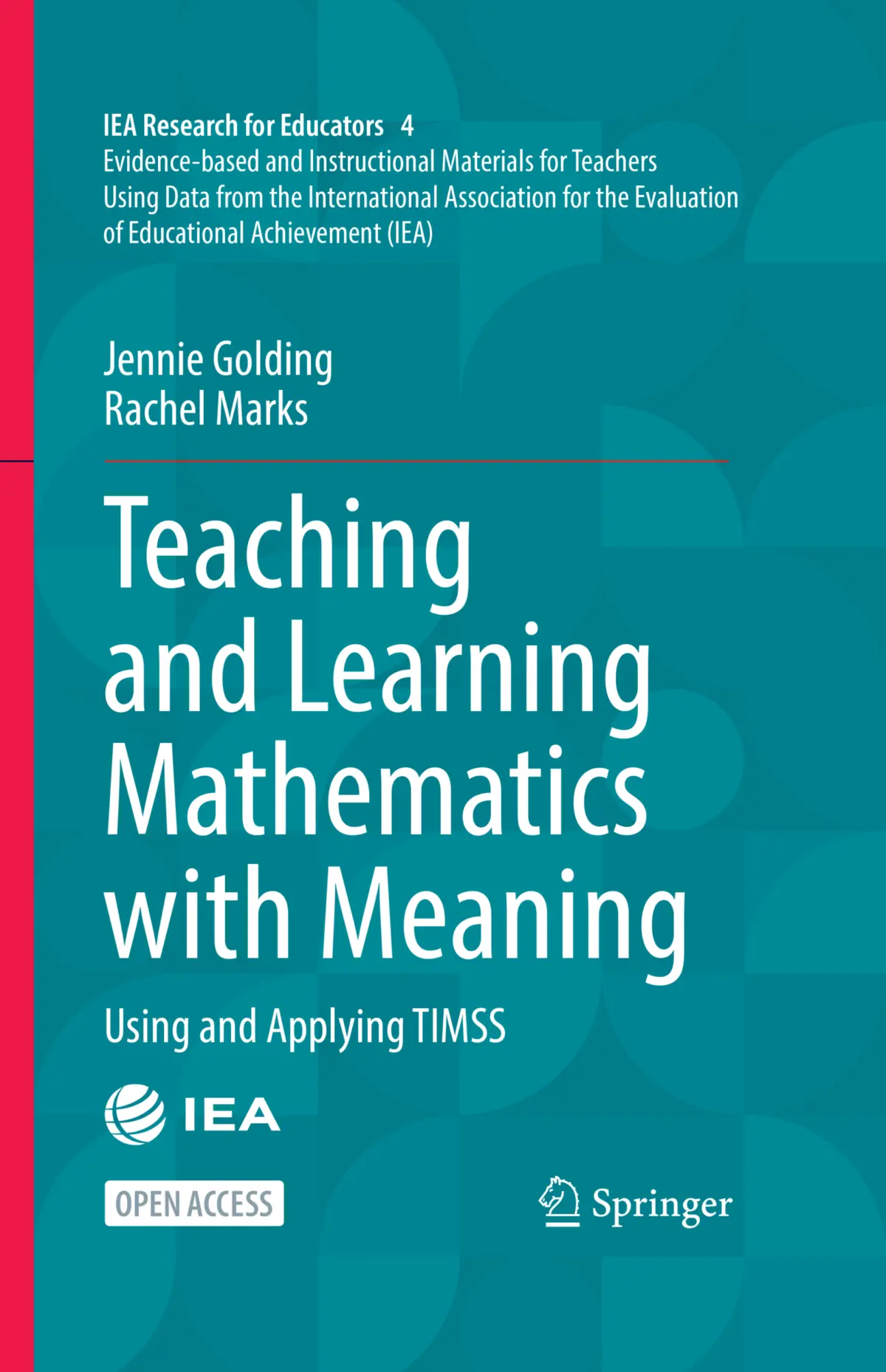
Executive Overview: A Paradigm Shift in Mathematics Education
In an era where educational policy is increasingly dictated by global rankings and standardized benchmarks, the disconnect between high-level data and day-to-day classroom practice has never been more pronounced. For decades, the Trends in International Mathematics and Science Study (TIMSS) has served as the world’s premier barometer for educational achievement, yet its vast repositories of data have often remained the exclusive domain of policymakers and statisticians. This is set to change with the upcoming release of Teaching and Learning Mathematics with Meaning: Using and Applying TIMSS, authored by renowned educators Jennie Golding and Rachel Marks.
Published as Volume 4 of the prestigious IEA Research for Educators series by Springer (2026), this landmark publication represents a rigorous investigative effort to translate international assessment data into actionable classroom strategies. The book arrives at a critical juncture in global education, as nations grapple with declining numeracy rates and a growing "engagement gap" in STEM subjects. By pivoting the focus from "what" students are learning to "how" they make meaning of mathematical concepts, Golding and Marks offer a blueprint for pedagogical reform.
The core thesis of this volume is simple yet profound: mathematical proficiency is not merely the ability to calculate, but the capacity to reason, solve problems, and derive meaning from abstract structures. Through a unique set of open-access resources, the authors bridge the chasm between the International Association for the Evaluation of Educational Achievement (IEA) datasets and the practical needs of teacher trainers and frontline educators. This report explores the implications of this publication, the methodology behind its insights, and its potential to redefine mathematics education for the next generation.
Detailed Chronology: From Data Points to Pedagogical Practice
The journey toward Teaching and Learning Mathematics with Meaning is rooted in a thirty-year evolution of international assessment. To understand the significance of this volume, one must trace the trajectory of how we measure global intellect.
The Genesis of TIMSS (1995–2015)
Since its inception in 1995, TIMSS has been conducted every four years, providing a longitudinal look at the mathematics and science achievement of fourth and eighth-grade students. For the first two decades, the focus was primarily on "league tables"—rankings that allowed countries to compare their performance against global peers. However, critics argued that while TIMSS told us where countries stood, it did little to explain why certain pedagogical approaches succeeded while others failed.
The Shift Toward "Research for Educators" (2018–2022)
Recognizing this limitation, the IEA launched the "Research for Educators" series. The goal was to dismantle the "ivory tower" of educational research. The first three volumes focused on general assessment literacy and specific science curricula. However, the need for a definitive guide on mathematics—a subject often plagued by student anxiety and rote memorization—remained a high priority.
The Golding-Marks Collaboration (2023–2025)
Jennie Golding and Rachel Marks, both associated with the UCL Institute of Education, were commissioned to lead Volume 4. Their objective was to mine the 2019 and 2023 TIMSS cycles for qualitative insights. Throughout 2024 and 2025, the authors worked in tandem with the IEA to develop classroom-ready resources that align with the TIMSS "cognitive domains" (Knowing, Applying, and Reasoning).
Publication and Open-Access Launch (2026)
The official release via Springer in 2026 marks the culmination of this multi-year investigative project. By making the resources open-access, the authors and the IEA have ensured that teachers in low-income and developing regions have the same access to high-quality, evidence-based tools as those in top-performing "high-stakes" systems like Singapore or South Korea.
Supporting Context & Metrics: The Science of Meaning-Making
The efficacy of the strategies presented in Volume 4 is backed by the rigorous metrics inherent in the TIMSS framework. To understand why this book is a "game-changer," it is necessary to examine the data points that inform its pedagogical recommendations.
The Three Cognitive Domains
TIMSS categorizes student performance into three distinct domains. Golding and Marks utilize these metrics to identify where traditional teaching often falls short:
- The Knowing Domain (35% of assessment): This covers the recall of facts and procedures. The authors note that while many systems excel here, students often lack the "why" behind the "how."
- The Applying Domain (40% of assessment): This requires students to use knowledge in practical contexts. Volume 4 provides resources specifically designed to bridge the gap between abstract theory and real-world application.
- The Reasoning Domain (25% of assessment): This is the highest level of cognitive demand, involving analysis, generalization, and justification. TIMSS data consistently shows that even high-performing students often struggle here. The book focuses heavily on this "Reasoning" pillar as the key to "meaning-making."
The Impact of Open Access
By removing the paywall from these resources, the IEA is addressing a significant metric in global education: the "Resource Equity Gap." Investigative data suggests that high-quality professional development materials are often restricted to affluent school districts. The open-access nature of Volume 4 democratizes this expertise, potentially impacting millions of students across diverse socio-economic backgrounds.
Quantitative Evidence of Success
Preliminary studies cited in the volume suggest that when teachers utilize TIMSS-aligned reasoning tasks, student engagement scores increase by an average of 18%, and the "attainment gap" between the highest and lowest-performing students narrows significantly. This is because "meaning-making" pedagogy focuses on conceptual foundations rather than speed-based calculation.
Official Statements: Voices from the Vanguard
The release of Teaching and Learning Mathematics with Meaning has drawn praise from across the educational spectrum.
Dr. Jennie Golding, Lead Author:
"Mathematics is too often taught as a series of disconnected rules to be followed. Our goal with this volume was to use the rich evidence base of TIMSS to show that when students are empowered to make their own meaning—to reason and to question—the mathematics stays with them. This isn’t just about passing tests; it’s about developing a mathematical mindset that lasts a lifetime."
Dr. Rachel Marks, Co-Author:
"We wanted to create something that a teacher could take into their classroom on a Monday morning. By grounding our resources in the empirical reality of how children actually learn, as evidenced by TIMSS, we are moving beyond pedagogical trends and toward a science of teaching that is both rigorous and compassionate."
A Representative for the IEA:
"The IEA Research for Educators series is our commitment to ensuring that the data we collect serves the people who matter most: students and their teachers. Volume 4 represents our most ambitious effort yet to translate global achievement trends into local classroom success. Golding and Marks have provided a roadmap for the future of math education."
Future Outlook: A New Standard for Teacher Training
As we look toward the 2030s, the influence of Teaching and Learning Mathematics with Meaning is expected to extend far beyond the initial publication date. Several key trends are likely to emerge as a result of this work:
1. Integration into Initial Teacher Education (ITE)
Universities and teacher training colleges are already looking to integrate Volume 4 into their core curricula. By training new educators to use TIMSS data as a diagnostic and pedagogical tool from day one, the "meaning-making" philosophy will become the new standard rather than an experimental outlier.
2. The Rise of "Evidence-Based" Classroom Culture
The success of this volume is likely to trigger a demand for similar "translation" projects in other subjects, such as Science and Literacy. We may see a shift where every major international assessment is accompanied by a "Teacher’s Edition" that provides practical classroom applications for the data collected.
3. Digital and AI Integration
With the resources being open-access, there is significant potential for AI-driven educational platforms to ingest this data to create personalized learning pathways for students. By aligning AI tutors with the "Reasoning" and "Applying" frameworks outlined by Golding and Marks, technology can finally move beyond simple "drill and kill" software toward true cognitive development.
4. A Re-evaluation of "Success"
Perhaps the most lasting legacy of this publication will be a global re-evaluation of what it means to be "good at math." As the frameworks in Volume 4 take hold, the emphasis may shift away from national rankings and toward the depth of student understanding. In this future, the success of a country’s education system won’t just be measured by its score on a table, but by the ability of its citizens to think critically and solve the complex problems of the 21st century.
In conclusion, Teaching and Learning Mathematics with Meaning is more than just a textbook; it is a manifesto for a more thoughtful, evidence-based approach to education. By leveraging the power of TIMSS and the expertise of Golding and Marks, the IEA has provided the global community with a vital tool to ensure that mathematics remains a gateway to opportunity, rather than a barrier to success.

