
Executive Overview
In the contemporary educational landscape, academic success is frequently measured by test scores, homework completion rates, and standardized metrics. However, beneath these traditional barometers of achievement lies a critical cognitive foundation that often determines whether a student thrives or struggles: executive functioning.
Every educator, regardless of grade level or content area, is fundamentally a teacher of executive functioning. Whether guiding a fourth-grade student through a multi-step math word problem, supervising an eighth-grade class drafting an argumentative English essay, or facilitating a middle school art project, teachers rely heavily on students’ brain-based abilities to plan, organize, focus, and manage time. Far from being an isolated component of special education or behavioral therapy, executive functioning is the invisible engine driving all academic and personal learning.

This comprehensive report explores the essential role of executive functioning in modern education, outlines actionable strategies for seamlessly embedding these cognitive frameworks into existing curricula, and highlights innovative, low-barrier methods—such as bell-ringer activities, targeted vocabulary, and guided read-alouds—that educators can adopt to foster resilient, independent learners.
Defining Executive Functioning: The Brain’s Command Center
To understand the necessity of integrating executive functioning into daily instruction, one must first examine what the term encompasses. Neuroscientists and cognitive psychologists define executive functions as a suite of top-down mental processes managed primarily by the prefrontal cortex of the brain. These core abilities enable individuals to plan, focus attention, remember instructions, and successfully juggle multiple tasks.

Key pillars of executive functioning include:
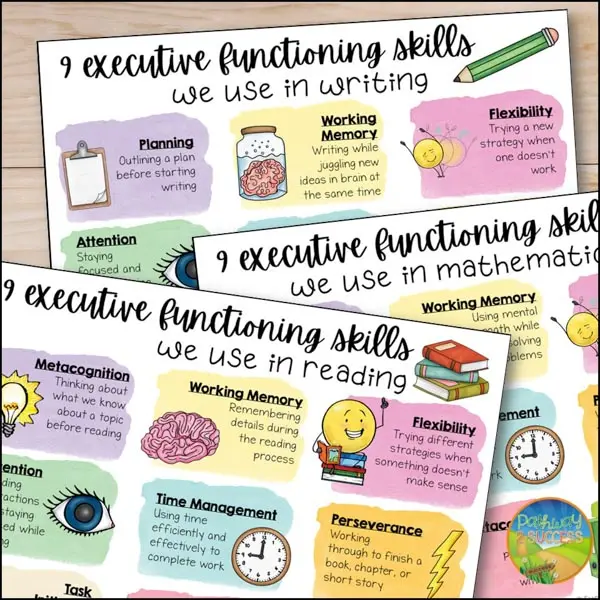
- Planning & Prioritizing: The ability to identify steps required to reach a specific goal and sequence them logically.
- Organization: The capacity to arrange materials, physical spaces, and informational data in an orderly manner.
- Task Initiation: The mental momentum required to begin a project or assignment in a timely fashion, overcoming inertia or procrastination.
- Time Management: The skill of estimating how long a task will take and allocating time efficiently to meet deadlines.
- Attention & Focus: The ability to screen out distractions and sustain concentration on tasks, individuals, or abstract concepts.
- Working Memory: The faculty of retaining and manipulating complex information over short intervals.
- Self-Monitoring & Metacognition: The practice of checking one’s own progress toward a goal and thinking critically about one’s own thinking processes.
- Self-Control & Emotional Regulation: The capability to pause, inhibit impulsive reactions, and make deliberate choices.
- Perseverance & Problem-Solving: The resilience needed to work through complex challenges and setbacks.
- Flexible Thinking: The adaptability required to pivot when plans change, accept alternative viewpoints, and embrace new approaches.
When these cognitive processes are underdeveloped or unsupported, students frequently experience academic burnout, chronic disorganization, and frustration—not because they lack intelligence or capability, but because the foundational mechanics of learning require explicit guidance.
Detailed Chronology: The Evolution of Executive Functioning in Pedagogy
For decades, traditional education operated under the assumption that executive functioning skills were innate traits that students either possessed naturally or failed to develop. Those who struggled with organization or task initiation were often labeled as unmotivated, lazy, or undisciplined.
The Shift Toward Cognitive Integration
As neurological research advanced through the late 20th and early 21st centuries, educational paradigms shifted dramatically. Brain imaging and cognitive developmental studies revealed that the prefrontal cortex—the command center for executive functions—is among the last areas of the human brain to fully mature, continuing its development well into a person’s mid-twenties.

Recognizing this prolonged developmental window transformed educational theory:
- Phase 1: Remediation and Isolation (Early 2000s): Initially, executive functioning challenges were addressed primarily through isolated interventions, often removed from general education classrooms via specialized support staff or individualized education programs (IEPs).
- Phase 2: Universal Design for Learning (2010s): Educators began recognizing that executive dysfunction impacted a wide swathe of mainstream students, particularly in an increasingly digital, high-distraction world. Frameworks like Universal Design for Learning (UDL) began incorporating structural supports, such as visual schedules and graphic organizers, into general classrooms.
- Phase 3: Comprehensive Classroom Integration (Present Day): Today, progressive pedagogical strategy rejects the siloed approach. Leading educational researchers and practitioners advocate for "embedded executive functioning"—the philosophy that every lesson plan, lecture, and assignment should intentionally model and reinforce cognitive skill-building alongside academic content.
Supporting Context and Practical Integration Strategies
Integrating executive functioning skills does not require overhauling an established curriculum or abandoning state standards. Instead, it involves minor, intentional modifications to how lessons are delivered, structured, and reflected upon.

1. Planning and Metacognition
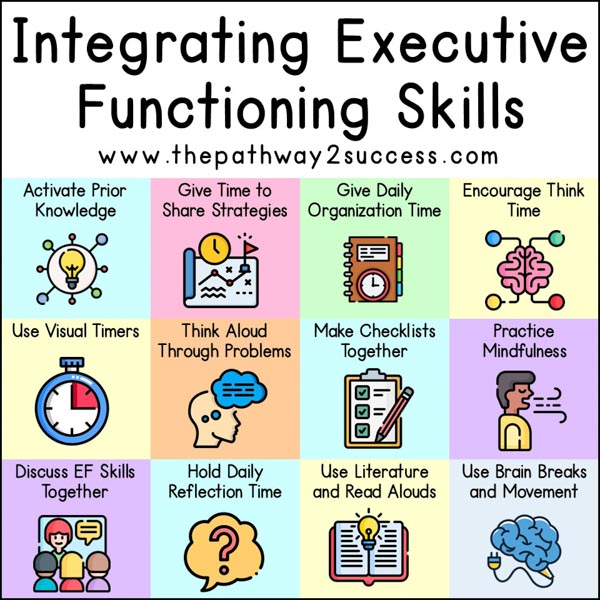
- Backward Mapping: When assigning long-term projects, require students to work backward from the deadline, establishing mini-milestones and check-in dates.
- Think-Aloud Protocols: Model metacognition by verbalizing your own thought processes while solving a complex problem or drafting an essay on the board. Ask students, "What made me pause here? How did I decide which strategy to use next?"
2. Organization and Task Initiation
- Color-Coding Systems: Assign specific colors to subjects, digital folders, and physical notebooks to reduce cognitive load during transitions.
- The "First Five Minutes" Protocol: Combat task initiation hurdles by establishing predictable, low-stakes routines for the opening moments of class, ensuring students transition smoothly into academic work without prolonged downtime.
3. Attention, Time Management, and Self-Monitoring
- Visual Timers: Utilize visible countdown clocks or interval timers during independent work periods to help students build internal time-awareness.
- Error-Analysis Checklists: Instead of simply marking incorrect answers on an assessment, provide students with a self-monitoring rubric that prompts them to identify where and why an error occurred (e.g., misread instructions, rushed calculation, or skipped step).
4. Perseverance and Flexible Thinking
- Productive Struggle Debriefs: When students encounter a difficult concept, pause instruction to discuss the emotional and cognitive experience of working through frustration. Validate that confusion is a normal stage of deep learning.
- Alternative Perspective Exercises: In subjects ranging from social studies to literature, routinely ask: "How might someone with a different background interpret this event or character’s motivation?"
Dedicated Structures for Skill Building
While embedding these skills into daily content is vital, carving out brief, explicit windows for executive functioning instruction can accelerate student comprehension. Teachers do not need dedicated multi-hour blocks; short, impactful mini-lessons yield remarkable results.
The Power of Micro-Interventions
- Executive Functioning Word of the Day: Introduce key cognitive vocabulary terms—such as neuroplasticity, momentum, routine, adapt, and self-discipline. Pair each word with a short explanation and guided reflection questions to prime the brain for learning.
- Daily Motivational Quotes: Begin class with curated quotes that emphasize perseverance, focus, or problem-solving. Spend three minutes discussing how the quote applies to both academic challenges and everyday life.
- Targeted Discussion Cards: Use prompt-based task cards to spark dialogue among students. Questions such as "How does making a checklist change your stress levels?" or "How is self-control related to positive decision-making?" build self-awareness and peer empathy.
- Strategic Read-Aloud Integration: Utilize literature across all grade levels to examine character choices. Pausing a story to ask, "What problem is the protagonist facing, and what steps are they taking to solve it?" bridges narrative comprehension with real-world executive skill development.
Future Outlook: Preparing Students for Lifelong Success
The ultimate objective of modern education extends far beyond the mastery of academic content; it is the cultivation of autonomous, resilient individuals capable of navigating an increasingly complex and unpredictable world.

As automation and artificial intelligence reshape the modern workforce, rote memorization and basic information retrieval are losing their comparative advantage. What remains universally valuable are the distinctly human capabilities housed within executive functioning: the discipline to initiate tasks without immediate oversight, the emotional regulation to persist through professional setbacks, the mental flexibility to adapt to shifting technological landscapes, and the metacognitive awareness to continuously learn and upskill.
By intentionally integrating executive functioning strategies into everyday classroom instruction, educators are doing much more than improving classroom management or standardized test scores. They are handing students the psychological and cognitive keys to independence—empowering them to become architects of their own academic success and lifelong well-being.

