
EXECUTIVE OVERVIEW
In the landscape of early childhood education, mastering phonological awareness is widely recognized as a foundational stepping stone toward reading proficiency. Educators and curriculum developers continually search for methodologies that bridge the gap between abstract phonetic concepts and engaging, developmentally appropriate classroom practices. Enter the "Spring Syllable Sort" and its broader counterpart, the comprehensive "Four Seasons Syllable Sort"—two innovative pedagogical tools designed to enhance literacy centers for preschool (Pre-K) and kindergarten students.
Rooted deeply in the modern Science of Reading framework, these activities shift the focus from rote memorization to active auditory and visual processing. By utilizing seasonal vocabulary paired with picture cues rather than complex written text, young learners are empowered to isolate phonological components, segment words through physical movement (such as clapping and tapping), and categorize them by syllable count. This comprehensive overview examines the mechanics, pedagogical value, integration strategies, and long-term educational implications of introducing seasonal syllable sorting into early childhood classrooms.

DETAILED CHRONOLOGY & METHODOLOGY: THE EVOLUTION OF SYLLABLE SORTING
The journey toward effective phonological instruction has undergone a significant transformation over the past decade. Traditional reading programs often rushed young learners into text decoding before they had fully developed the auditory ear necessary to process spoken language. Recognizing this gap, early childhood literacy specialists began designing interventions targeted specifically at phonological awareness—the ability to recognize and manipulate the spoken parts of sentences and words, including syllables, onsets, rimes, and phonemes.
Phase One: Auditory Discovery and Movement Integration
The methodology behind the Spring Syllable Sort begins well before a student touches a sorting mat. In the initial phase, educators introduce students to seasonal vocabulary words using vivid picture cards. Because pre-readers cannot rely on orthographic cues to decode words, the emphasis is placed entirely on auditory perception and visual association.
Once vocabulary is established, students engage in kinesthetic learning. By employing physical actions—clapping hands, tapping fingers, or marching in place—learners experience the natural rhythm of language. For instance, a single clap for "bee" contrasts dynamically with two claps for "tulip" or three claps for "caterpillar." This kinesthetic feedback loop helps cement the abstract concept of a "syllable" into a tangible, physical experience.

Phase Two: Categorization and Independent Practice
Following whole-group or small-group guided instruction, students transition to independent or center-based sorting. Armed with syllable counting cards and colorful word/picture representations, children physically organize the vocabulary items into distinct sets based on their syllable counts.
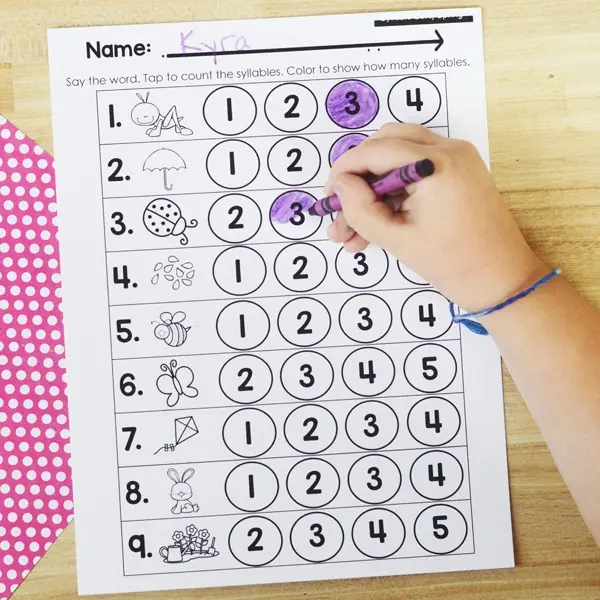
To reinforce this cognitive work, the activity incorporates optional response worksheets. These black-and-white printables allow students to record their findings, offering educators a quick and reliable assessment tool to measure comprehension. An included answer key ensures that independent or take-home literacy practice remains self-correcting and frustration-free.
SUPPORTING CONTEXT & METRICS: ALIGNMENT WITH THE SCIENCE OF READING
To understand the profound impact of tools like the Spring and Four Seasons Syllable Sorts, one must examine the empirical data supporting phonological awareness training in early childhood settings.

The Science of Reading Paradigm
According to contemporary literacy research, reading comprehension is the ultimate goal, built upon two equally crucial pillars: language comprehension and word recognition (often visualized as Scarborough’s Reading Rope). Word recognition is heavily dependent on decoding skills, which in turn rely upon a bedrock of phonological and phonemic awareness.
- Auditory Before Visual: Research indicates that children who can successfully segment and manipulate spoken syllables before encountering complex written texts demonstrate stronger decoding skills later in elementary school.
- Kinesthetic Retention: Studies in cognitive neuroscience show that integrating motor skills—such as clapping and tapping—with cognitive tasks significantly enhances memory retention in children aged four to six.
- Vocabulary Integration: Seasonal themes provide a natural framework for thematic vocabulary acquisition. When children learn words related to spring (e.g., seed, flower, puddle, butterfly) or the four seasons broadly, they expand their oral language vocabulary while simultaneously analyzing phonetic structures.
Comprehensive Design Metrics of the Seasonal Curriculum
The expanded 42-page Four Seasons Syllable Sort pack exemplifies how scalable these resources can be for modern classrooms. Designed for versatility, the pack features:
- Targeted Clip Cards: Designed to build fine motor skills alongside literacy skills.
- Multi-Seasonal Scope: Extending beyond spring to cover autumn, winter, and summer, ensuring year-round reinforcement.
- Flexible Delivery Formats: Compatible with traditional print-and-cut center setups, take-home packets, and digital hybrid learning environments via platforms like Teachers Pay Teachers.
OFFICIAL STATEMENTS AND EXPERT PERSPECTIVES
Early childhood educators and curriculum developers have increasingly emphasized the necessity of play-based, hands-on phonological activities.

"Phonological awareness is not something that happens by accident; it requires intentional, engaging instruction that meets young learners where they are developmentally," notes a leading preschool literacy strategist. "When we ask children to sit quietly and fill out endless worksheets on abstract language concepts, we lose their attention. However, when we ask them to clap out the sounds of a blossoming flower or sort picture cards of seasonal phenomena, we tap into their natural curiosity."
Furthermore, advocates of the Science of Reading movement stress that instructional materials must be carefully structured to avoid cognitive overload. By stripping away complex written text during the initial sorting phase and replacing it with evocative picture clues, educators allow children to focus entirely on the auditory processing of syllables.
"Introducing vocabulary before independent work is a critical pedagogical safeguard," explains an early elementary reading specialist. "If a child does not recognize the image on the card—whether it’s a ‘tadpole’ or a ‘snowflake’—they cannot accurately count its syllables. Pre-teaching vocabulary bridges the gap between oral language comprehension and structural phonological analysis."

FUTURE OUTLOOK: THE TRAJECTORY OF EARLY LITERACY TOOLS
As educational standards continue to evolve toward more rigorous, evidence-based practices, the demand for high-quality, adaptable literacy centers will only intensify. The success of targeted resources like the Spring Syllable Sort and the Four Seasons Syllable Sort points toward several emerging trends in Pre-K and kindergarten education:
- Increased Emphasis on Multisensory Learning: Future literacy tools will likely lean even further into kinesthetic, auditory, and visual integrations, recognizing that young minds thrive when multiple senses are engaged simultaneously.
- Seamless Home-School Connections: With a growing emphasis on take-home literacy practice, educators require resources that are easy for parents to understand and implement without specialized training. Self-correcting activities complete with answer keys and straightforward instructions fit this demand perfectly.
- Thematic Integration Across Disciplines: Syllable sorts anchored in seasonal themes demonstrate how literacy instruction does not need to exist in a vacuum. By intertwining science concepts (such as the four seasons and natural vocabulary) with reading foundational skills, educators optimize instructional time.
Conclusion
The transition from spoken language to proficient reading is a complex journey, but tools like the Spring Syllable Sort illuminate the path forward. By combining rigorous phonological awareness principles with joyful, seasonal exploration, these activities provide educators with an indispensable asset. Whether deployed in a bustling Pre-K literacy center, utilized as a targeted intervention, or sent home for family practice, seasonal syllable sorting proves that foundational reading skills can—and should—be an engaging, interactive adventure.

