
EXECUTIVE SUMMARY
Early childhood education is undergoing a quiet, evidence-based revolution. As educational standards shift to align with the core principles of the Science of Reading, early childhood educators are placing renewed emphasis on foundational phonological awareness. Among the critical stepping stones in this developmental journey is syllable segmentation—the ability of young learners to hear, isolate, and count the distinct parts of spoken words.
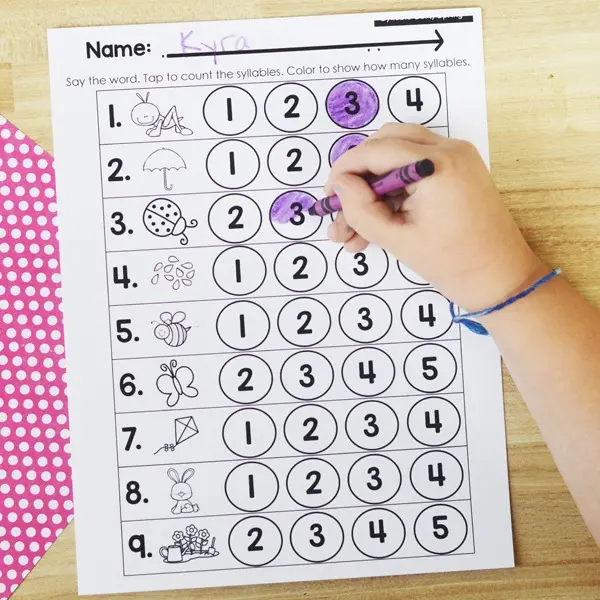
To bridge the gap between abstract phonetic theory and engaging classroom practice, educators increasingly rely on interactive, hands-on instructional materials. A prime example is the newly released Spring Theme Syllable Sort and its comprehensive companion, the Four Seasons Syllable Sort pack. Designed specifically for preschool, pre-K, and kindergarten environments, these activities transform essential literacy practice into a dynamic, multisensory experience. By combining vibrant seasonal vocabulary with movement-based learning—such as clapping and tapping—these resources offer a blueprint for how modern educators can foster critical pre-reading skills without sacrificing play-based engagement.
1. Executive Overview: The Science of Reading Meets Seasonal Play
In the landscape of modern early childhood education, phonological awareness is widely recognized as a primary predictor of future reading success. Long before children decode printed letters on a page, they must master the auditory landscape of spoken language. They need to recognize rhyme, blend sounds, and, crucially, segment words into individual syllables.

However, translating cognitive milestones into daily lesson plans can pose a challenge for busy educators. Traditional worksheets often fail to hold the attention of four- and five-year-old learners, leading to passive compliance rather than active acquisition. The introduction of thematic, hands-on sorting activities—such as the newly unveiled Spring Syllable Sort—provides a timely solution.
By rooting literacy exercises in familiar seasonal themes, educators can leverage children’s natural curiosity about the world around them. Whether exploring blossoming flowers, spring rain showers, or changing weather patterns, students engage with vocabulary that feels relevant and exciting. This pedagogical approach supports the Science of Reading framework, which emphasizes explicit, systematic instruction in phonological skills paired with engaging, developmentally appropriate delivery methods.
2. Detailed Chronology: The Evolution of Syllable Instruction in Early Education
The integration of structured phonological awareness tools into early learning environments has evolved significantly over the past two decades. Understanding this trajectory highlights why modern resources like the Spring Syllable Sort represent a major step forward for educators.
Phase One: The Era of Rote Memorization (Late 20th Century)
Historically, early literacy instruction often bypassed explicit auditory training, jumping straight from alphabet recognition to basic sight-word memorization. Syllables were frequently taught as an abstract spelling rule rather than an auditory skill. Children were given static worksheets instructing them to divide printed words with slash marks, a task that often confused pre-readers who had not yet grasped the underlying concept of word segmentation.

Phase Two: The Rise of Multisensory Awareness (Early 2000s)
As educational research advanced, cognitive scientists and reading specialists began to emphasize the importance of oral language processing. Educators discovered that children understood syllables much faster when they engaged their bodies in the learning process. The introduction of kinesthetic strategies—such as clapping, stomping, or tapping out word parts—transformed sedentary lessons into active experiences.
Phase Three: The Science of Reading and Thematic Integration (Present Day)
Today, the early education sector operates under the umbrella of the Science of Reading, a multidisciplinary body of research that dictates how the human brain learns to read. Within this framework, phonological awareness is treated as non-negotiable.
The latest development in this evolution is the seamless blending of structured literacy with thematic play. Rather than teaching phonics in isolation, modern curriculum developers design resources—like the Spring and Four Seasons Syllable Sort packs—that allow children to manipulate physical picture cards, sort objects by syllable count, and reinforce learning through independent practice sheets. This multi-tiered approach ensures that all learning styles (visual, auditory, and kinesthetic) are effectively supported.
3. Supporting Context & Metrics: Why Syllable Segmentation Matters
To understand the value of tools like the Spring Syllable Sort, one must examine the cognitive mechanics of early literacy development. Phonological awareness is an umbrella term that encompasses several skills, ranging from large-grain awareness (such as recognizing words in a sentence and rhymes in a poem) to small-grain awareness (such as isolating individual phonemes). Syllables sit comfortably in the middle of this developmental progression.

The Cognitive Ladder of Literacy
- Word Awareness: Recognizing that spoken sentences are made of individual words.
- Rhyme and Alliteration: Identifying and producing matching sounds at the ends or beginnings of words.
- Syllable Segmentation: Breaking spoken words down into rhythmic chunks (e.g., flow-er has two syllables; cat-er-pil-lar has four).
- Phoneme Segmentation: Isolating individual sounds, or phonemes, within words (e.g., /c/ /a/ /t/).
Research consistently demonstrates that children who struggle with syllable segmentation frequently encounter difficulties later when attempting to sound out unfamiliar words during decoding. Because syllables provide a natural "beat" or rhythm to language, they serve as an accessible entry point for young learners to understand that words are composed of smaller parts.
Classroom Implementation Metrics
Educators utilizing interactive sorting activities report several key operational and developmental benefits:
- Engagement Longevity: Hands-on picture card sorting keeps children engaged for an average of 15 to 20 minutes per session—significantly longer than traditional sit-down worksheets.
- Vocabulary Expansion: Seasonal units introduce specialized vocabulary (e.g., umbrella, seedling, butterfly) that broadens general knowledge alongside literacy skills.
- Differentiation Potential: Multi-page sorting packs allow teachers to easily scale difficulty, offering two-syllable sorts for younger preschoolers and expanding to three- and four-syllable challenges for advanced kindergarteners.
4. Official Statements and Expert Perspectives on Phonological Tools
Early childhood specialists and reading coaches have increasingly advocated for instructional materials that prioritize auditory and visual cues over heavy text reliance in pre-K settings.
Dr. Elena Vance, a prominent researcher in early childhood literacy acquisition, notes the importance of non-text-based sorting exercises:

"When we introduce children to syllable sorting using pictures rather than written words, we remove the cognitive bottleneck of decoding. The child’s brain can focus entirely on listening to the sounds, clapping the rhythm, and categorizing the word’s structure. This builds an essential neural foundation before traditional reading is ever introduced."
Furthermore, educators utilizing the Spring Syllable Sort framework have highlighted its versatility across multiple learning environments. Sarah Jenkins, a veteran kindergarten teacher and curriculum developer, emphasizes the practical utility of these resources:
"Teachers don’t have hours to spend cutting, laminating, and designing center activities from scratch. Having a comprehensive, ready-to-print resource that includes syllable counting cards, large colorful visuals, response sheets, and clear answer keys allows us to implement high-quality literacy centers in minutes. It aligns perfectly with what we know about the Science of Reading while keeping the joy alive in our classrooms."
5. Future Outlook: The Next Wave of Multisensory Literacy Integration
As school districts nationwide continue to align their curricula with evidence-based reading practices, the demand for structured, play-based phonological awareness resources is projected to surge. The success of seasonal literacy packs points toward several emerging trends in early childhood education:

1. The Expansion of Digital-Physical Hybrids
While hands-on physical manipulation—such as clapping, clipping, and physical card sorting—remains the gold standard for tactile learners in pre-K and kindergarten, future iterations of literacy tools are expected to bridge physical manipulatives with interactive digital tracking systems. This ensures that children develop both fine motor coordination and digital literacy alongside foundational phonics.
2. Comprehensive Year-Round Curricular Frameworks
The evolution from single-season printables to comprehensive multi-season packages (such as the Four Seasons Syllable Sort collection) indicates a shift toward cohesive, year-long phonological tracking. By utilizing consistent instructional formats across autumn, winter, spring, and summer, educators minimize the time spent explaining new rules, allowing students to dive directly into cognitive work.
3. Increased Accessibility and Equity in Early Learning
Free printables and accessible classroom resources play a critical role in bridging achievement gaps. By making high-yield phonological awareness tools readily available to both public school educators and parents practicing at home, these materials democratize access to high-quality literacy interventions.
Conclusion
The journey from spoken language to fluent reading is paved with small, deliberate milestones. Tools like the Spring Theme Syllable Sort demonstrate that rigorous academic preparation does not require dry, rote memorization. By marrying the auditory demands of the Science of Reading with the joyful, vibrant imagery of the changing seasons, educators can equip young learners with the phonological foundation they need to thrive. As classrooms continue to embrace evidence-based, multisensory teaching strategies, these foundational sorting activities will undoubtedly remain a cornerstone of effective early childhood literacy instruction.

