
Executive Overview
As the holiday season approaches, educators and parents continually seek innovative methods to sustain academic engagement amidst the festive distractions of December. In response to this perennial classroom challenge, early childhood development advocates have introduced a dynamic, movement-based literacy tool: the Christmas Ornament ABC Scavenger Hunt. Designed specifically for preschool, pre-kindergarten, and kindergarten classrooms, this low-preparation instructional resource bridges the gap between physical activity and foundational phonics instruction.
By combining kinetic learning with letter recognition, the scavenger hunt transforms traditional, sedentary desk work into an immersive holiday-themed adventure. Early childhood experts have long emphasized that young learners process information more effectively when gross and fine motor skills are integrated into academic tasks. This initiative capitalizes on that developmental window, offering educators a structured yet flexible framework to teach uppercase and lowercase letter identification, phonemic awareness, and individualized spelling.
This comprehensive report examines the pedagogical foundations of the Christmas Ornament ABC Scavenger Hunt, detailing its operational mechanics, classroom implementation strategies, differentiation potential, and the broader implications of gamified learning within early childhood curricula.
Detailed Chronology: The Evolution of Play-Based Phonics
The conceptualization of the Christmas Ornament ABC Scavenger Hunt did not occur in a vacuum; rather, it represents a culmination of decades of research into play-based pedagogy and active learning models within early childhood education.

Phase 1: Identifying the December Engagement Gap
Historically, the month of December presents unique classroom management and instructional challenges. Educators frequently note a sharp decline in student attention spans as anticipation for the winter holidays builds. Traditional workbook exercises often yield diminishing returns during this period, leading to behavioral fatigue and decreased knowledge retention. Recognizing this hurdle, curriculum developers began exploring ways to harness children’s natural enthusiasm for seasonal motifs—such as ornaments, trees, and winter wonderlands—and channel them toward literacy goals.
Phase 2: Designing the Kinetic Learning Framework
During the preliminary design phase, creators focused on the concept of "edutainment"—merging educational content with engaging gameplay. Scavenger hunts emerged as an ideal medium. Children naturally gravitate toward exploratory games that involve searching, discovering, and checking off items. By replacing traditional flashcards with hidden or displayed ornament-shaped letter cards, the activity transformed from a passive visual drill into an active, whole-body learning experience.
Phase 3: Pilot Testing and Resource Iteration
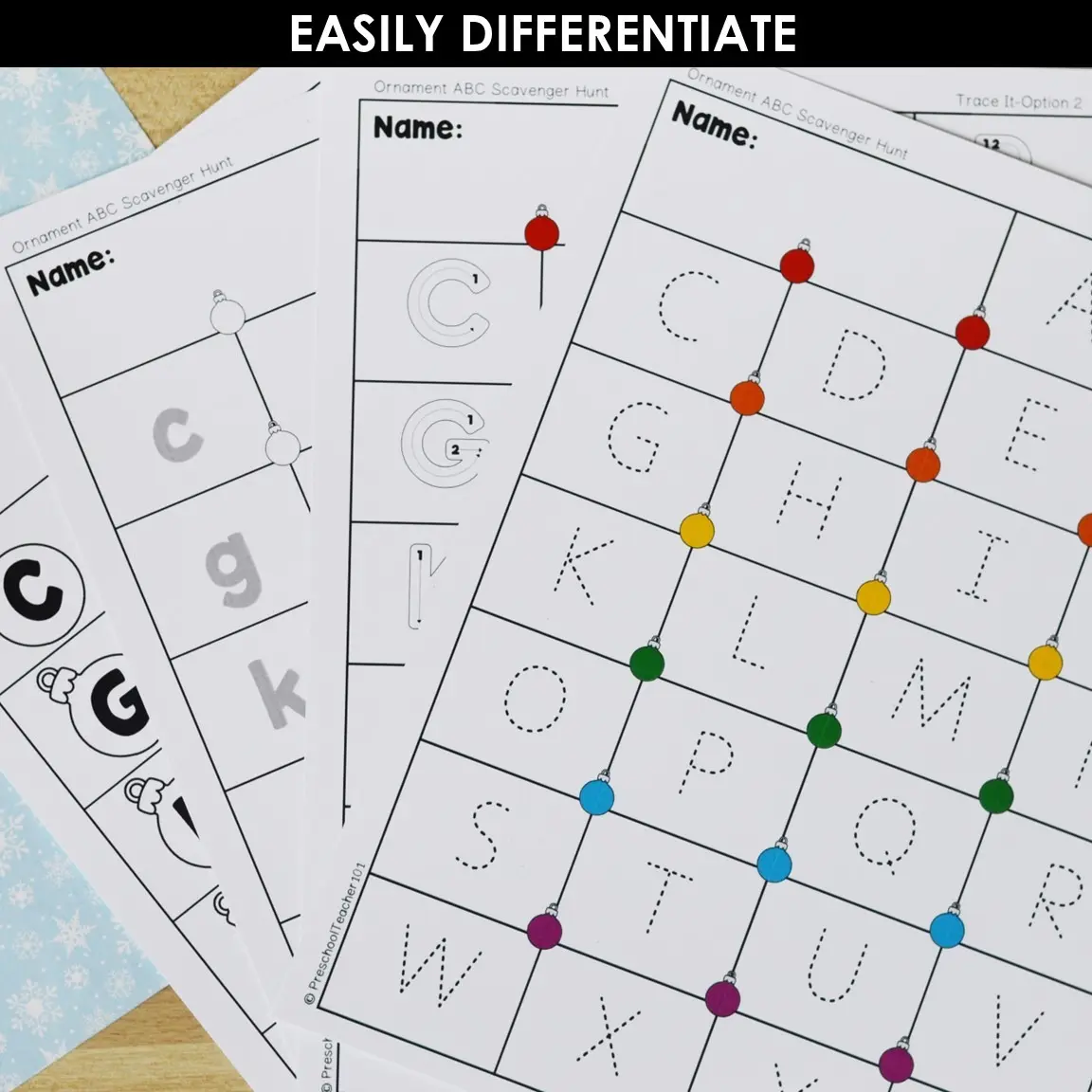
Initial trials of the scavenger hunt in preschool and kindergarten classrooms yielded overwhelmingly positive feedback. Educators reported that students who typically struggled with sustained focus during letter-recognition drills remained engaged for extended periods when allowed to move around the room. Based on educator feedback regarding diverse classroom needs, the resource evolved from a basic uppercase-only printable into a comprehensive, 39-page differentiated pack featuring both uppercase and lowercase variants, color and black-and-white cards, and multiple recording sheet configurations.
Supporting Context & Metrics: The Science of Movement and Literacy
To understand why the Christmas Ornament ABC Scavenger Hunt is effective, one must examine the neurological and developmental frameworks underpinning early childhood education.

The Role of Kinesthetic Learning in Cognitive Retention
Neuroscience and educational psychology consistently demonstrate a profound link between physical movement and cognitive processing. When young children engage in gross motor activities—such as walking across a classroom, searching for hidden cards, and bending down to inspect objects—blood flow to the brain increases, enhancing alertness and neural connectivity.
- Enhanced Focus: Active learning reduces the restlessness commonly observed in young children forced to sit for prolonged periods.
- Multi-Sensory Integration: By combining visual identification (seeing the letter on the ornament), tactile interaction (coloring or placing manipulatives), and kinetic movement (walking to locate the card), the activity reinforces memory pathways across multiple sensory modalities.
Differentiated Instruction in Early Literacy
No two children enter a classroom with the exact same baseline of literacy skills. Effective early childhood instruction demands robust differentiation. The scavenger hunt model supports this by allowing educators to tailor the experience to individual learning stages:
- Targeted Intervention: Rather than requiring an entire class to master the entire alphabet simultaneously, teachers can deploy specific subsets of letter cards.
- Personalized Milestones: A proven best practice in early education is starting with the letters found in a child’s own name, instantly boosting personal relevance and engagement.
- Flexible Modalities: For students who experience hand fatigue from coloring, the activity easily adapts to accommodate tactile manipulatives such as counting chips, festive mini-erasers, or playdough stamps.
Official Statements and Pedagogical Perspectives
Early childhood specialists, curriculum designers, and classroom teachers have widely praised the pedagogical utility of seasonal scavenger hunts.
Dr. Elena Vance, a professor of Early Childhood Education at the Institute for Child Development, notes:

"The greatest hurdle in early literacy instruction is not a child’s capacity to learn, but their emotional and physical alignment with the task. When we force young learners into sedentary, rote-memorization loops during high-energy months like December, we create friction. Tools like the Ornament ABC Scavenger Hunt eliminate that friction by aligning with a child’s developmental imperative to move, explore, and play."
Practicing kindergarten educator Sarah Jenkins shares her classroom experience:
"Implementing the scavenger hunt transformed our literacy centers. Instead of groaning when I announce phonics time, my students cheer. They are actively hunting for letters, sounding them out as they find them, and eagerly checking them off their sheets. It brings joy back into foundational skill-building."
Future Outlook: The Direction of Gamified Early Education
As educational technology and printable pedagogical resources continue to evolve, the demand for high-engagement, low-prep materials is projected to grow. The success of the Christmas Ornament ABC Scavenger Hunt highlights several key trends shaping the future of early childhood classrooms:

1. The Blending of Physical and Digital Resources
While physical printables, manipulatives, and hands-on movement remain irreplaceable in preschool and kindergarten settings, future iterations of literacy games are increasingly designed to complement digital tracking tools and interactive whiteboards, offering hybrid models for modern classrooms.
2. Year-Round Thematic Continuity
The yearlong series of scavenger hunts—of which the Christmas Ornament edition is a premier installment—demonstrates the viability of maintaining a consistent instructional format adapted to changing seasonal themes. This structural consistency reduces the cognitive load on teachers, who do not need to teach new rules or procedures for every holiday; the familiar mechanics allow students to dive straight into the academic content.
3. Equity and Accessibility in Education
Free foundational samples paired with robust, affordable comprehensive packs ensure that both under-resourced home-schooling environments and fully funded institutional classrooms can access high-tier pedagogical tools. This democratization of teaching resources supports equitable literacy outcomes across diverse socioeconomic demographics.
Conclusion
The Christmas Ornament ABC Scavenger Hunt proves that academic rigor and festive fun are not mutually exclusive. By embedding essential alphabet recognition and phonics practice within an active, gamified format, this resource addresses the unique behavioral and cognitive needs of young learners during the holiday season. Through thoughtful design, flexible differentiation, and a commitment to kinesthetic engagement, tools of this caliber pave the way for sustainable, joyful, and highly effective early childhood literacy instruction.

