
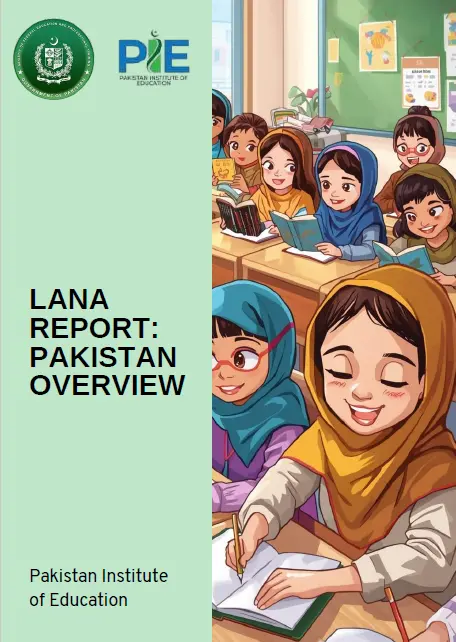
ISLAMABAD — In an era where global economic competitiveness is increasingly dictated by human capital, the release of the "2023 LaNA Linking Study: Pakistan" serves as a watershed moment for the nation’s educational discourse. Published in early 2026, this comprehensive report—spearheaded by lead researchers Muhammad Shahid Soroya, Alberto Soriano Diaz, and a distinguished cohort of specialists—offers a rigorous, data-driven diagnostic of the foundational learning outcomes of Grade 5 students across the Islamic Republic of Pakistan.
The study, conducted under the technical aegis of the International Association for the Evaluation of Educational Achievement (IEA) in collaboration with the Pakistan Institute of Education (PIE), represents more than just a statistical exercise. It is a fundamental assessment of the "learning crisis" that has long shadowed the South Asian nation, providing a granular look at how 8,744 students across 360 schools navigate the essential domains of reading and mathematics.
Executive Overview: A Nation at a Pedagogical Crossroads
The 2023 LaNA (Literacy and Numeracy Assessment) Linking Study arrives at a time of profound transition for Pakistan. As the country grapples with the lingering effects of the 2022 catastrophic floods and a volatile economic climate, the education sector has remained under intense scrutiny. The primary objective of the LaNA study was to establish a baseline that links national assessment results to international benchmarks, effectively allowing Pakistan to measure its progress against Global Proficiency Frameworks (GPF) and Sustainable Development Goal (SDG) 4.1.1.
The findings are both illuminating and sobering. By focusing on Grade 5—a critical juncture where students are expected to transition from "learning to read" to "reading to learn"—the study exposes a fragmented landscape of achievement. While certain urban centers and private institutions show resilience, vast swaths of the rural population continue to struggle with foundational competencies. The report underscores that the disparity in learning outcomes is not merely a product of individual student effort but is deeply rooted in provincial governance, school infrastructure, and the socio-economic status of the household.
Detailed Chronology: From Fieldwork to Foundational Insights
The trajectory of the LaNA 2023 study reflects a multi-year commitment to methodological excellence. The process was initiated in late 2022, following a series of consultations between the Ministry of Federal Education and Professional Training and international partners.
- Phase I: Framework Development (Late 2022): The IEA worked alongside local experts, including Muhammad Idrees Asad and Waqar Ahman Awan, to adapt the LaNA instruments to the Pakistani context. This involved ensuring that the reading passages and mathematical problems were culturally relevant while maintaining the psychometric rigor required for international linking.
- Phase II: Data Collection (2023): The field operation was a massive logistical undertaking. Teams of assessors were dispatched to 360 schools across all four provinces—Punjab, Sindh, Khyber Pakhtunkhwa, and Balochistan—as well as the Islamabad Capital Territory (ICT). The sample of 8,744 students was carefully stratified to ensure a representative mix of public and private schools, as well as gender-balanced participation.
- Phase III: Analysis and Linking (2024–2025): Following the data collection, the IEA’s psychometricians performed a "linking" analysis. This process involved mapping the LaNA results onto the scales used by international assessments like PIRLS (Progress in International Reading Literacy Study) and TIMSS (Trends in International Mathematics and Science Study).
- Phase IV: Official Publication (2026): The final report, authored by Soroya et al., was released to the public, providing the first comprehensive post-pandemic look at the country’s foundational learning health.
Supporting Context & Metrics: The Anatomy of an Educational Divide
The metrics contained within the report reveal a complex tapestry of success and failure. To understand the gravity of the 2023 LaNA results, one must look at the specific variables that dictate a child’s success in the Pakistani classroom.
The Provincial Disparity
One of the most striking revelations of the study is the "performance gulf" between provinces. Punjab and the ICT consistently outperformed the more remote regions of Balochistan and rural Sindh. In mathematics, the ability to perform basic operations—addition, subtraction, and simple multiplication—varied by as much as 30 percentage points between the highest and lowest-performing regions. This suggests that the "postcode lottery" remains a dominant factor in a child’s future in Pakistan.
The Gender Lens
The data regarding gender provides a nuanced perspective. While national averages show a narrowing gap in certain urban enclaves, the rural data tells a different story. In many districts, Grade 5 girls continue to lag behind boys in mathematics, a trend often attributed to "math anxiety" and a lack of female STEM role models in the teaching workforce. Conversely, in reading, girls in many private schools outperformed their male counterparts, suggesting that when barriers to access are removed, female students excel in literacy.
School Environment and Resources
The 360 schools sampled presented a stark contrast in "learning readiness." Schools with basic amenities—electricity, clean drinking water, and functional toilets—showed a direct correlation with higher student scores. Furthermore, the presence of a school library or even a small classroom collection of books was identified as a "high-impact" variable for reading proficiency. However, the study found that a significant percentage of public schools remain "resource-poor," hampering the ability of teachers to deliver the curriculum effectively.
The "Linking" Significance
Why does "linking" matter? For years, Pakistan’s national assessments were criticized for being "too easy" or not comparable to global standards. By using the LaNA tool, the IEA has provided a bridge. The 2023 study confirms that a student who is considered "proficient" by local standards may still fall below the "low international benchmark" of the IEA. This reality check is essential for policymakers who aim to make Pakistani graduates competitive in the global labor market.
Official Statements: Voices from the Vanguard
The release of the report prompted a series of statements from the lead researchers and educational authorities, emphasizing the need for immediate structural reform.
Muhammad Shahid Soroya, Lead Researcher:
"This study is not merely a collection of numbers; it is a mirror held up to our national priorities. The fact that Grade 5 students in many regions are struggling with basic numeracy tells us that our early childhood education systems require a fundamental overhaul. We cannot build a high-tech economy on a foundation of sand."
The Pakistan Institute of Education (PIE) Spokesperson:
"The collaboration with the IEA has allowed us to adopt a level of transparency never before seen in our national reporting. The 2023 LaNA data will serve as the North Star for our ‘Education 2030’ roadmap. We acknowledge the gaps, particularly in Balochistan and rural Sindh, and we are committed to data-driven interventions."
Alberto Soriano Diaz, IEA Contributor:
"Pakistan’s participation in the LaNA linking study demonstrates a courageous commitment to international standards. The data shows that while challenges are significant, there are pockets of excellence. The goal now is to scale those successes from the 360 sampled schools to the tens of thousands of schools across the nation."
Future Outlook: A Roadmap for Reform
The 2023 LaNA Linking Study concludes with a series of urgent recommendations that are expected to shape Pakistani educational policy for the next decade.
- Uniformity in Curriculum Implementation: The report calls for a more rigorous application of the Single National Curriculum (SNC), ensuring that "foundational literacy" is prioritized over rote memorization.
- Targeted Teacher Training: The data suggests that student performance in mathematics is closely tied to teacher competency. A national program for "Math Pedagogy" is recommended to help teachers move beyond traditional chalk-and-talk methods.
- Digital Integration: Given the disparities found in the study, the researchers suggest utilizing EdTech to bridge the gap in resource-poor schools. Providing digital reading materials to rural schools could circumvent the lack of physical libraries.
- The "Early Years" Pivot: Perhaps the most critical takeaway is the need to intervene before Grade 5. The study suggests that by the time a student reaches the fifth grade, their learning trajectory is often already set. Strengthening Grade 1 through Grade 3 instruction is vital to ensuring that the 2026 and 2029 assessments show an upward trend.
As Pakistan looks toward the end of the decade, the 2023 LaNA Linking Study stands as a definitive record of where the nation stands and where it must go. The authors—Soroya, Diaz, Asad, Awan, Ijaz, and Shoukat—have provided the diagnostic; it is now up to the legislators, educators, and parents of Pakistan to administer the cure. The future of millions of children depends on whether the insights of this report are translated into the classrooms of tomorrow.

